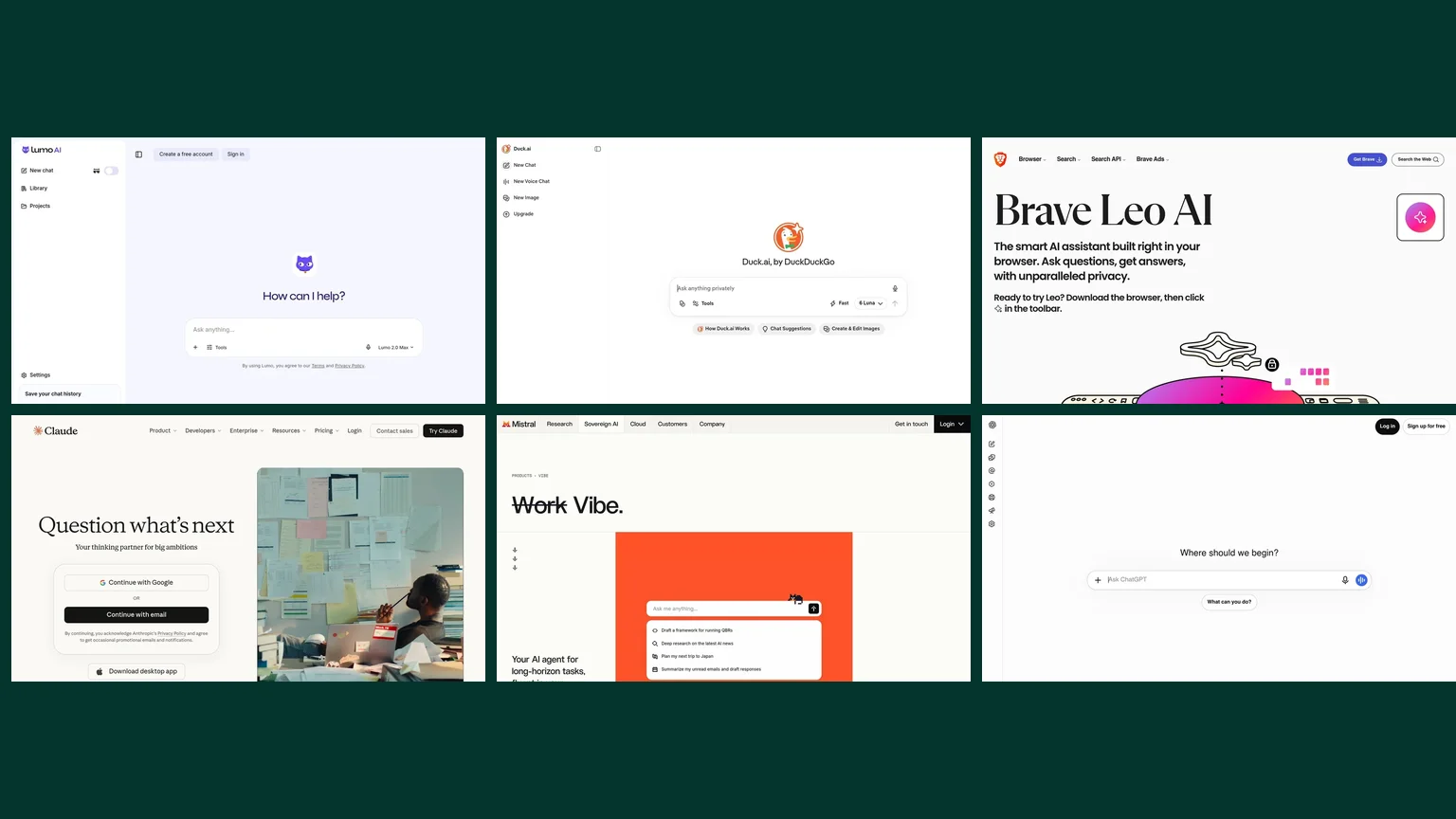
You tell your chatbot things you would never type into a search engine: a money problem, a contract you need to understand, a health worry. Those chats land on a company’s servers, and some companies use them to train their models or, since 2026, to show you ads. I compared six AI assistants on one question only, what happens to your conversations, using each company’s own help pages and policies as read on October 24, 2026, plus a hands-on test of Lumo and ChatGPT.
Quick answer: the most private AI chatbots are Duck.ai (DuckDuckGo), Brave Leo (built into the Brave browser) and Lumo (Proton). All three skip training on your chats by default and work without an account; Lumo is the only one of the three with encrypted history synced across devices. Claude trains on your chats only if you opt in. ChatGPT and Mistral’s Vibe (formerly Le Chat) use individual users’ chats by default unless you switch it off, and ChatGPT now shows ads on its Free and Go plans.
In this guide
How I compared these private AI chatbots
This is not a ranking of answer quality; for that, see head-to-heads like Claude vs ChatGPT. Here privacy is the only yardstick, measured with six questions: can you use it without an account, does it train on your chats by default, how long are chats kept, is there an ephemeral mode, are there ads, and where is the company based.
Every answer comes from the vendor’s help center, privacy policy or pricing page, read on October 24, 2026. When something is not stated, I say so. I also tested Lumo without an account on six real tasks and gave two of them to ChatGPT, also signed out. I could not do the same with Claude, which requires an account, or with Vibe, which asks you to accept its terms before your first question.
Why bother? In a survey Proton published in September 2026 of 4,014 chatbot users in the US, UK, France and Germany, 66% said they had shared at least one sensitive topic with an AI chatbot, and 42% had little or no trust in AI companies to protect it. In the US, 65.3% worried more about ad profiling than about model training (57.6%). Proton makes Lumo, so read those figures as a signal rather than proof.
Private AI chatbots compared
| Chatbot | No account | Trains on chats by default | What the company keeps | Ephemeral mode | Ads | Paid plan |
|---|---|---|---|---|---|---|
| Lumo | Yes (guest mode) | No | Zero-access encrypted history (with an account) | Ghost mode (signed in) | None | Plus $9.99/mo billed yearly |
| Duck.ai | Yes | No | Nothing at DuckDuckGo; history stays on your device | Local history can be turned off | Not mentioned | DuckDuckGo Plus $9.99/mo |
| Brave Leo | Yes (Brave browser) | No | Nothing after the session; local history | Temporary chats | Not mentioned | Premium $14.99/mo |
| Claude | No | Only if you opt in | Deleted within 30 days; up to 5 years if you opt in | Incognito chats | Not mentioned | Pro $20/mo |
| Vibe (Mistral) | Not verified | Yes, you can opt out | Until you delete the chat or account | Not found | Not mentioned | Pro $14.99/mo before tax |
| ChatGPT | Yes | Yes, you can opt out | Until you delete, then purged within 30 days | Temporary Chat (copy kept 30 days) | Yes on Free and Go | Go $8, Plus $20, Pro from $100/mo |
Sources: official help pages, privacy policies and pricing pages, read October 24, 2026 (ChatGPT prices read October 23). “Not mentioned” means I found no ads and no page about ads.
Lumo (Proton): encrypted history, tested without an account
Lumo is the AI assistant from Proton, the Swiss company behind Proton Mail. Proton commits to never training its models on your conversations, keeping no chat logs and storing history with zero-access encryption that only your device can decrypt. The code is open source. Guest mode drops you straight into a chat without signing up.
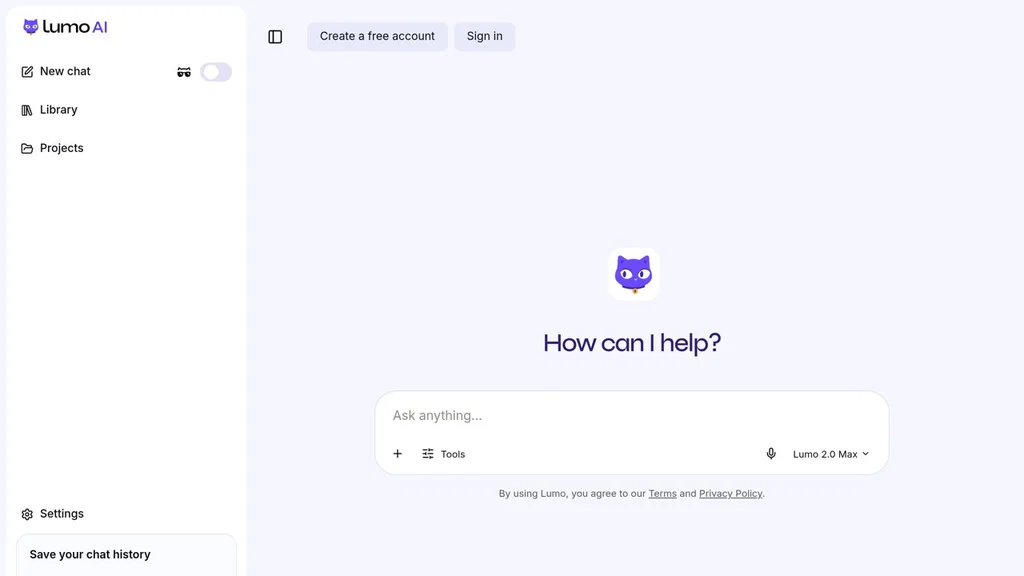
I tested Lumo on October 24, 2026 in guest mode with Lumo 2.0 Max: a solid invoice reminder email (with one clumsy sentence), a train timetable problem solved correctly, a CSV of sales analyzed with no calculation errors, a realistic image in under 20 seconds, and a web search where it flagged the reliability of its own source. On the two tasks I also gave ChatGPT, the results were equivalent: Lumo is not smarter, it is more discreet.
Two caveats. Encryption covers stored history, but each message is processed on Proton’s servers to produce a reply, which Lumo itself pointed out. And ghost mode, which wipes a chat when you close it, needs an account; in guest mode nothing is kept between visits anyway. Lumo Plus costs $9.99 a month billed yearly ($119.88), against a $12.99 monthly reference price, with a 30-day money-back guarantee.
Best for: keeping history, but encrypted
Lumo is the only no-training chatbot here that syncs encrypted history across your devices, with Proton Mail and Drive around it.
Affiliate link: I may earn a commission if you subscribe, at no extra cost to you.
Duck.ai (DuckDuckGo): the anonymous middleman
Duck.ai does not build its own models. It sits between you and third-party ones from OpenAI, Anthropic, Mistral and open-model hosts. DuckDuckGo strips your IP address and any personal metadata before your prompt goes out, so the request appears to come from DuckDuckGo. Providers agree not to train on these chats and to delete them right after replying, with one exception: OpenAI and Anthropic may keep a short-lived cache for up to an hour.
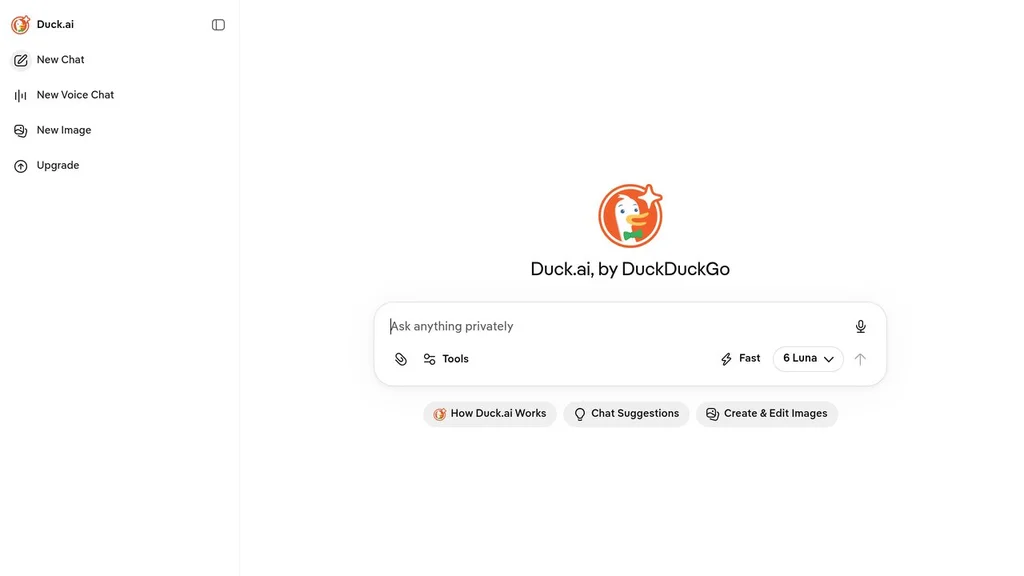
Nothing is stored at DuckDuckGo: your history (up to 100 chats) is kept locally on your device, and you can switch it off. There is no named incognito mode; that setting does the job. Free use has an unpublished daily cap. Stronger models come with the DuckDuckGo subscription, $9.99 a month for Plus (which includes a VPN) or $19.99 for Pro. It is the simplest way to ask a one-off question without leaving a trail, less so for ongoing work across devices.
Brave Leo: the browser assistant that keeps nothing
Leo is built into the Brave browser, which is both its strength and its catch: you need Brave to use it. The free tier asks for no account. Brave says it does not store prompts, responses or personal data on its servers and does not train on conversations; history stays local, and temporary chats vanish when closed.
Brave hosts the models on its own infrastructure without sharing data with their makers. Since October 15, 2026, an end-to-end encrypted chat option has been in beta, but it only covers one model (GLM 5.3 Flash), not the others. Leo Premium costs $14.99 a month ($149.99 a year) and adds access to stronger models, with higher rate limits. Brave also lets you plug in your own model, local or remote, if you would rather not rely on its servers at all.
Claude (Anthropic): training only with your consent
Under consumer terms rolled out from August 28, 2025, Anthropic trains Claude on Free, Pro and Max chats only if you allow it through the model improvement setting. The trade-off: if you say yes, data can be kept for up to five years. Otherwise, a deleted chat is purged from Anthropic’s back end within 30 days.
Incognito chats are never used for training and are kept for 30 days for safety. But Claude requires an account with your name, email and phone number, so there is no anonymous use. Pro costs $20 a month ($17 a month billed yearly). Among the big US models, it is the best privacy compromise, as long as you check that setting.
Vibe (Mistral): European, but trained by default
Mistral’s Le Chat was renamed Vibe in late May 2026. Mistral is a French company and hosts data in the European Union by default. Yet for individual accounts, Free and Pro alike, chats are used for training until you turn that off in the privacy settings.
Chats are kept until you delete them or your account, and I found no ephemeral mode in Mistral’s help center. A thumbs up or down lets Mistral use the rated exchange on every plan. Pro is listed at $14.99 a month before tax. The European hosting is real; privacy by default is not, so switch the option off when you sign up.
ChatGPT (OpenAI): trained by default, now with ads
On Free, Plus and Pro, OpenAI says it may use your content to train its models. You can turn off “Improve the model for everyone” in Data controls, but a thumbs rating can reopen the whole conversation for training. Even signed out, the page warns that chats may be reviewed and used to improve its models.
Temporary Chat stays out of your history and out of training, but OpenAI may keep a copy for 30 days. And ads can now appear on the Free and Go plans; Plus and Pro are ad-free, and OpenAI says it never sells your data to advertisers. Plans run Go $8, Plus $20 and Pro from $100 a month. For free alternatives, see my list of the best AI tools.
Which private AI chatbot should you pick?
There is no single winner: the right choice depends on what you share and how you work. Here is how I would choose.
A one-off question, no trail: Duck.ai. No account, IP stripped, nothing kept at DuckDuckGo, several models to choose from.
You already use Brave: Leo. It is already there, keeps nothing server-side and offers temporary chats.
An everyday assistant with history on all your devices: Lumo. The only one here that combines no training, encrypted synced history and Proton Drive integration.
You want a big US model: Claude, with model improvement switched off. Staying on ChatGPT or Vibe: opt out of training and use temporary chats for sensitive topics.
Whatever you use, some data never belongs in a chatbot: passwords, card numbers, health details tied to your name, client information. Anonymize before you send; the answer is almost always just as useful. For step-by-step settings, see OpenAI’s page on how your data is used and DuckDuckGo’s Duck.ai privacy page.
FAQ
Which AI is fully private?
No cloud chatbot is fully private, since your messages are processed on someone’s servers. Among the six compared here, Duck.ai, Brave Leo and Lumo come closest: no training on your chats, no account needed, and either nothing stored server-side or history encrypted so the company cannot read it.
Is there a private AI chatbot for free?
Yes. Duck.ai, Lumo in guest mode and Brave Leo in the Brave browser are free and need no account, with usage caps that their makers do not publish in detail.
Is AI available in incognito mode?
Several assistants offer one: Claude has incognito chats, ChatGPT has Temporary Chat, Brave Leo has temporary chats and Lumo has ghost mode for signed-in users. ChatGPT and Claude still keep these chats for up to 30 days for safety.
How private is ChatGPT temporary chat?
Temporary chats are not saved to your history and are not used for training, but OpenAI may keep a copy for up to 30 days for safety reasons.
How much does a private AI cost?
As of October 24, 2026: Lumo Plus is $9.99 a month billed yearly, DuckDuckGo Plus (with Duck.ai and a VPN) is $9.99 a month, and Brave Leo Premium is $14.99 a month.
Does a VPN make my AI chats private?
No. A VPN hides your IP address, but the chatbot still receives the content of your messages. The provider’s rules on training and retention are what protect that content.