Key takeaway: Otomatic.ai industrializes WordPress publishing for volume, while Wisewand.ai focuses on fine semantic optimization. This fundamental distinction points the choice toward automation to manage networks of sites, or toward in-depth SERP analysis to durably rank strategic pages on competitive queries.
Picking the winner of the Otomatic vs Wisewand match depends primarily on your priority between mass production and semantic excellence. This article dissects each tool’s strengths to avoid investing in a solution that doesn’t fit your SEO strategy. Discover which software offers the best growth lever for your sites, whether you target volume or authority.
- Otomatic vs Wisewand comparison summary
- Otomatic.ai: the SEO automation engine for WordPress
- Wisewand.ai: the high-precision SEO writing craftsman
- Features: Otomatic vs Wisewand head-to-head
- Otomatic vs Wisewand: the budget question
- User reviews: what do customers think?
- Verdict: should you choose Otomatic or Wisewand in 2026?
Otomatic vs Wisewand comparison summary
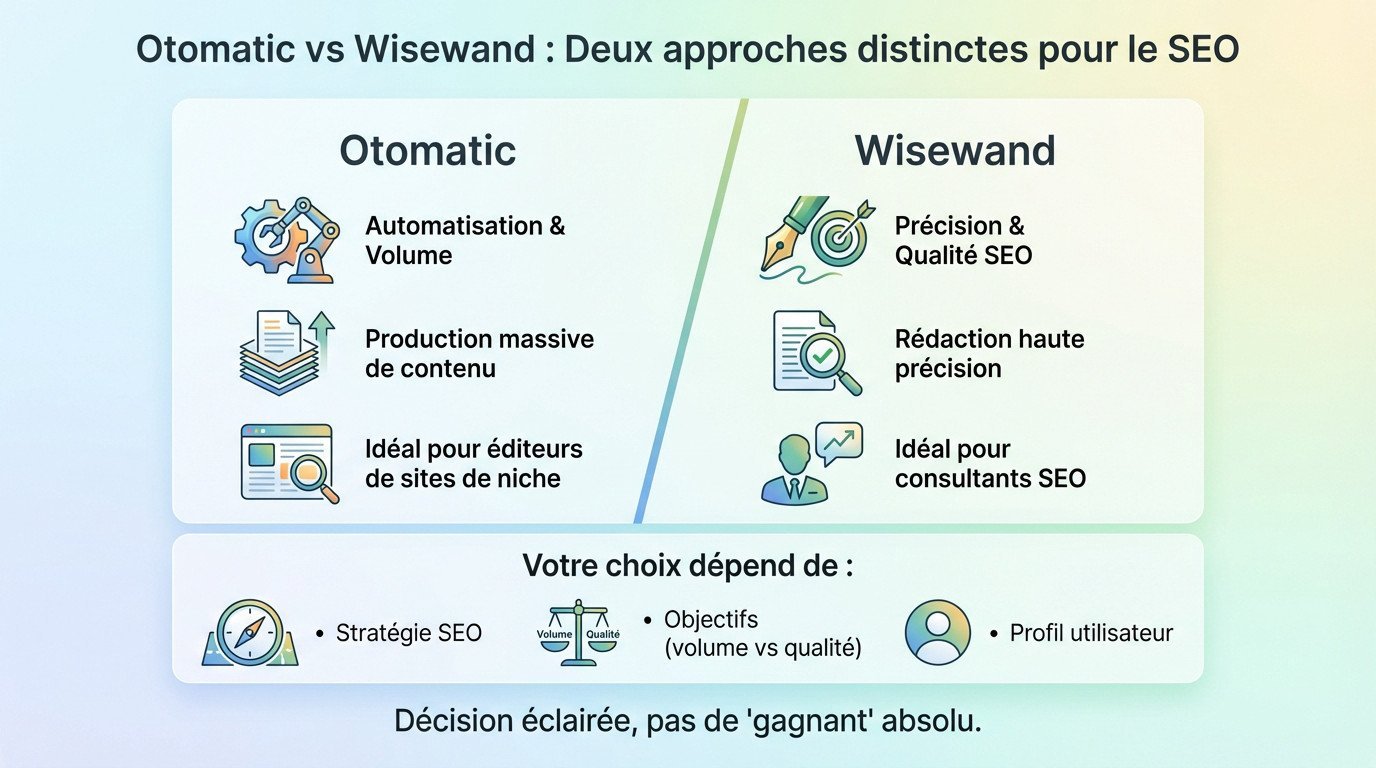
Let’s be clear from the start: this Otomatic vs Wisewand match doesn’t pit two direct rivals against each other. They don’t play in the same league. Otomatic is a machine built for automation and volume production. Conversely, Wisewand bets everything on high-precision SEO writing.
Your choice will therefore depend entirely on your current strategy. A niche site publisher chasing mass automation will prefer Otomatic. An SEO consultant demanding semantic finesse will naturally turn to Wisewand.
I’m not going to crown a single winner here. Instead, we’ll dissect these two distinct philosophies. The goal is to help you make an informed decision based on your real needs.
Otomatic.ai: the SEO automation engine for WordPress
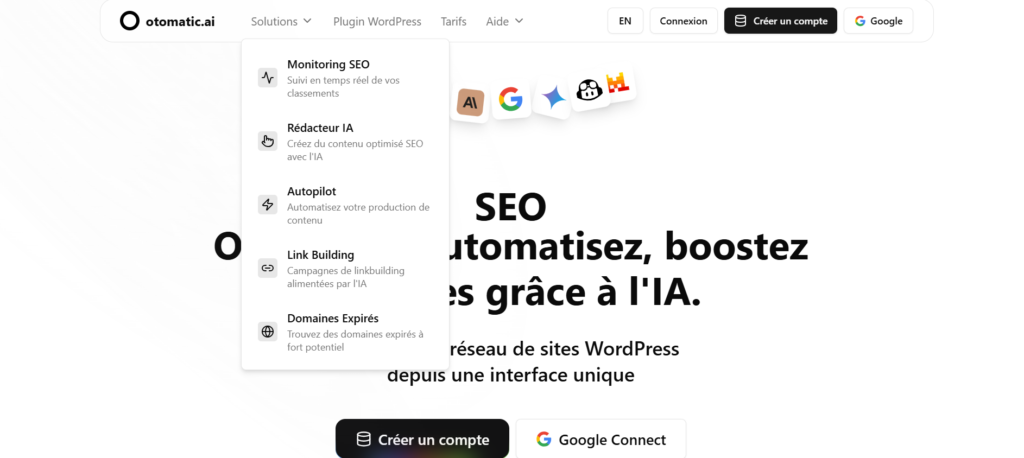
Let’s get straight to it with Otomatic. Forget the image of a simple writer; here we’re talking about a real control tower to automate site management.
Otomatic’s philosophy: volume and speed
Otomatic.ai doesn’t do delicate work. It targets publishers who must produce content in volume to exist online. The tool relentlessly hunts down repetitive manual tasks. In short, it’s a war machine for raw operational efficiency.
The goal isn’t to polish a sentence for an hour, but to feed one or several sites fast. Thanks to its native WordPress integration, the publishing flow becomes continuous. It’s throughput, not embroidery.
It’s the weapon of choice for managing PBNs or vast niche sites. If your strategy involves intelligent « filling » on broad topics, you’ve got your tool.
Its real advantage? Automating publishing and overall site management, without constant human intervention.
For which type of user?
The typical profile is the publisher running a blog portfolio or the marketer hungry for volume. Looking to save time? It’s clearly designed for you.
No need to be an engineer, but solid WordPress mastery remains required. The ambition is to simplify the process from A to Z, eliminating friction between text generation and going live.
Naturally, you tend to compare Otomatic to other tools to gauge its firepower. That’s a logical reflex when looking for the best tech stack.
But to settle it definitively, nothing beats deep analysis. I recommend you read our full Otomatic review to see what it really has under the hood.
Wisewand.ai: the high-precision SEO writing craftsman
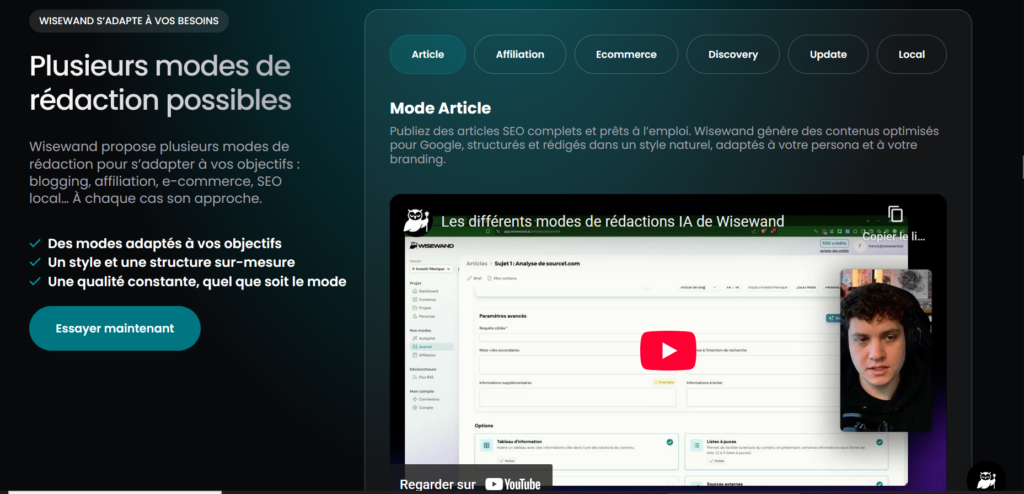
Now to Wisewand. Here we completely shift register and philosophy.
Wisewand’s philosophy: quality and semantic relevance
Forget soulless mass generation. Wisewand.ai positions itself as a digital craftsman, specialized in creating high-quality SEO content. It doesn’t aim to fill pages by the mile, but to durably rank on Google. A surgical approach designed for excellence.
Its strength lies in data analysis. The tool scans the SERP to decode search intent and inject the semantic entities Google expects. It doesn’t invent anything, it mathematically applies what already works for top results.
The output must fool a human. Wisewand produces fluent text capable of bypassing the strictest AI detectors. That’s essential to sustain your rankings against future algorithm updates.
Here, volume matters little. Priority is the SEO performance of each individual article to drive qualified traffic and convert.
The ideal user profile
This tool targets demanding publishers, freelancers, and affiliates managing strategic « money sites ». If you’re looking to build real authority on a competitive niche, this is the weapon you need. No room for useless filling.
Wisewand speaks to those who see writing as an investment. The goal is to maximize the ROI of each publication. Every article must bring traffic or money, not just bulk numbers.
The typical user gives major weight to internal linking and fine semantic optimization. In the Otomatic vs Wisewand duel, it’s clearly the choice of technical precision for experts.
In short, it’s the craftsman’s tool, not the factory’s. You keep total control over final quality.
Features: Otomatic vs Wisewand head-to-head
Now that the philosophies are clear, let’s put both tools side by side to compare their concrete features and see what they have inside.
The main lesson jumps out: the tools don’t play in the same league. Otomatic is a management and deployment tool, Wisewand is a creation and optimization tool.
Otomatic’s strength: WordPress integration
Otomatic bets everything on execution speed. Its flagship feature is its ability to integrate directly with WordPress to automate publishing without constant human intervention. That’s clearly its #1 selling point for publishers managing networks.
Concretely, it changes the life of anyone who hates copy-paste. You gain massive time, reduce tedious operations, and can schedule publications across multiple sites in a few clicks.
This technical approach is built for scalability and large-scale project management. When publishing speed becomes a key success factor, it’s the tool that lets you flood a topic fast.
Wisewand’s master asset: SEO context analysis
Wisewand tackles the problem from a totally different angle with its intelligent SERP analysis. The tool doesn’t just write dumbly, it dissects the competitors at the top of Google to understand exactly what works today.
This translates into much better integration of LSI keywords, named entities, and an article structure that precisely matches search intent. The text is cut to please the algorithm.
I particularly appreciate the « SEO Score » which acts as a practical guide for the user. It’s concrete help to improve optimization before publishing, a direct advantage to aim for top positions without having to rework after the AI.
Resilience against Google: a strategy difference
We need to address the longevity angle, because that’s where everything plays out. Otomatic’s « volume » approach can be riskier against updates like Helpful Content Update if quality isn’t closely supervised.
Conversely, Wisewand’s method is much more aligned with Google’s E-E-A-T requirements (Experience, Expertise, Authoritativeness, Trustworthiness). Its content comes out more natural, semantically rich, and sourced, which limits the risk of algorithmic penalty.
To me, Wisewand’s strategy looks more « durable » if you want to keep it for years. Otomatic’s remains a « blitz » strategy that has its own tactical advantages, but also increased risks.
Otomatic vs Wisewand: the budget question
Let’s talk money, because that’s often where the decision crystallizes.
Comparing these two tools on face price alone would be a strategic mistake. Their economic philosophies are diametrically opposed in the Otomatic vs Wisewand match. There’s no « cheaper » solution in absolute terms, just a model better suited to your cash flow and publishing frequency.
Wisewand bets everything on freedom with a transparent credit system. The rule is simple: one credit equals one article generated. It’s an à-la-carte approach that avoids paying for empty space if your output is irregular. You only spend what you actually consume, with no nasty surprises.
Conversely, Otomatic appears to adopt the more rigid structure of monthly or annual subscription. It’s the classic SaaS standard: a fixed cost for continuous access. This format usually reassures those needing to run full throttle without monitoring credit balance before each generation.
Here’s how these models concretely face off:
- Wisewand.ai:
- Model: Credit-based payment (1 credit = 1 article).
- Pro: Total flexibility, no forced commitment, ideal for occasional or variable needs.
- Con: The per-article cost may seem higher if volume becomes industrial.
- Otomatic.ai:
- Model: Recurring subscription (assumed).
- Pro: Predictable cost, potentially more cost-effective for continuous mass production.
- Con: Less flexible, commitment required, may be oversized for small needs.
Your final choice will depend mostly on your current workflow. A freelancer with variable orders will prefer the safety of Wisewand credits, while an agency with tight flow will likely find its match in Otomatic’s subscription stability.
User reviews: what do customers think?
Features on paper are nice. But real user opinions are often more telling.
Wisewand is still young, yet it already enjoys an excellent online reputation. Feedback is nearly unanimous. It’s a strong trust signal.
On the Otomatic side, feedback is much quieter. A logical situation for an automation tool often used « below the radar ». PBN managers rarely love the spotlight.
What emerges from Wisewand.ai reviews:
- ✅ Content quality: Users insist on the « natural » and « unique » output of texts, which often dodge AI detectors.
- ✅ SEO relevance: SERP analysis and semantic optimization constantly come up as major ranking strengths.
- ✅ Ease of use: The interface is rated intuitive, even for non-technical users.
- ❌ Areas for improvement: A few features are still under development, a classic for such a recent solution.
These reviews confirm the tool’s precise positioning. Wisewand delivers on SEO quality without compromise. We’re not on useless kilometre-generation. The added value is real.
The lack of buzz around Otomatic isn’t necessarily a bad sign. It simply reflects its nature as a « backstage » tool. Automation pros often keep their secrets.
Verdict: should you choose Otomatic or Wisewand in 2026?
So in the end, which tool deserves your budget? The answer isn’t binary.
Forget the idea of a universal winner. The best tool is the one that aligns with your strategy, your time, and your ambitions. It’s bespoke, not off-the-rack.
When to choose Otomatic.ai?
Otomatic is for you if your priority is speed and volume. You manage multiple WordPress sites and the time spent publishing manually is a bottleneck? It’s hell. This tool blasts that bottleneck immediately.
It’s the rational choice for site networks, large-scale content strategies, or simply to free up time on technical management.
If your business model relies on quantity, then you should seriously consider this option. See if Otomatic.ai matches your SEO strategy.
When to opt for Wisewand.ai?
Wisewand is your ally if every article matters. You aim for top positions on competitive keywords and quality is non-negotiable. Here we’re not playing on volume, we’re playing on surgical precision.
It’s the perfect tool for « money sites », premium affiliate blogs, and SEO agencies selling performance to clients.
If you prefer to publish one exceptional article per week, this is the tool. Test Wisewand.ai for SEO writing.
The final choice at a glance
To put it simply, here’s who each tool is for. Look where you stand:
- Otomatic.ai: For the high-volume site publisher (the marathoner).
- Wisewand.ai: For the demanding SEO consultant or affiliate (the sprinter).
Some might even use both: Wisewand for pillar articles and Otomatic for supporting content. Combining both approaches can be a powerful strategy to dominate a niche.
In the end, Otomatic and Wisewand address two distinct needs of modern SEO. The first excels at mass automation for site networks, while the second prioritizes semantic finesse for strategic pages. Your choice must therefore align with your model: the power of volume or the precision of craftsmanship.