
Key takeaway: Google doesn’t penalize artificial intelligence, it penalizes low-quality content produced without oversight. To stay safe, human input remains essential to validate expertise (E-E-A-T) and relevance. The safest approach is to drop raw generation in favor of writing SERP-driven SEO content with Wisewand.ai.
Does using generative tools expose your site to traffic losses, or is there a reliable way to do AI SEO writing without a Google penalty? This technical analysis compares ChatGPT to specialized solutions like Wisewand AI and Frase.io to identify the safest approach. You’ll discover which tool actually combines productivity with strict respect for Google’s algorithmic quality standards.
- Google and AI: what gets penalized (and what doesn’t)
- Criteria for « safe » AI content for SEO
- Generalist LLMs vs specialized SEO tools: the match-up
- Tool comparison: risk level vs use case
- Prepare your content for the future: AIO and GEO
Google and AI: what gets penalized (and what doesn’t)
Google’s official position: AI is not banned
Google has been clear: using AI for SEO writing without penalty is possible. The problem isn’t the tool, it’s the final result.
The rule is the same for everyone: content must be high quality, useful, and answer search intent. E-E-A-T remains your absolute benchmark for judging relevance.
Think of artificial intelligence as just one tool in your writer’s arsenal. It never replaces the expert, it simply assists them.
The real risk: content treated as spam
Google relentlessly hunts spammy content, any text generated to manipulate rankings, without real value for the end user.
Manual penalties target specific abusive automation practices. Here are the technical mistakes that cost you:
- Auto-translated texts without human review.
- Mass-paraphrased content without original contribution.
- Aggregated texts from different sources without synthesis or added value.
From assisted writing to mass automation
You must distinguish assisted writing from mass automation. The first optimizes your work, while the second generates hundreds of articles without human supervision. That’s a major difference.
The first approach boosts your real productivity. The second is an absolute red line for Google’s algorithms.
The key is meaningful human input on every page. That’s what guarantees quality and prevents penalty.
Criteria for « safe » AI content for SEO

The hybrid approach: human stays the pilot
To guarantee penalty-free AI SEO writing, full automation is off the table. Your role is that of a strict editor who must verify facts, fix hallucinations common to language models, and enrich the text with real data.
The tool offers a working base, but it’s always the human who decides and validates the final version.
Only your direct supervision ensures the originality and relevance needed to stand out in the content flood.
Beyond words: value, structure, and intent
Google doesn’t rank keywords, it ranks answers. If AI builds the outline, the human must validate that the substance answers a specific search intent.
The difference lies in what the algorithm doesn’t know: a real anecdote, a quantified case study, or a sharp opinion.
A readable structure, with clear headings and short paragraphs, remains an essential technical quality signal.
E-E-A-T in the age of AI
Faced with the rise of generated text, E-E-A-T criteria (Experience, Expertise, Authoritativeness, Trustworthiness) become the main credibility filter.
To meet these requirements, add a clear author bio, cite institutional sources, and integrate unique experience feedback. Show you actually tested the product, that’s what creates trust the algorithm can’t fake.
This layer of human expertise immunizes your page against anti-spam filters and validates your legitimacy.
Generalist LLMs vs specialized SEO tools: the match-up
ChatGPT and Claude AI: raw text generators
ChatGPT and Claude work like raw text engines, powerful but blind. They generate fluent content on any subject, but with no strategic vision of current SEO.
Their major weakness is the complete lack of SEO awareness. They ignore SERP competition and don’t understand the precise search intent Google expects.
They provide the raw material, that’s it. The optimization work to turn that draft into a high-performing article is entirely on you.
Frase.io and Wisewand AI: optimization assistants
By contrast, specialized tools like Frase.io and Wisewand AI don’t just try to write. They analyze the competition first, then structure content built to rank sustainably.
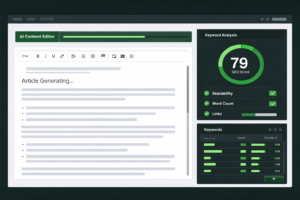
They handle the analytical heavy lifting, delivering a SERP-based brief and a real-time optimization score. That’s the best approach for AI SEO writing without penalty, because the process stays guided.
To decide, see the Frase.io vs Wisewand AI matchup that breaks down their respective strengths.
Otomatic: direct WordPress integration
Otomatic offers a radically different solution, a plugin that brings AI directly into the WordPress ecosystem. No more endless copy-paste between tools.
Its competitive edge is the integrated workflow that speeds up publishing. However, this ease increases the risk of « over-automating » without enough human review.
Read more about direct WordPress integration with Otomatic without sacrificing quality.
👉 Try Otomatic to publish faster on WordPressTool comparison: risk level vs use case
This table summarizes each tool’s strengths and weaknesses for SEO writing. It helps quickly identify the solution that fits your content strategy.
| Tool | Tool type | Ideal for… | Human supervision needed | SEO risk (if misused) |
|---|---|---|---|---|
| ChatGPT/Claude | Generalist LLM | First draft / Brainstorming | Very high | High (generic content) |
| Frase.io | SEO & Content Assistant | SERP analysis / Structuring | High | Medium (sometimes robotic text) |
| Wisewand AI | SEO & Content Assistant | Semantic optimization / Briefing | High | Medium (requires solid SEO expertise) |
| Otomatic | WordPress AI Plugin | Fast publishing / Integration | Very high | Very high (mass publishing risk) |
Recommendations by use case
For a quick first draft or to overcome writer’s block, ChatGPT or Claude are perfect. They unlock creativity instantly with no technical constraint.
To build a detailed outline and make sure you cover the topic in depth, Frase.io is an excellent SERP-based guide. It structures your thinking efficiently by analyzing the competition.
For sharp semantic optimization and integrated workflow, Wisewand or Otomatic are worth considering to save time on production.
Pitfalls to avoid with each tool
The main pitfall is blind trust in the machine. Every tool has technical limits and can generate factual errors or flat content.
You need to understand the limits of ChatGPT vs an SEO tool like Wisewand before validating your strategy. A direct comparison often reveals gaps in raw semantic relevance.
- Publishing raw text without rewriting it in your own voice.
- Skipping data and fact verification.
- Ignoring semantic optimization and SEO structure.
Prepare your content for the future: AIO and GEO

Beyond avoiding penalties, the real winning strategy is thinking about the next step: how to make your content a source for AIs themselves.
What is AIO (Artificial Intelligence Optimization)?
AIO, often paired with GEO (Generative Engine Optimization), is the art of optimizing your content for generative AIs. You go beyond the simple keyword to structure information logically.
The goal is twofold: rank well in traditional search and become a cited source in answers from AIs like Perplexity, Claude, or Google SGE. That’s where the visibility battle of the future plays out.
How to structure your content to become a source
To please AIs, content must be factual, clear, and extremely well-structured. Language models hate ambiguity and dense text blocks.
- Use section headings that are precise questions.
- Provide direct, concise answers right below.
- Use bullet lists to structure enumerations.
- Present numerical data clearly and in isolation.
- Source your information, it’s imperative for credibility.
Why this is the best anti-penalty insurance
By creating content so qualitative and well-structured that it becomes a reference for AIs, you by definition meet Google’s highest quality and reliability requirements. Succeeding in AI SEO writing without penalty goes through this structural rigor.
It’s a proactive strategy. Instead of simply « avoiding the penalty », you aim to become an unmissable authority, naturally immunizing your content against future algorithm updates.
The origin of the content matters less to Google than its final quality. To avoid any penalty, using tools like Wisewand or Frase must systematically come with rigorous human supervision. The alliance between AI’s generative power and domain expertise (E-E-A-T) is the only sustainable strategy to rank your pages over the long term.