
Quick answer: GEO and SEO are not opponents. GEO (Generative Engine Optimization) is about making your pages citable in answers from ChatGPT, Perplexity or Google AI Overviews, while SEO is about ranking in search results. Start by hardening your SEO (indexed pages, clear answers, proof), then measure whether AI assistants cite you before you optimize anything further.
Contents
You publish an article, it ranks, and yet some of your readers no longer go through the results page: they put the question to an assistant, which answers while citing (or not) two or three sources. GEO is the name for the work of being one of those sources. The topic is new, the promises are loud, and most guides stop at generalities. This one starts from what a publisher of a content or affiliate site does every day: the brief, the page structure, the proof and the measurement.
GEO and SEO: neighbouring jobs, not rival camps
SEO tries to place a page on a list of results so that someone clicks. GEO tries to get your content, or your name, picked up inside the answer written by a generative engine. In the first case the unit of success is the position and then the click. In the second it is the mention or the citation, sometimes with no click at all.
Both feed on the same raw material: a page that robots can reach, content that really answers the question, and a reputation that extends beyond your own site. GEO does not replace SEO, it adds a second way of reading your results: instead of only asking “does Google rank me?”, you also ask “does an assistant know I exist, and what does it say?”. If you are comparing writing tools on the SEO side, our best AI SEO tool guide is still the starting point for production.
One point of method before going further: an AI answer is not stable like a results page. Two people asking the same question can get different sources, and so can the same person an hour later. That is why GEO is run with repeated samples of questions, not with a “rank”.
The SEO vs GEO table
These are the seven criteria that matter when you move from one to the other.
| Criterion | SEO | GEO |
|---|---|---|
| Objective | Earn a good position to receive clicks | Be cited or recommended in a generated answer |
| Unit of success | Position, impressions, clicks, CTR | Brand mentions, citations of your pages, share of answers where you appear |
| Where you appear | Results list, snippets, cards | The answer text, the source list, sometimes only the brand name |
| Signals | Relevance, links, page experience, technical access | Clarity of passages, reliability of claims, presence elsewhere on the web, robot access |
| Content | A page that covers the search intent | Self-contained, factual passages that are easy to extract and cross-check |
| Measurement | Search Console, rank trackers | Tracking questions sent to AI assistants, server logs, sometimes analytics |
| Time to results | Weeks to months, with a stable history | Variable and poorly documented: answers change from one query to the next |
A note on the last row: we do not put a number on GEO timing, because no serious source we could open gives a reliable duration. If someone sells you “results in 30 days”, ask for the data. For the SEO analysis side, see also our Surfer SEO review.
GEO vs AEO vs AI SEO: the vocabulary
The three acronyms circulate as synonyms, but they do not share the same origin. Here is how we use them on this site.
- GEO (Generative Engine Optimization): the term from academic research, formalized in the Princeton paper and its co-authors, and now the common label for optimizing toward generative engines.
- AEO (Answer Engine Optimization): optimizing for engines that give a direct answer rather than a list. It covers featured snippets, voice assistants and chatbots. In practice the work is almost the same as GEO.
- AI SEO: a catch-all phrase. Depending on the author, it means either optimizing for AI (so GEO) or using AI to do SEO (writing, clustering). Always check which meaning is in play.
For your daily work, keep this: whatever the label, the useful question is “which reader question, put to which assistant, surfaces which source?”. The rest is sales vocabulary. The same goes for “GEO vs SEO vs AEO” comparisons: they differ in marketing, not in the tasks you do.
What the sources actually say
A lot of numbers circulate about GEO. We dropped most of them because we could not trace them to an open, verifiable source as of October 25, 2026. Here is what holds.
According to the Princeton GEO study (Aggarwal and co-authors, accepted at KDD 2024), the authors propose an optimization framework for generative engines and a benchmark called GEO-bench. They report that their methods can raise a piece of content’s visibility in generative answers by up to 40%. Read “up to” carefully: it is a maximum measured on their benchmark, not an average gain you will get at home. They also state that effectiveness varies by domain, which is an argument for testing on your own topic rather than applying a recipe.
On Google’s side, the Search Central documentation on AI features is clear: a page must be indexed and eligible to be shown in Search with a snippet to appear in AI Overviews or AI Mode, and there are no additional requirements or special optimizations. Google adds that you do not need new machine-readable files, AI text files or special markup. In plain words: for Google, “GEO” is SEO done well. The available controls go through robots.txt and snippet directives such as nosnippet.
That only holds for Google. For ChatGPT, Perplexity or Claude, each vendor has its own collection rules, and we do not claim to know them in detail. What I can say is that the foundations (reachable pages, clear answers, verifiable claims) are shared by all of them. For a hands-on view of how we write comparison pages with that in mind, see our Writesonic review.
What changes in a publisher’s work
Here is where GEO touches your routine, with examples taken from a review and comparison site.
The brief: one question, one answer, one proof
Your brief used to start from a keyword and an outline of headings. Add three lines: the exact question a reader would put to an assistant, the two-sentence answer you want to see reused, and the proof that backs it (a test, a price captured on a date, a screenshot). If you cannot write the proof, the article is not ready.
The structure: passages that stand alone
An assistant extracts pieces, not pages. A paragraph that starts with “as we saw above” cannot be quoted. Write each section so that it makes sense in isolation: the subject named in the first sentence, the answer before the nuance, a heading that looks like a real question. As a side effect, it also helps a hurried human reader.
The proof: date it, name it, show it
“This tool is expensive” adds nothing. “The Starter plan is listed at this price on its pricing page on October 25, 2026” can be checked, quoted and ages cleanly. On our review pages we date every price, say when a tool was not tested and attach a screenshot of the official page. A dated, sourced statement is the kind of passage an engine can cross-check, and it also protects your credibility with the reader. For this format in practice, open our Frase review.
The measurement: stop watching position alone
A page can keep its position and lose clicks if the answer is now read inside the interface. Add two families of indicators to your dashboard: clicks and impressions from Search Console on one side, and on the other a small sample of questions tracked in assistants (see the next section). They tell different stories, and the gap between them is the instructive part.
The robot and the brand: two separate things
Being cited first requires being readable by robots: check your robots.txt, do not block by mistake the agents you want reading you, and keep important pages reachable without mandatory scripts. Then comes the brand: an assistant plausibly cites a name it meets in several places (third-party tests, comparisons, forums) more readily than a site that only describes itself. That is a reasonable working hypothesis, not an established law, so test it on your own pages before spending budget.
Measuring your AI visibility: which tools
Without measurement GEO stays an impression. Two approaches coexist: manual checking (ask your ten key questions to several assistants every week and note who is cited, free but time-consuming) and tracking tools, which send your questions (the “prompts”) repeatedly and aggregate the brands and sources cited. All prices below were read on the official pages at the dates given; they change, so verify before committing.
Finseo
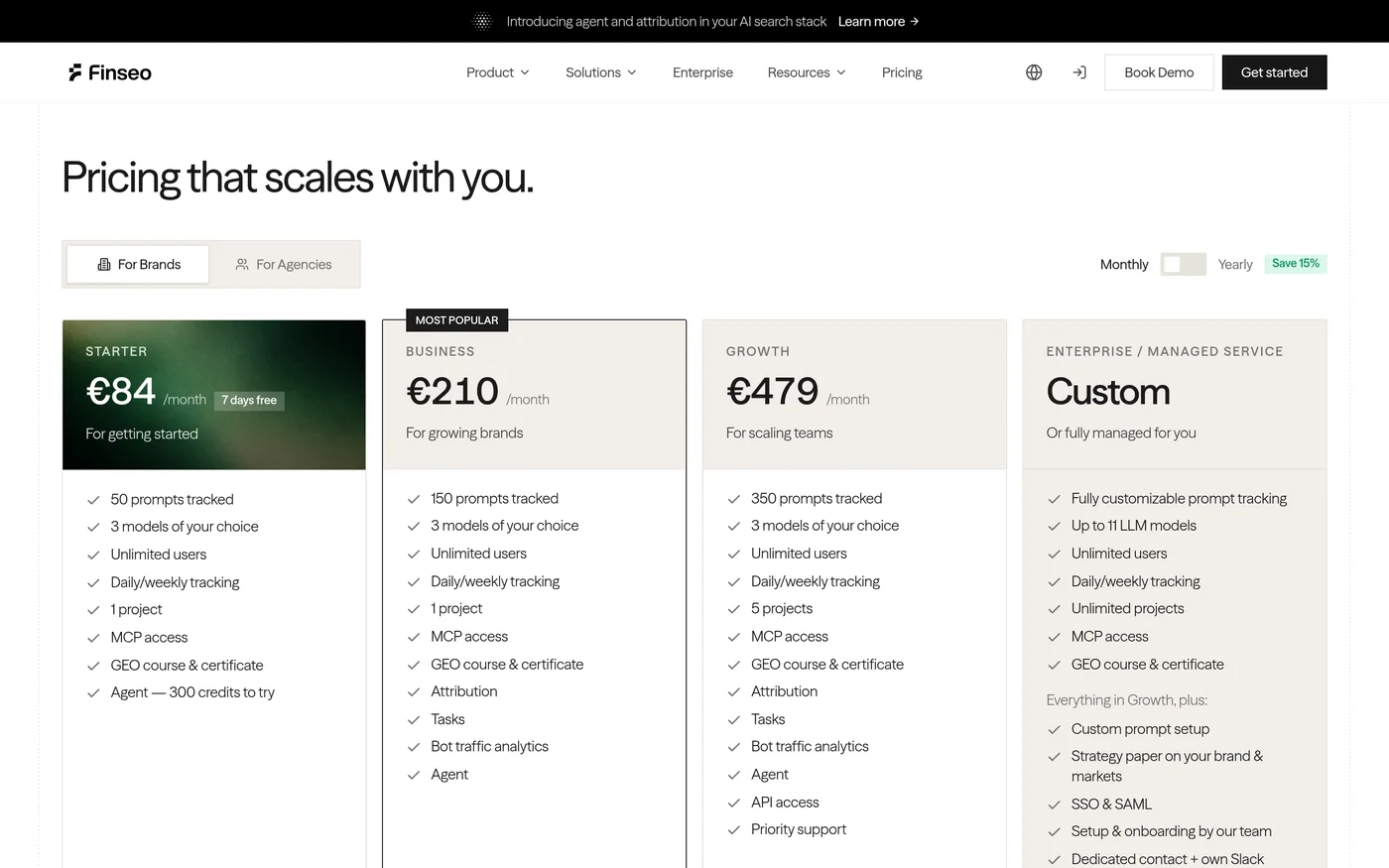
According to its pricing page on October 25, 2026, Finseo starts with a Starter plan at EUR 84 per month excl. VAT (50 prompts, 3 models, 7-day trial). AI traffic attribution and bot analytics only appear from the EUR 210 tier, and the top tier is EUR 479. We have not tested Finseo: everything here comes from its pricing page, not from use. Partner link: we earn a commission if you subscribe, at no extra cost to you.
Peec AI
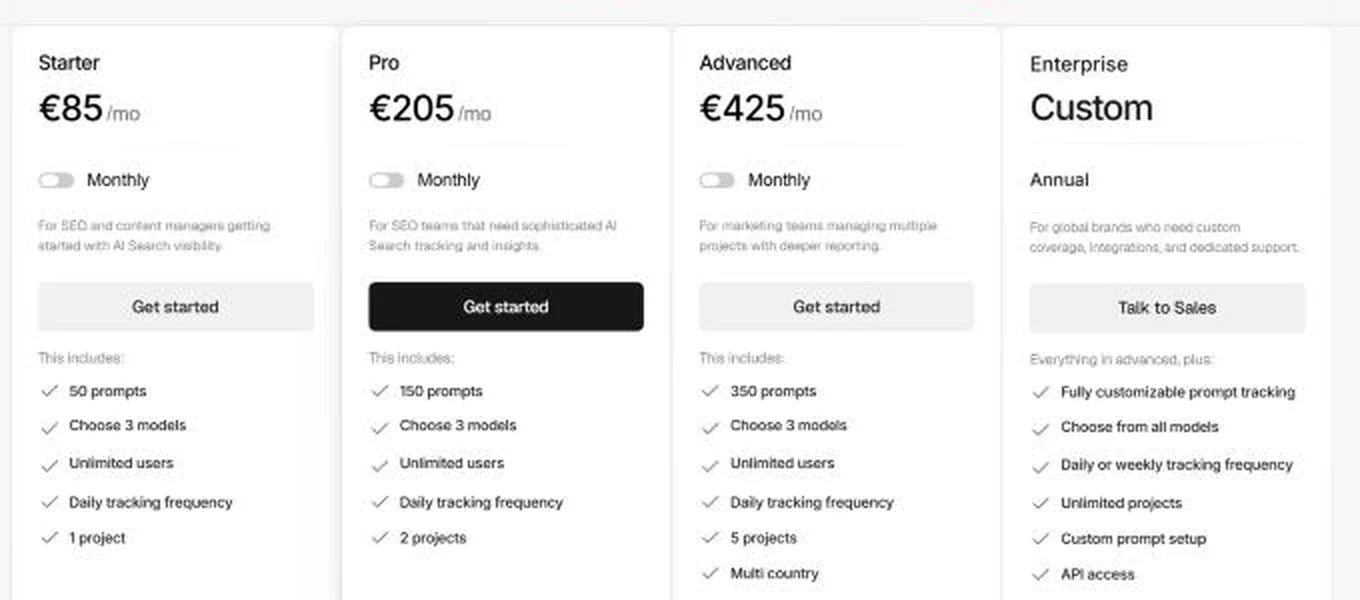
Peec AI shows a grid at 50, 150 and 350 prompts, with features close to Finseo’s (AI visits, bot tracking). There is no reason to name a winner without a side-by-side test: both answer the same need, and the difference will come down to the volume of prompts you actually need.
OtterlyAI
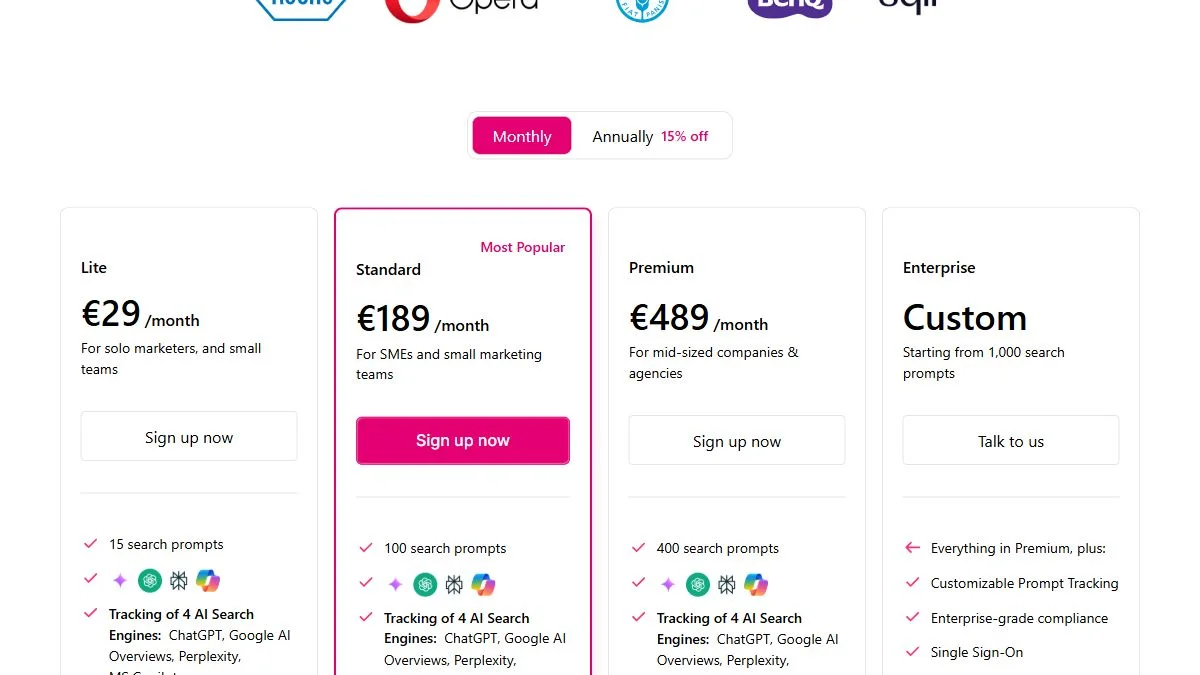
OtterlyAI offers three tiers, displayed in euros from France on October 23, 2026: Lite at EUR 29 per month, Standard at EUR 189 and Premium at EUR 489. It is the lowest entry ticket of the three tools named here, which makes it a natural candidate if you just want to see whether tracking brings you anything.
Profound and AthenaHQ
Both target larger companies. Their prices are quote-based or high: see their pricing pages. We do not detail them for lack of current open data.
SEO suites that add AI tracking
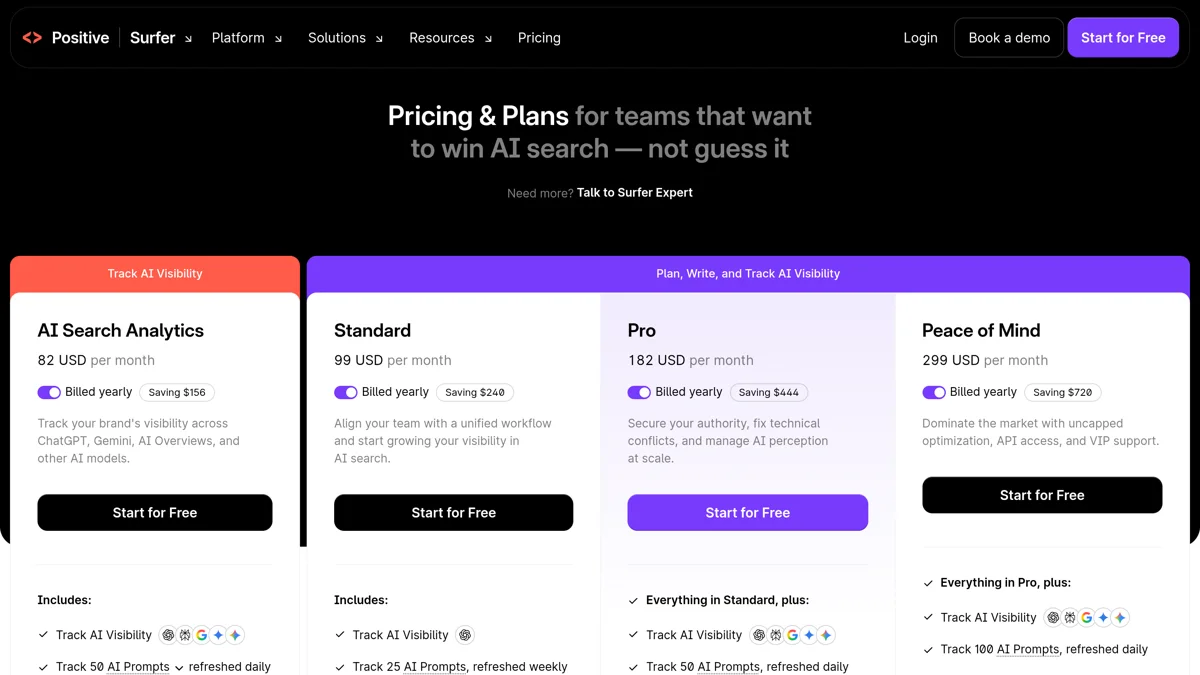
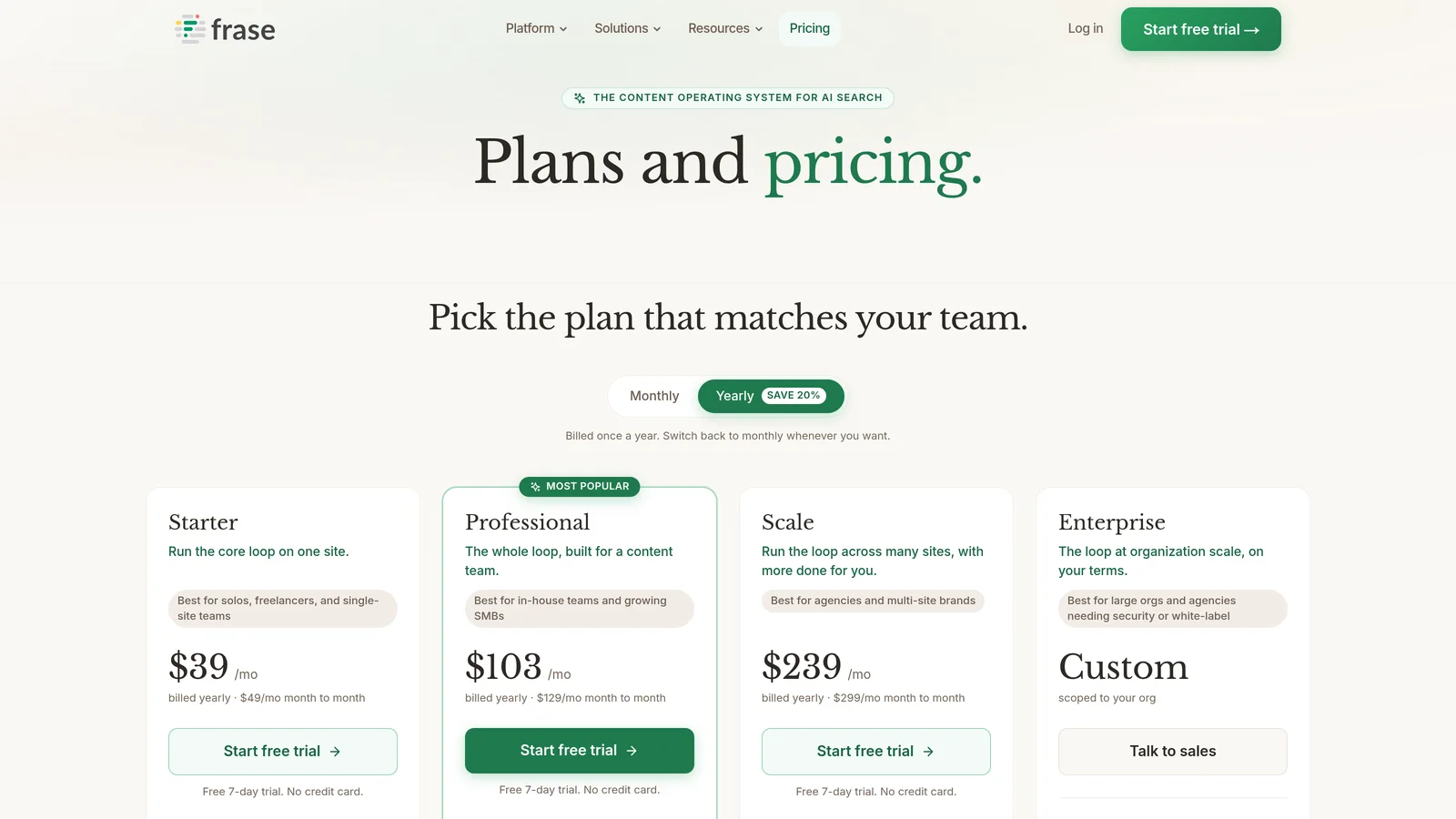
If you already pay for a writing tool, check what it includes first. Surfer has an “AI Search Analytics” plan at $82 per month billed annually, according to its pricing page on October 25, 2026. Frase tracks AI visibility prompts: 20 on Starter, 50 on Professional, 75 on Scale, according to its pricing page. Writesonic presents itself as an “AI Search Visibility Platform”. These suites are less specialized, but they spare you one more subscription.
An honest framing: Finseo is not the only tool of its kind, and nobody has shown it to be the most complete. Choose by the number of prompts you need, your budget and whether you already own an SEO suite. If your bottleneck is semantic coverage rather than tracking, our NeuronWriter review is the better read.
A 6-step action plan
A realistic plan for a solo content site with no team.
- Step 1, check access. Important pages indexed, a consistent robots.txt, nothing blocked by mistake. This is the one step Google itself presents as required to appear in its AI features.
- Step 2, pick ten questions. Take the pages that earn the most (affiliate or leads) and rephrase them as a reader would put them to an assistant.
- Step 3, take a manual snapshot. Ask those ten questions to two or three assistants, note who is cited and with which wording. Keep the date.
- Step 4, rewrite the key passages. A clear answer at the start of each section, a dated proof, a heading shaped like a question. You do not need to redo everything: begin with your three most profitable pages.
- Step 5, decide whether to buy a tool. If manual checking takes you more than an hour a week, compare a tracking tool. Otherwise, pay for nothing.
- Step 6, measure again a month later. Same questions, same assistants. Compare, adjust, and write down what moved so you do not fall back into superstition.
FAQ: GEO vs SEO
Is GEO replacing SEO?
No. According to Google’s documentation, there is no additional requirement to appear in its AI features: a page must first be indexed and eligible for a snippet. GEO complements SEO and builds on it.
Is AI SEO called GEO?
Not exactly. GEO means optimizing for generative engines. “AI SEO” is vaguer: it can also mean doing SEO with AI tools. Check the meaning each time.
Is SEO dead now with AI?
No. Generative answers rely on pages from the web, and Google itself points to classic indexing as the condition for its AI Overviews. Clicks may fall on some queries, though, so watch your own data rather than slogans.
Is SEO dead or evolving in 2026?
Evolving. The fundamentals (indexable pages, useful answers, trust) are unchanged, while measurement now also includes whether assistants mention you. As of October 25, 2026, we could not find a reliable source quantifying how much traffic has shifted, so we will not give a number.
What is the difference between GEO and AEO?
AEO targets any engine that gives a direct answer (snippets, voice, chatbots), GEO targets generative engines specifically. The daily tasks are nearly identical.
How do I measure AI visibility?
By hand, asking your key questions to several assistants and noting the sources, or with a prompt-tracking tool such as Finseo, Peec AI or OtterlyAI. Repeat the measurement regularly, since answers vary.