
Asking “Gemini or ChatGPT?” now means comparing two things that are no longer quite the same kind of product. One is an assistant sold on its own. The other is an assistant slipped into a Google plan that also carries storage, creative credits and, at higher tiers, YouTube Premium. The sticker price tells you very little until you look at what else is in the box. Here is the comparison, with US prices read on the official pages on October 23, 2026.
In short: if you already pay Google for storage, Gemini is the obvious value: Google AI Pro is $19.99 a month with 5 TB of storage and the assistant built into Gmail and Docs. If you want only an assistant, ChatGPT is the more coherent product: Plus is $20, there is an $8 Go tier, and custom GPTs, scheduled tasks and an always-on agent on Pro that Google does not match. Both have a free plan worth testing first, and neither publishes an exact message quota.
Prices read on October 23, 2026 from Google’s US subscriptions page and OpenAI’s pricing page (cross-checked on OpenAI’s US App Store listing). Links to Google and OpenAI are plain official links. We compare plans and published features, not model benchmarks.
In this article
- The US prices face to face
- Google sells a plan, OpenAI sells an assistant
- Integration: Gmail and Docs against custom GPTs
- Which models sit behind each plan
- The free versions
- Can Gemini do everything ChatGPT can?
- Is Gemini better than ChatGPT in 2026?
- Does Gemini spy on you? Privacy basics
- The calculation that decides it
- Who should pick which
- FAQ
The US prices face to face
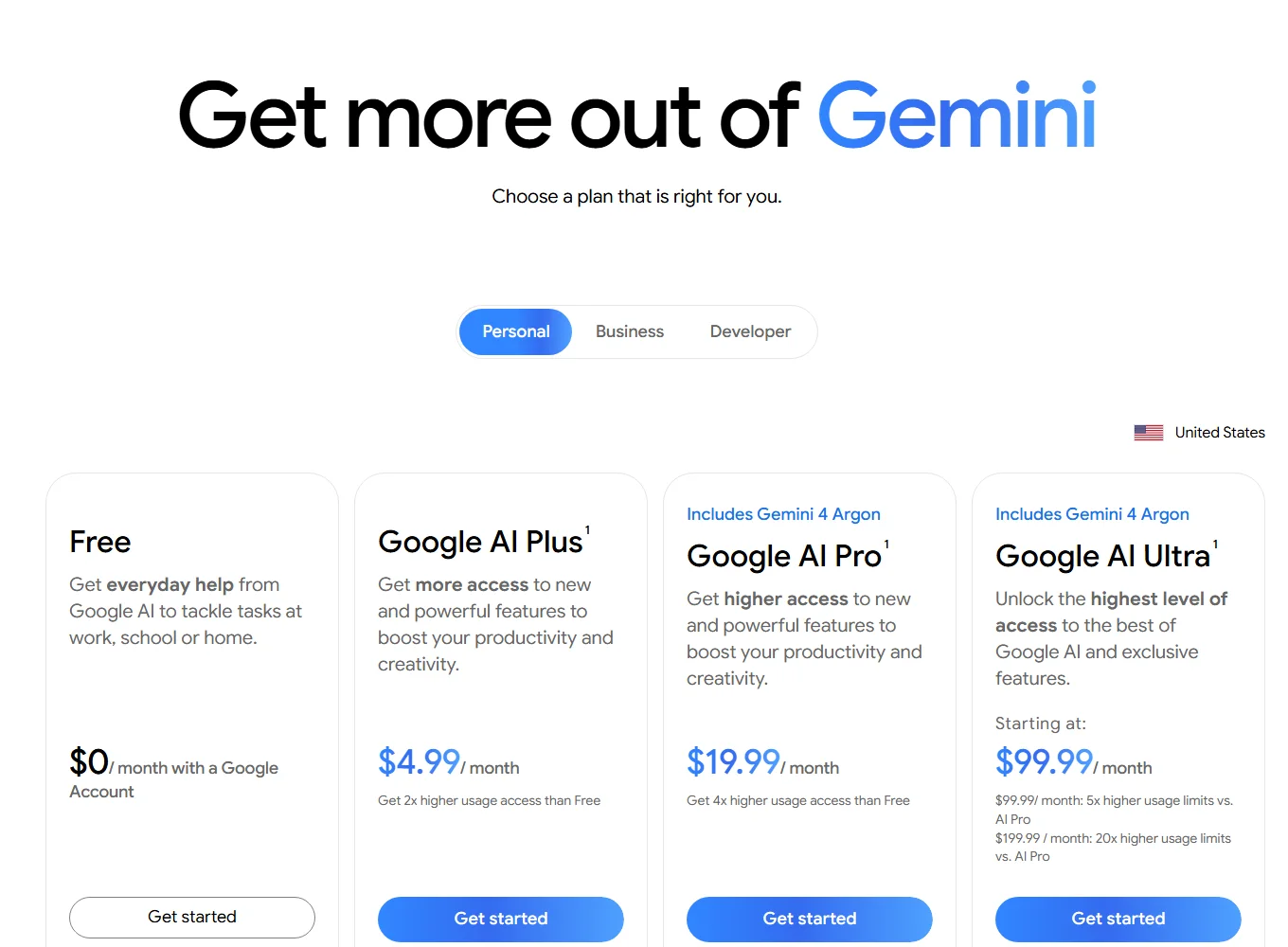
Both companies list monthly dollar prices on their US pages. Google’s ladder has four rungs, OpenAI’s has four too, and the two line up closely at the top and bottom.
| Level | Google AI (Gemini) | ChatGPT |
|---|---|---|
| Free | Free, $0 (15 GB storage) | Free, $0 |
| Entry | AI Plus, $4.99/month 400 GB, 2x the free usage |
Go, $8/month may include ads |
| Standard | AI Pro, $19.99/month 5 TB, 4x the free usage |
Plus, $20/month ($19.99 on the US App Store) |
| Heavy use | AI Ultra, from $99.99/month (5x Pro limits) $199.99 for the 20x variant |
Pro, from $100/month three tiers: $100, $200 and $500 |
At the standard level the gap is a single cent, so price alone does not decide anything. Google’s entry tier is much cheaper than OpenAI’s ($4.99 against $8) and bundles 400 GB of storage with it. At the top the two are essentially mirror images: about $100 for five times the Pro-level usage, and about $200 for the biggest multiplier.
Google sells a plan, OpenAI sells an assistant
This is the reading key most comparisons skip. Google AI Pro at $19.99 includes, according to Google’s page:
- 5 TB of cloud storage shared across Gmail, Drive and Photos.
- YouTube Premium Lite: most videos ad-free, offline and in the background.
- Google Home Premium (Standard plan) with 30 days of event history and Gemini features.
- 1,000 Google Flow credits for the creative studio, access to the Pro model and the newest Gemini model, plus higher limits on the Jules coding agent and entry limits in Google Antigravity.
- Gemini inside Gmail, Docs, Vids and more, and Chrome auto browse that can complete tasks for you.
So if you already pay for Google storage, and maybe for YouTube, the real extra cost of Gemini is not $19.99 but the difference between your current subscriptions and this plan. For many households that difference is small, sometimes nil.
ChatGPT does not play that game. Its $20 pays for the assistant and nothing else. That is easier to read and mechanically less efficient for anyone who already lives in the Google ecosystem.
The flip side of a bundle. A plan that stacks storage, video, home features and AI is harder to cancel without consequences. The day you want to leave Gemini, you lose the storage and the YouTube perk too. That is the point of a bundle, and it is an exit cost you should count from day one.
Integration: Gmail and Docs against custom GPTs
The two companies chose different battlegrounds, and this is probably the most structuring criterion after price.
Gemini: the assistant where you already work
Google’s argument is native integration. Gemini appears in Gmail to help with email, in Docs to draft and rewrite, in Vids and Notebook for research and study. Deep Research, which browses many sites to build a report, is on every plan, and higher tiers raise the limits and add more access in Search. If your workday is Gmail, Docs and Drive, the assistant comes to you.
ChatGPT: personalization and automation
OpenAI answers with a trio Google does not match in its current form: custom GPTs, scheduled tasks and projects, all included from the Plus plan. You configure an assistant once and reuse it, or schedule a recurring job. Plus also includes expanded Codex usage and ChatGPT Work on desktop, web and mobile, and Pro adds Dot, an always-on agent. The question to ask yourself is simple. Do you want the AI to come to you, inside the apps you open every morning? Pick Gemini. Do you want to build tailored assistants and trigger them when needed? Pick ChatGPT.
Not sure which suits your workday? Both free plans are enough for a test week. Run the same three real tasks on each before paying.
Which models sit behind each plan
Model names change every few months and the two companies number them differently, so use them as labels, not as a scoreboard. Here is what each publishes on its own page today.
- Google: the free plan uses Gemini’s Flash-Lite model. AI Plus adds the Flash model. AI Pro and Ultra add the Pro model and Gemini 4 Argon, the newest model Google highlights across its pages. Ultra gives the highest access and up to 20x the Pro usage limits.
- OpenAI: free users get unlimited text chats with GPT-6 (subject to abuse guardrails) and limited access beyond that. Plus adds advanced reasoning models with GPT-6, including GPT-6.1 Sol. Pro adds GPT-6 Astra and GPT-5.6 Sol Pro.
Do not choose on version numbers. A “4” at Google and a “6” at OpenAI are not on the same scale, and both change quickly. What matters to you is the level of access your plan unlocks and the limits attached to it, not the digit on the label.
The free versions
Both are usable for light daily use, and they are more generous than they were a year ago. Gemini Free includes the Gemini app with the Flash-Lite model, image generation and editing, Deep Research, Gemini Live voice, Canvas and Gems, limited Google Flow access and 15 GB of storage. Google describes its paid tiers as multipliers of that free usage (2x for AI Plus, 4x for AI Pro), which implies a base limit it does not quantify.
ChatGPT Free includes unlimited text chats with GPT-6 under abuse guardrails, but limited uploads, image creation, voice chats, deep research, memory and context, plus limited Codex and ChatGPT Work access. The context window is 27K on Free and 54K on Go and Plus.
Neither publishes a message quota. That is a constant of this market: you will never know in advance how many requests your plan allows. The practical test is to use the free plan for two weeks and note every time you hit a limit.
Can Gemini do everything ChatGPT can?
Not exactly, and the reverse is true too. The overlap is large: chat, image generation, deep research, voice conversations, coding help, file analysis, memory. The differences are in the edges.
- Gemini has, and ChatGPT lacks: built-in storage and YouTube perks, Gemini in Gmail, Docs and Vids, Google Home features, Chrome auto browse and a household bundle.
- ChatGPT has, and Gemini does not match in the same form: custom GPTs, scheduled tasks inside the assistant, the Go entry tier and an always-on agent on Pro.
- Both have: deep research, image and voice features, a coding agent (Jules and Antigravity on Google, Codex on OpenAI) and heavy-use tiers at about $100.
So the honest answer is “mostly, with different strengths”. If a specific feature is the reason you are buying, check that exact feature on the current pricing page, because both companies keep moving things between tiers.
Is Gemini better than ChatGPT in 2026?
No independent benchmark can crown a winner, and results change with each model update. What we can say is structural. Gemini is better value if you already live in Google’s ecosystem and want to replace a storage subscription. ChatGPT is better if you want a configurable assistant with automation and the widest range of tiers. If someone tells you one is simply “better”, ask them for what task and on which plan.
Is there a better AI than ChatGPT? Again, it depends on the job. Claude is often preferred for long writing and code, Perplexity for sourced research, Grok for live posts on X. We compare them in Claude vs ChatGPT, Grok vs ChatGPT and the best AI to use in 2026.
As for the question whether Gemini is “more negative” than ChatGPT, we found no reliable public measurement. Tone and refusals depend on the prompt, the safety settings and the model version. If tone matters to you, set it explicitly in your instructions on either product.
Does Gemini spy on you? Privacy basics
The short, careful version: any cloud assistant processes what you type, and both companies give you controls. On the Google side, your conversations are tied to your Google account and to the activity settings you choose, so open the Gemini activity and privacy controls when you start. On the OpenAI side, OpenAI’s pricing table shows an opt-out from model training on every plan. Treat both as services run by advertising and platform companies, avoid pasting passwords, client secrets or medical details into a consumer plan, and read the current data policy before you rely on either for sensitive work.
The calculation that decides it
Forget for a minute which model is “smarter”, a question nobody can answer objectively, and do this three-line sum.
- What do you already pay Google every month? Count Google One storage and YouTube Premium if you have it.
- Is that total close to $19.99? If yes, moving to Google AI Pro gets you Gemini for a marginal cost. That is hard to beat.
- If not, do you need automations? If yes, ChatGPT Plus at $20. If you only want to chat with an AI now and then, ChatGPT Go at $8 or either free plan is enough.
This sum gives a clear answer in most cases, and it is far more reliable than a performance ranking that changes with every model update. For a yearly view: Google AI Plus is about $60, Go about $96, Google AI Pro about $240 and ChatGPT Plus about $240.
Who should pick which
Pick Gemini if
- You already pay for Google storage: the plan absorbs your current spend.
- You spend your day in Gmail, Docs and Drive.
- You want household extras like YouTube Premium Lite and smart-home features bundled in.
- You want the cheapest entry: $4.99 for AI Plus, against $8 for Go.
Pick ChatGPT if
- You want custom assistants and scheduled tasks.
- You do not want a subscription that mixes AI, storage, video and smart-home features.
- You want an always-on agent and the longest context on the Pro tier.
- You work with people who already use it and share configurations.
Look elsewhere if
- You already juggle several assistants. An aggregator can cover them under one subscription, a route we discuss in our Merlin AI vs ChatGPT comparison.
- Your main use is long-form writing: see Claude vs ChatGPT.
- You want content that ranks in search. Then you need an SEO tool, see below.
A general assistant is not an SEO tool. Gemini and ChatGPT write text, but neither reads a search results page, scores semantic coverage or tracks your rankings. If your goal is publishing content that ranks, pair an assistant with a purpose-built tool such as Wisewand, or see our best AI SEO tool guide.
FAQ
Is Gemini better than ChatGPT?
No independent ranking settles it, and results shift with every model release. The real difference is structural: Gemini is sold inside a Google plan with storage and other perks, ChatGPT is sold as an assistant with a richer automation ecosystem. The better choice depends on what you already pay for and what you want to do.
How much does Gemini cost compared with ChatGPT?
On October 23, 2026 in the US: Google AI Plus $4.99 a month (400 GB), Google AI Pro $19.99 (5 TB), Google AI Ultra from $99.99. ChatGPT: Go $8, Plus $20, Pro from $100. At the standard level they are one cent apart.
Is Gemini included in Google One?
Google’s AI plans carry the storage allowance: AI Plus includes 400 GB, AI Pro 5 TB. If you already pay for Google storage, an AI plan absorbs that spend instead of adding to it, which is the main appeal.
Can Gemini do everything ChatGPT can do?
Mostly, with different strengths. Both cover chat, images, deep research, voice and coding help. ChatGPT has custom GPTs, scheduled tasks and an always-on agent on Pro. Gemini has deep integration with Gmail, Docs and Chrome, plus bundled storage and YouTube perks.
Can I use Gemini for free?
Yes. The free plan includes the Gemini app with the Flash-Lite model, image generation and editing, Deep Research, Gemini Live, Canvas and Gems, and 15 GB of storage. Paid plans are described as 2x and 4x the free usage, with no published message quota.
Which is better for writing?
Both write well and no benchmark proves a winner. If your text lives in Google Docs, Gemini’s integration saves time. If you want a reusable writing assistant with your own instructions, ChatGPT custom GPTs fit better. For long documents also see Claude.
Does Gemini spy on you?
Any cloud assistant processes what you type. Google ties Gemini activity to your account and gives you privacy and activity controls, and OpenAI offers a training opt-out on every plan. Review the settings on whichever you use and keep sensitive data out of consumer plans.
Should I use ChatGPT or Gemini?
Do the three-line sum: what you already pay Google, whether that is near $19.99, and whether you need automations. If you live in Google apps, Gemini. If you want assistants you can configure and schedule, ChatGPT. If you only chat occasionally, stay on the free plans.
Want to publish content that ranks? Neither assistant is built for search. We compare the tools that are, by profile and budget.