
You need to paraphrase a text to avoid copying a source, vary your style, clarify a muddy passage or make it shorter. An AI paraphraser does that in seconds, as long as you know how to steer it and where the free tools stop. This guide covers the method: the prompt that works in ChatGPT, a comparison of the main paraphrasing tools with plans read on October 23, 2026, and what to do when you want a text that reads as human.
In short: you have two routes. A precise prompt in an AI assistant such as ChatGPT or Claude is the most flexible. A one-click paraphrasing tool (QuillBot, Wordtune, ZeroGPT, Scribbr) is faster but gives you less control, and free plans cap the length. Paraphrasing does not make a text original: you still need to cite the source, and a reworded copy of someone else’s article adds no value for SEO. If your goal is to publish content that sounds natural, write it properly from the start.
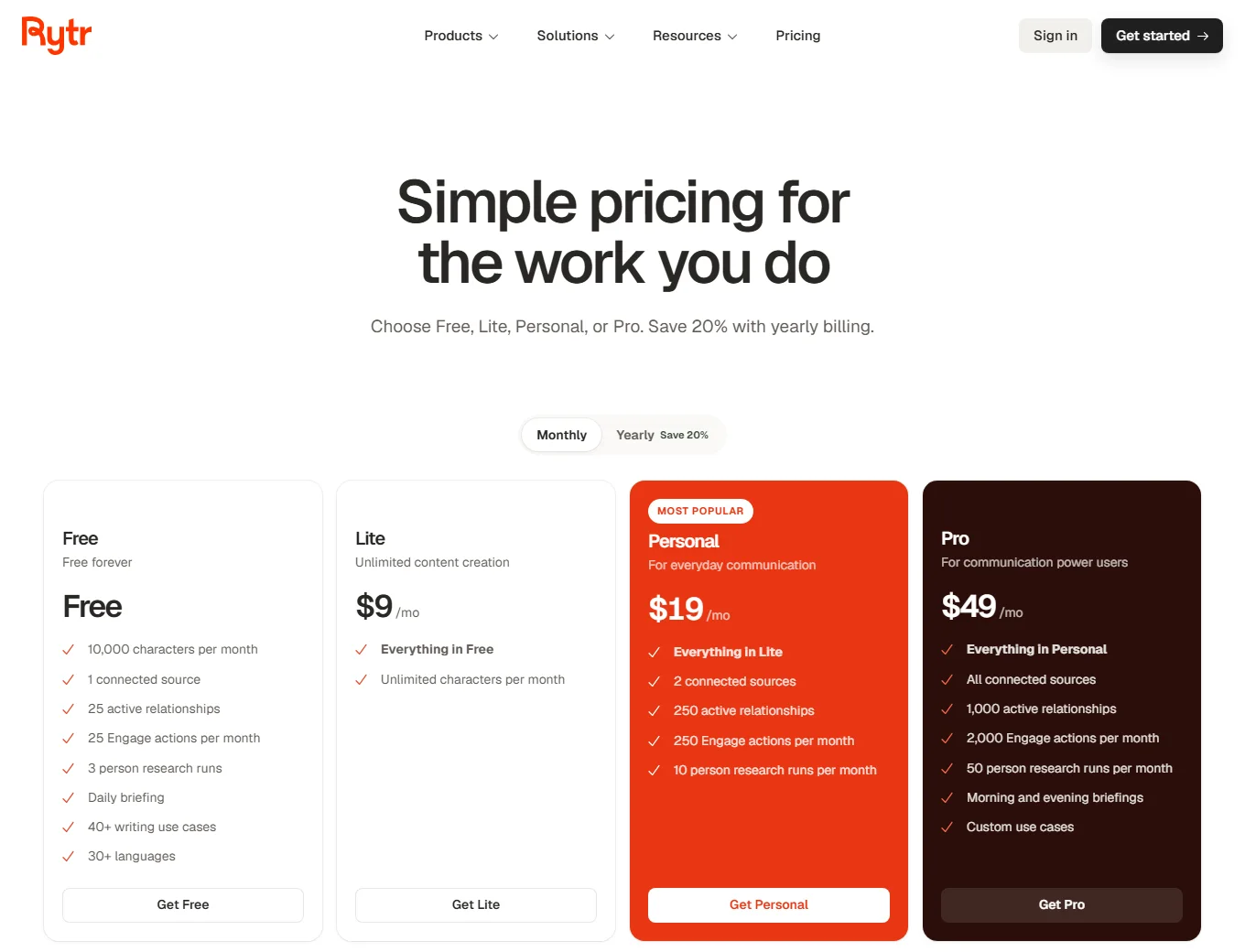
A budget writer to draft and rework text: Rytr has a free plan (10,000 characters a month) and an unlimited plan at $9 a month, read on October 23, 2026.
Some links here are affiliate links (Rytr, Wisewand): we earn a commission if you subscribe, at no extra cost to you. All prices were read on the vendors’ pages on October 23, 2026 and may change.
In this article
- What an AI paraphraser does
- How to paraphrase text with AI: the method
- The prompt that works
- A before and after example
- Free AI paraphrasers compared
- Paraphrasing for free, without AI, or “anti-AI”
- Making AI text sound human
- Paraphrasing for SEO and duplicate content
- Does paraphrasing avoid plagiarism?
- Mistakes to avoid
- FAQ
What an AI paraphraser does
To paraphrase, or reword, is to rewrite a text while keeping its meaning but changing the words and the structure. People do it for four main reasons: to avoid plagiarism by restating an idea in their own words, to clarify a confusing passage, to change tone (simpler, more formal) and to shorten. AI is good at this because it manipulates language quickly.
Three nearby tasks get confused. Paraphrasing changes the wording while keeping the meaning. Summarizing keeps the essentials in fewer words. Humanizing makes AI-written text feel more natural so it reads, and sometimes scores, as human-written. Paraphrasing is the basic gesture, and humanizing is a more demanding special case.
How to paraphrase text with AI: the method
There are two approaches, depending on how much control you want:
- The one-click paraphraser (QuillBot, Wordtune, ZeroGPT, Scribbr): paste, pick a mode such as standard, formal or simple, and get the reworded version. Fast, but you accept the output as it comes.
- An AI assistant with a precise prompt (ChatGPT, Claude, Gemini): longer to set up, but you control tone, length, reading level and what must not change. It is the best route for a text that matters.
In both cases, one rule applies: always read the result. A paraphraser changes words but can introduce misreadings and awkward phrasing, or quietly change a number. Automatic rewording is a starting point, not a finished piece.
The prompt that works
A bare “paraphrase this” gives a flat result. Give clear instructions:
Adapt the brackets to your need. For several paragraphs, work one at a time: assistants keep coherence better on short blocks than on a long text pasted in one go. If the first answer sounds stiff, reply with one correction rather than starting over, for instance “keep your version but make the opening sentence shorter and less formal”.
Two additions that help: ask the assistant to “keep all names, numbers and quotations unchanged”, and, if the result will be read by a specific audience, say who it is: “for busy managers” or “for first-year students”. Specifics beat adjectives.
A before and after example
Here is a heavy, repetitive sentence, then its reworded version for clarity:
Before: “It is important to note that the implementation of this solution makes it possible to obtain results that are both faster and more efficient in terms of overall productivity.”
After: “This solution is simple: it makes work faster and more productive.”
What changed: the crutch phrases (“it is important to note that”) went, the sentence was cut, and a direct verb replaced a noun-heavy construction. Good paraphrasing is not a game of synonyms, it is first of all work on clarity. The same principle applies to one sentence or a whole text: shorter, sharper, same meaning.
Free AI paraphrasers compared
Almost every online paraphraser has a free version with a cap on words. The table below sums up what we read on the vendors’ pages on October 23, 2026.
| Tool | Free | Paid (read Oct 23, 2026) | Strength | Limit |
|---|---|---|---|---|
| QuillBot | Yes: paraphrase up to 100 words, 2 modes (Standard and Fluency) | Premium about 10 per month billed annually (9.95 euros on the page shown to us); full paraphrasing, 9 modes, 23 languages | Many modes, custom modes, paraphrases in 23 languages | Free cap is small; advanced modes are paid |
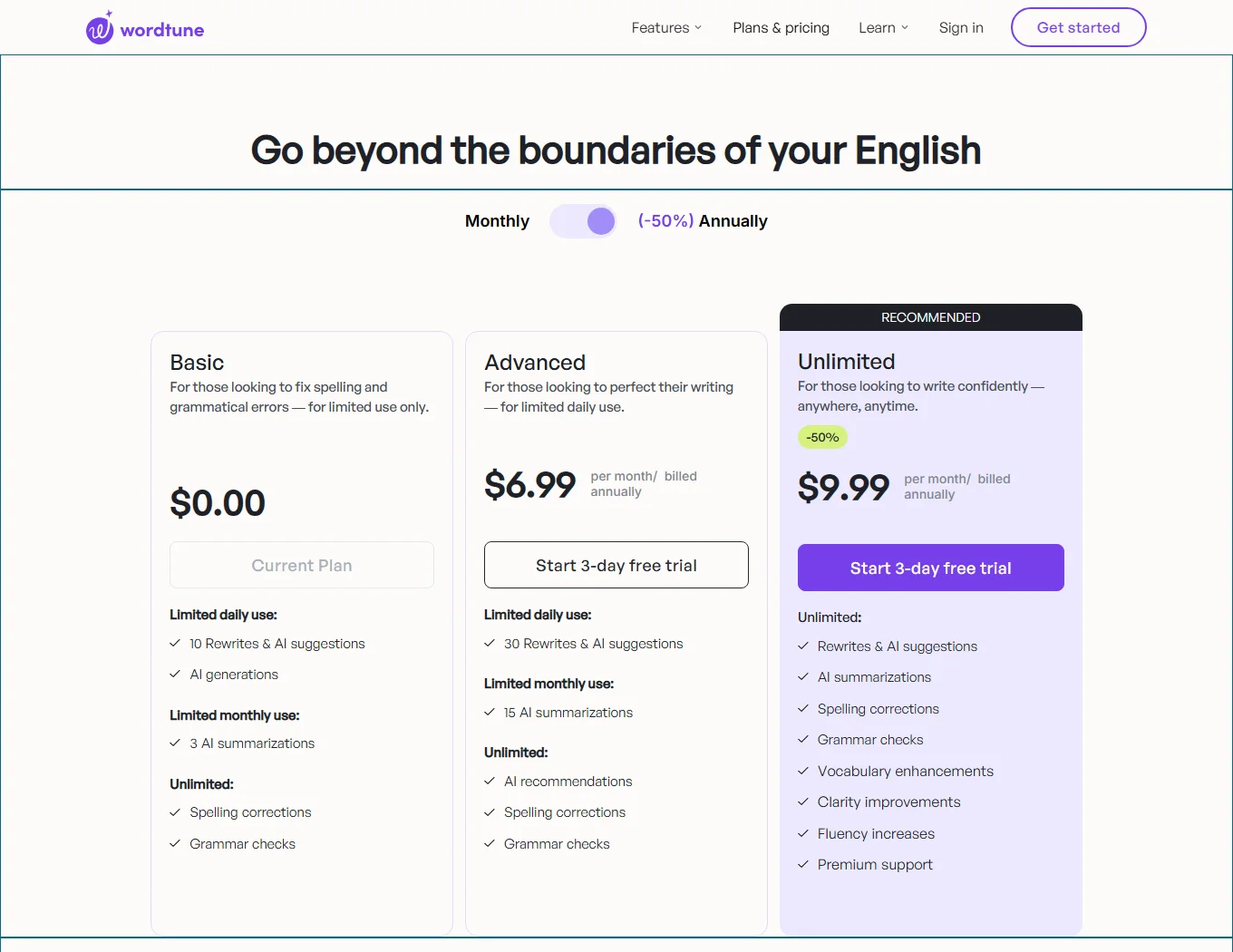
| Wordtune | Yes: 10 rewrites and AI suggestions per day | Advanced $6.99 a month and Unlimited $9.99 a month, both billed annually (as shown on the annual view) | Sentence-level rewrites with tone control | Daily cap on the free and Advanced plans |
| ZeroGPT paraphraser | Yes, free forever | Paid plans exist | Pairs with its AI detector | Output can feel mechanical |
| Scribbr | Yes, free tool | Not itemized here | Built for students and academic writing | Academic focus, limited style range |
| Grammarly | Free plan with 100 AI prompts | Pro (price depends on your country) | Rewrites inside the editor you already use | Paraphrasing is one feature among many |
| Rytr | Free: 10,000 characters a month | Lite $9 a month with unlimited characters | Cheap drafting in 30+ languages, 40+ use cases | A writing assistant, not a dedicated paraphraser; check that a rewrite use case is listed before you subscribe |
Their shared limit: they rework the surface. They change words, they add no real value (example, expertise, point of view), and text that has only been paraphrased is often still recognizable. Useful as a stopgap, not enough for content that has to convince.
If you want a tool that drafts for you rather than just rewording, Rytr has a free plan and an unlimited plan at $9 a month; our Rytr review and Rytr pricing pages go through the plans. For SEO-structured articles in many languages, see our Wisewand review.
Paraphrasing for free, without AI, or “anti-AI”
For free: QuillBot, Wordtune, ZeroGPT, Scribbr and the free plans of general assistants all let you paraphrase at no cost, with no installation. Free plans cap the number of words per pass. For a long text, split it into blocks and run them one at a time.
Without AI: rewording by hand is still the most reliable method. Change the order of the ideas, replace words with synonyms that fit, cut long sentences, and above all add your own analysis. It is slower, but it is the only way to add real value.
“Anti-AI”: many people search for how to paraphrase so that a text is not flagged as AI-generated. That is the territory of humanizing, not simple paraphrasing, and it comes next.
Making AI text sound human
Turning AI text into something that sounds human is a step above paraphrasing. It is not enough to swap words: you have to break the even rhythm of machine writing, remove its stock phrases (“moreover”, “it is important to note”, “in today’s fast-paced world”) and add concrete detail. A standard paraphraser gets you only halfway there.
If your goal is to pass detectors, first understand what they measure; our comparison of the best AI detectors explains perplexity and burstiness and shows how to cross-check a result. The aim is not to fool a machine but to deliver a text a person wants to read. Three edits do most of the work:
- Vary the rhythm. Mix very short sentences with longer ones.
- Add something only you know: a figure from your own work, a real example, an opinion.
- Cut the filler. Delete throat-clearing openers and closers that add no information.
Instead of reworking text after the fact, draft natural, SEO-structured content from the first pass.
Paraphrasing for SEO: beware of duplicate content
It is tempting to publish fast by taking an existing article, paraphrasing it and posting it. Bad idea. Google targets spun content and content that adds no value, whether it comes from a paraphraser or from raw AI output. A surface rewrite does not create originality, it recycles. For SEO, paraphrasing only makes sense if you add something: data, an example, an angle. We draw the line in our guide to AI SEO writing without a Google penalty, and the step-by-step workflow is in how to write an SEO article with AI.
Does paraphrasing avoid plagiarism?
Only partly. Paraphrasing changes the words, but presenting someone else’s idea without crediting them is still plagiarism. Plagiarism checkers also catch paraphrases that stay too close to the source structure. The good practice is to paraphrase and cite, adding your own analysis. In school and academic settings, follow your institution’s citation style and its policy on AI tools, since many ask you to disclose when you used one.
Mistakes to avoid
- Publishing a paraphrase unread. Misreadings and clumsy phrasing are common.
- Believing a rewording makes the text yours. A borrowed idea still needs a citation.
- Chaining several tools to “scramble” the text. The result becomes unreadable.
- Paraphrasing without adding anything. A reworded text with no new value stays hollow, and is useless for SEO.
- Confusing paraphrasing with humanizing. To pass a detector, a simple paraphrase is rarely enough.
- Letting numbers drift. Re-check every figure, date and name after the rewrite.
FAQ
How do I paraphrase a text for free with AI?
Three free routes: use a paraphrasing prompt in an AI assistant such as ChatGPT or Claude, use an online paraphraser (QuillBot, Wordtune, ZeroGPT, Scribbr) within its word cap, or rework the text by hand. Free tools cap words per pass, and doing it by hand remains the most reliable way to get a quality result.
Can ChatGPT paraphrase text?
Yes, and it is often the most flexible option. With a precise prompt (keep the meaning, change the words, set the tone and length) it paraphrases better than most one-click tools. Work on short blocks to keep coherence.
What is the best free AI paraphraser?
QuillBot has the most modes, but its free plan paraphrases only up to 100 words in two modes. Wordtune allows 10 rewrites a day. ZeroGPT and Scribbr are free tools too. None adds new value, so for a text that matters, an assistant with a precise prompt usually does better.
Does paraphrasing prevent plagiarism?
Not by itself. Changing the words does not make an idea yours, and plagiarism checkers can detect paraphrases that follow the source too closely. Paraphrase, cite the source and add your own analysis.
Will paraphrased text be flagged as AI?
It can be. A simple paraphrase keeps the regular rhythm that detectors look for. Rewriting in depth, with your own examples and a varied sentence rhythm, changes that. No detector is proof, so cross-check with two tools.
Is paraphrasing a competitor’s article good for SEO?
No. Google targets spun and low-value content. A reworded copy with nothing new added does not rank well and can hurt your site. Paraphrase only to restate ideas in your own words and add data, examples or a new angle.
What is the difference between paraphrasing and summarizing?
Paraphrasing rewrites a text in different words at about the same length and with the same meaning. Summarizing keeps only the essentials in fewer words. Many assistants can do either if you say which one you want.
Stop reworking text after the fact. Wisewand generates natural, SEO-structured content from the first draft.