
Grok is xAI’s assistant, best known for live access to posts on X. It is also priced differently from its rivals: its main plan sits at $30 a month, ten dollars above ChatGPT Plus, and the lineup on xAI’s site now runs to five tiers that come bundled with X features. Is the extra money worth it? Here is the comparison, using the vendors’ own US pricing pages as they read on October 23, 2026.
In short: Grok has a free plan and four paid tiers: Plus $8, Premium $30, Super $100, Ultra $200 a month. ChatGPT has Free, Go $8, Plus $20, Pro from $100. Grok’s unique asset is real-time search of the web and of X, plus image and video generation. Premium costs 50% more than ChatGPT Plus, but it also bundles X benefits such as ad-free scrolling on most surfaces. If you follow news and trends on X every week, it can make sense. For general writing and productivity, ChatGPT or another rival does the same work for less.
Prices read on October 23, 2026 on x.ai/pricing and chatgpt.com/pricing (US figures cross-checked on the US App Store listing for ChatGPT). Prices exclude tax. Links to xAI and OpenAI are plain official links. We compare official plans and published features, not model benchmarks.
In this article
- The prices face to face
- Five Grok tiers, and an App Store surprise
- Live access to X, the one real differentiator
- Is Grok still free?
- What the paid tiers include
- Is Grok limited like ChatGPT?
- What are the versions of Grok?
- Why $30 is a hard sell
- Where Grok sits among the assistants
- Who should pick which
- FAQ
The prices face to face
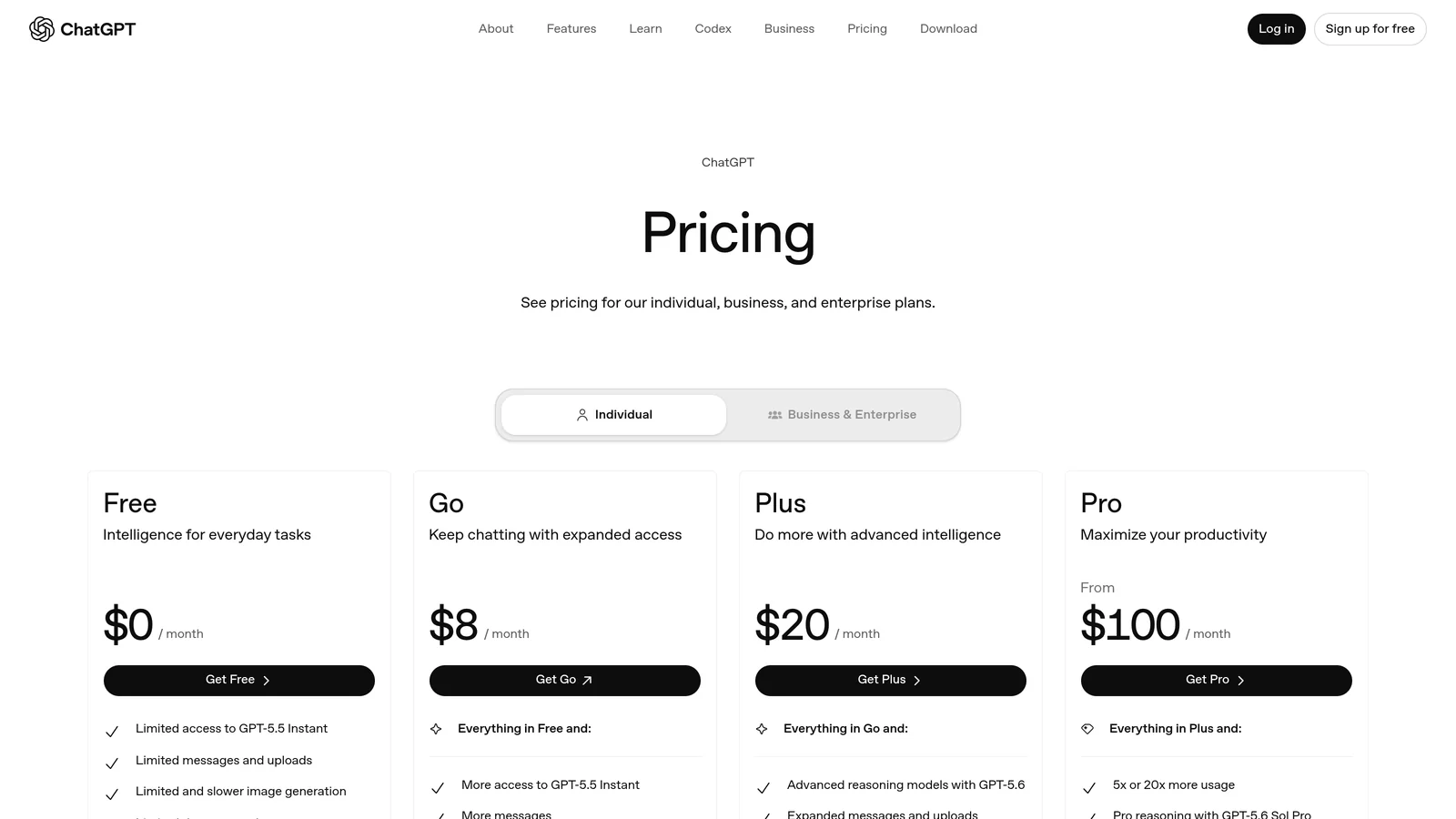
Put the two ladders side by side and a pattern appears: Grok has more steps, and its steps are not all aimed at the same buyer.
| Level | Grok (x.ai) | ChatGPT |
|---|---|---|
| Free | Free, $0 (limited AI usage) | Free, $0 |
| Entry | Plus, $8/month | Go, $8/month (may include ads) |
| Standard | Premium, $30/month (4x Plus usage) | Plus, $20/month |
| Heavy use | Super, $100/month (15x Plus usage) | Pro, from $100/month |
| Maximum | Ultra, $200/month (50x Plus usage) | Pro tier at $200 (and $500 on the US App Store) |
At $30, Grok Premium is 50% more than ChatGPT Plus, which works out to $120 more over a year ($360 against $240). The entry tier is a tie at $8 but the two are not comparable: Grok Plus is mostly an X and shared-usage plan aimed at social creators, while ChatGPT Go is a lighter version of the full assistant.
Five Grok tiers, and an App Store surprise
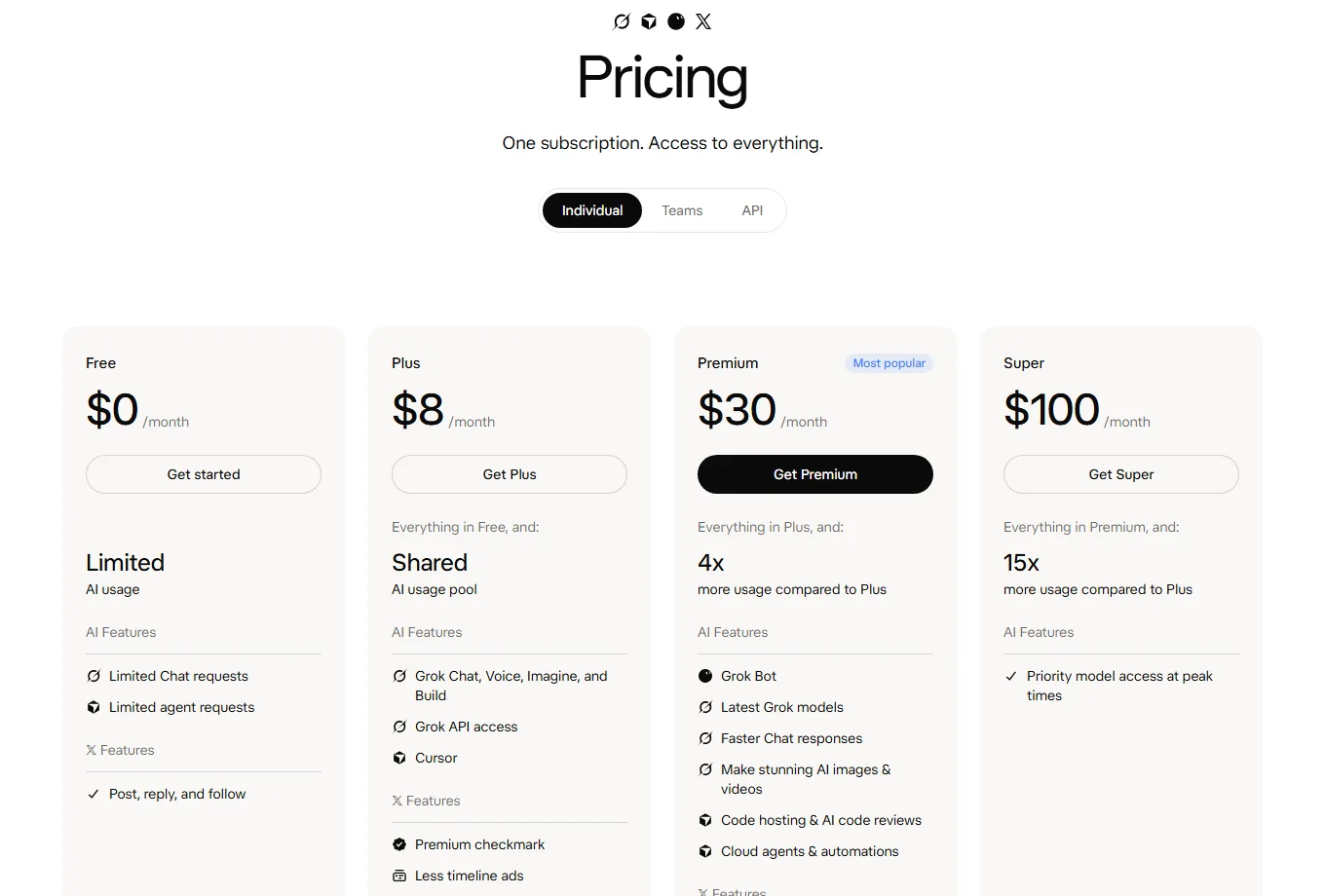
On its own pricing page, xAI now lists Free, Plus, Premium, Super and Ultra for individuals, plus Teams from $30 per user per month and a custom Enterprise tier. The tiers differ mostly by how large a shared pool of AI usage they carry: Plus is the baseline, Premium gives 4x, Super 15x and Ultra 50x. The page says it recommends Premium for new AI users, Super for daily agent users and Ultra for power users, and describes Plus as suited to social creators with limited AI usage.
A mismatch worth knowing about. The iOS App Store listing for Grok that we read the same day still used older names and different prices: SuperGrok Lite $10, SuperGrok $30, SuperGrok Plus $100 and SuperGrok Heavy $300. Those do not line up with the website tiers. If you subscribe, note the exact plan name and price shown at checkout, check whether it is monthly, and confirm what the plan includes before you pay. This is good advice for any subscription whose public grid is moving.
Live access to X, the one real differentiator
Here is what justifies Grok’s existence, and what no competitor offers in the same way: search that covers the open web and X live. Grok’s own page says it searches the web and X so that answers reflect what is happening now rather than last year’s training data, with live citations and follow-up questions.
That is not a gimmick. X remains a place where news, tech, finance and public debate move quickly. An assistant that can query that stream at the moment you ask does something ChatGPT, Claude and Gemini do differently: they search the open web, not a live social network. For a community manager, a news monitor, a trader following chatter or an analyst tracking trends, that is a structural advantage. For someone writing long articles or automating office tasks, it is a feature you will rarely use.
One caveat to keep in mind: accessing X in real time also means reading what is posted there, with the uneven reliability that implies. An answer built from fresh posts does not have the same standing as one built from documented sources. Cross-check before you rely on it, as you should with any answer engine.
Is Grok still free?
Yes. The Free plan is listed at $0 a month on xAI’s pricing page, with limited AI usage, limited chat requests and limited agent requests, along with the basic X features of posting, replying and following. The Grok page also says it is free to try on the web. Free usage will not carry a heavy workload, but it is enough to judge the core idea.
The best test costs nothing: use the free plan for two weeks and note each time you hit a limit, and each time live X search actually changed your answer. If neither happens, the question of paying for Grok answers itself.
What the paid tiers include
Plus, $8 a month
A shared AI usage pool across Grok Chat, Voice, Imagine and Build, Grok API access and access to Cursor, along with X benefits: the premium checkmark, fewer ads in your timeline, enhanced creator tools and advanced analytics. Think of it as an X subscription with a small AI allowance.
Premium, $30 a month
Everything in Plus with 4x more usage, access to the latest Grok models, faster chat responses, image and video generation, the Grok Bot, code hosting and AI code reviews, cloud agents and automations, plus ad-free scrolling on most surfaces, a preferred handle and a higher reply boost on X. This is the tier xAI labels “most popular”.
Super and Ultra, $100 and $200 a month
Super gives 15x the Plus usage and priority model access at peak times. Ultra gives 50x. Both keep the third-party models in Cursor billed separately at API list price. These tiers only make sense for people who run agents or code daily and would otherwise hit their limits.
The Imagine tools are worth a note: xAI says they generate images up to 2K resolution and videos up to 15 seconds from text or reference photos. An assistant that generates video is a real differentiator against the standard tiers of several rivals. Do not mistake it for a replacement for a dedicated video tool in quality or control, though.
Curious about the live X search? You can test the core idea on the free plan before you pay anything.
Is Grok limited like ChatGPT?
Yes, in the sense that no plan is unlimited. xAI explains that every tier includes a pool of AI usage shared across Grok and Cursor, and that within Grok the pool covers Chat, Imagine, Voice and Bot. Higher tiers have larger pools and each product consumes it at a different rate. Your allowance refreshes weekly, so one heavy day does not wipe out the month. If you reach your included usage you can buy top-ups or wait for the refresh.
ChatGPT works similarly but states its limits differently: unlimited text chats on the free plan subject to abuse guardrails, then plan-by-plan caps on messages with uploads, images, voice, deep research and memory. Neither company publishes a message count, so the only way to know is to use it. The API is a separate matter: on Grok, API usage is billed separately at standard model rates and does not draw from your plan pool.
What are the versions of Grok?
Grok’s version numbers move quickly, which is why we avoid building a decision on them. For orientation: xAI’s API page uses grok-4.7 in its code samples, and Perplexity’s plan page lists “Grok 4.7” as xAI’s most advanced model on the day we read it. The consumer plans refer to “the latest Grok models” without a number. Alongside the chat model you will meet the product names Grok Imagine (images and video), Grok Voice, Grok Build (coding) and the Grok Bot. If a number matters to you, check the current model list on the page where you subscribe.
Why $30 is a hard sell
Reason through it calmly. In a market where the standard tier has settled around $20, pricing at $30 means justifying a third more. Three observations.
First, live X search and video generation are genuine differentiators, but they are specialized. They help part of the audience, while a price gap applies to everyone.
Second, the competition built cheaper steps that Grok only partly matches. ChatGPT has Go at $8, Claude has an annual discount that brings Pro to $17 a month, and Mistral’s Vibe Pro is $14.99. Grok’s $8 Plus tier is a social-media-first plan, not a light version of the full assistant.
Third, on writing quality, we know of no independent benchmark that would justify a premium, so be wary of comparisons that claim one without a source. They usually repeat vendor messaging.
The question to ask yourself: do I use X for work at least once a week? If yes, the $10 monthly gap over ChatGPT Plus is quickly recovered, especially since Premium includes X perks you may already pay for separately. If no, you are paying a premium for a feature you will not use, and any rival will do the same general work for less.
Where Grok sits among the assistants
To place Grok, here are the main US plans we read on October 23, 2026. Always check the vendor page, as these move often.
| Assistant | Paid entry | Standard | What sets it apart |
|---|---|---|---|
| Grok | $8 (Plus) | $30 (Premium) | Live search of the web and X, image and video generation |
| ChatGPT | $8 (Go) | $20 (Plus) | Custom GPTs, scheduled tasks, always-on agent on Pro |
| Claude | $17/month billed annually | $20 monthly or $17 annual (Pro) | Long writing, Claude Code and Science in Pro |
| Gemini | $4.99 (AI Plus) | $19.99 (AI Pro) | Bundle with 5 TB storage and Google apps |
| Perplexity | None (Pro is the first paid plan) | $17 a month, annual equivalent (Pro) | Sourced answers and a choice of models |
| Mistral Vibe | None (Pro is the first paid plan) | $14.99 (Pro) | European provider, work and code agent |
Two lessons from the table. First, Grok is the only one whose standard plan clearly exceeds $20, though its $8 tier sits below the rest. Second, the strategies diverge: Google sells a bundle, OpenAI and Anthropic sell the assistant, Perplexity sells an answer engine, and xAI sells an assistant tied to a social network. Comparing them line by line has limited meaning. Start from your real use and from what you already pay for. For the wider map, read the best AI to use in 2026, and for head-to-heads see Claude vs ChatGPT and Gemini vs ChatGPT.
Who should pick which
Pick Grok if
- You monitor X for work: it is the one argument you will not find elsewhere.
- You work on breaking topics where freshness matters more than depth.
- You want image and video generation in the same plan as your assistant.
- You already pay for X Premium: Grok Premium bundles those X benefits with the AI, which changes the maths.
Pick ChatGPT if
- You want a general-purpose assistant with the best feature-to-price ratio.
- You need custom GPTs and scheduled tasks.
- Budget matters: Go at $8 sets a low bar and Plus at $20 is the standard.
Look elsewhere if
- Your main task is long writing: see Claude vs ChatGPT.
- You live in Google apps: see Gemini vs ChatGPT.
- You pay for several assistants at once: an aggregator can cut the bill, see Merlin AI vs ChatGPT.
And for SEO? Real-time X access helps you spot a topic that is rising, not optimize an article. Grok does not read a search results page, score semantic coverage or track your rankings. For that you need a purpose-built tool such as Wisewand. See also our best AI SEO tool guide.
FAQ
How much does Grok cost?
On October 23, 2026, xAI’s pricing page lists Free at $0, Plus at $8 a month, Premium at $30, Super at $100 and Ultra at $200, plus Teams from $30 per user. Prices exclude taxes. The iOS App Store listing we read still showed older SuperGrok names at $10, $30, $100 and $300, so confirm the plan at checkout.
Is Grok free?
Yes. A free plan exists with limited AI usage and limited chat and agent requests. It is enough to test the live web and X search before paying.
Is Grok better than ChatGPT?
No independent benchmark settles it and both change with every update. What is certain: Grok Premium costs $30 against $20 for ChatGPT Plus, and Grok adds live search of X that ChatGPT does not have. Outside that use, the price gap is hard to justify.
Is Grok limited like ChatGPT?
Yes. Every Grok tier has a pool of AI usage shared across Grok and Cursor, refreshed weekly, and you can buy top-ups. ChatGPT also has plan-by-plan caps. Neither publishes an exact message count and neither is unlimited at any price.
What are the versions of Grok?
The version numbers move quickly. xAI’s API examples currently use grok-4.7, and Perplexity lists Grok 4.7 as xAI’s most advanced model. Consumer plans mention the latest Grok models without a number, so check the model list where you subscribe.
Can Grok generate images and videos?
Yes. The Imagine tools generate images from text or reference photos and short videos. xAI says up to 2K resolution and 15-second videos. They are included in paid tiers such as Premium and are a differentiator against several rivals, though not a substitute for a dedicated video tool.
What is comparable to Grok?
ChatGPT, Claude and Gemini are the closest general assistants. Perplexity is the closest in spirit for fresh, sourced answers. None of them searches X live in the same way.
Is Grok worth $30 a month?
It depends on a single criterion: is monitoring X part of your regular work. If yes, live access can pay for the gap. If not, ChatGPT, Claude or Mistral offer an equivalent general experience for $15 to $20.
Want to publish content that ranks? Spotting a rising topic is only the first step. We compare the tools built for optimization, by profile and budget.