Is Quetext free? Yes, there is a Free plan, and it is broader than many people expect: plagiarism checker, AI detector, summarizer, humanizer and even API access are listed. The caps are tight though, with 1,000 words for plagiarism. Here is exactly what Quetext’s free version includes in 2026, what it does not do, when to move to a paid plan, and what to use if you hit the limit.
In short: the Quetext free plan covers plagiarism (1,000 words), AI detection (1,000 words), a summarizer (2,000 words) and a humanizer (500 words). It is enough to test or check a paragraph, not a thesis. The cheapest paid step: $4.49 a month billed yearly for AI detection alone, $5.49 for plagiarism alone.
Prices and limits read on the official pages on October 25, 2026, not tested hands-on. This page contains affiliate links.
Contents
What the free plan includes
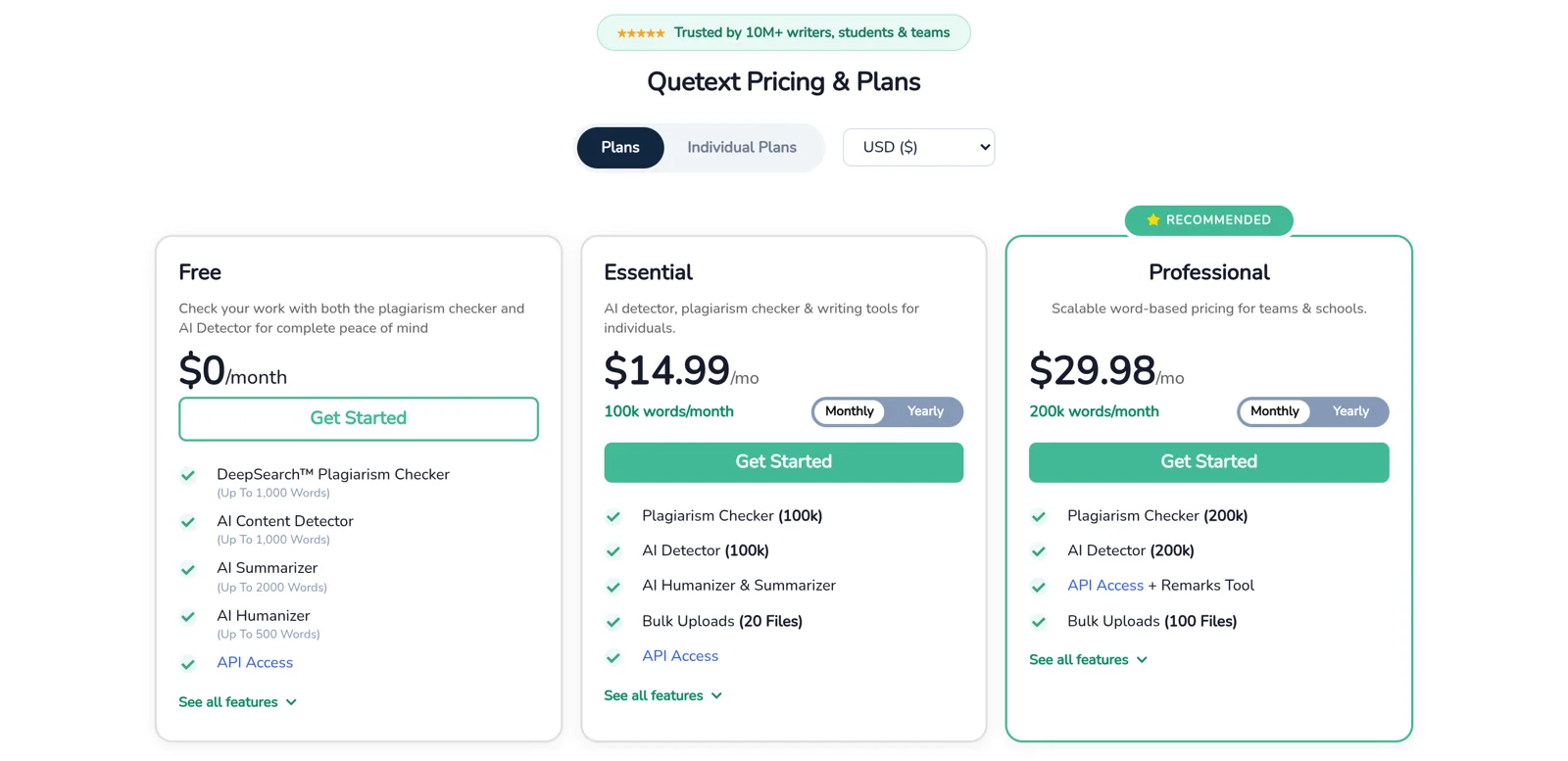
According to the pricing page read on October 25, 2026, the Free plan at $0 a month includes:
- DeepSearch plagiarism checker: up to 1,000 words per check.
- AI content detector: up to 1,000 words.
- AI summarizer: up to 2,000 words.
- AI humanizer: up to 500 words.
- API access, listed on the Free plan.
- A website citation generator and a citation assistant, with no word cap shown.
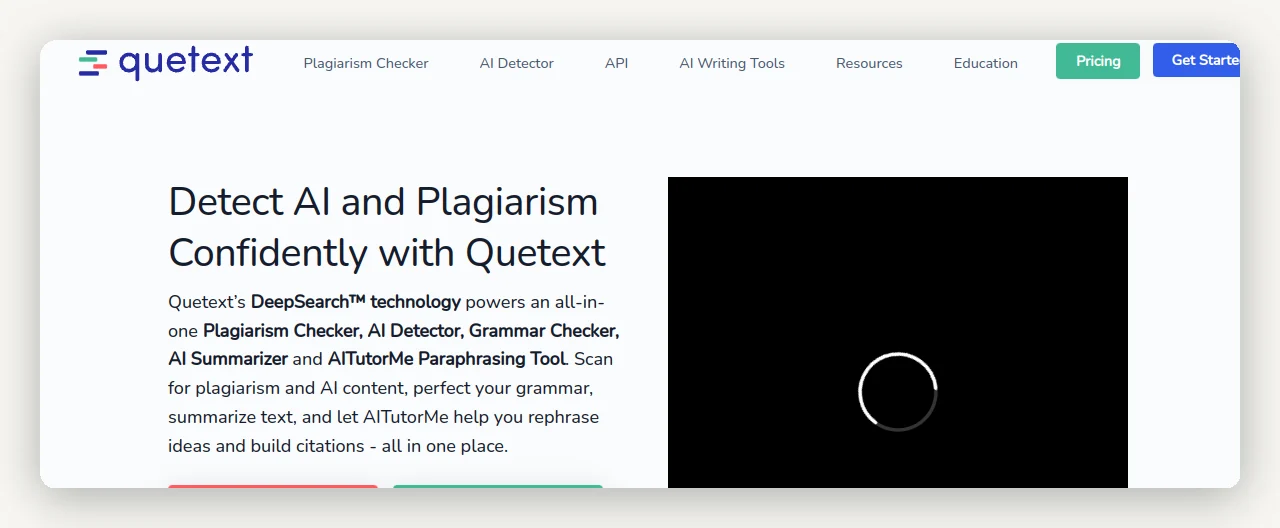
A check returns a similarity score, highlighted passages and the sources found. The vendor says its AI detector works in 25 languages, including French, without publishing precision figures per language. Details in our Quetext review (French).
The limits
- 1,000 words is about two pages: a short assignment or an excerpt, not a thesis.
- No bulk upload: 20 files start on Essential, 100 on Professional.
- The English interface does not prevent checking French or Spanish text.
- Limits move: older comparisons (including ours before an update) quoted 2,000 words for the humanizer, while the page now says 500.
A common limit to every checker: a low plagiarism score does not prove originality. It only says nothing was found in that tool’s database. Cross-check two tools for anything important.
Is it enough for you?
| Use | Does free cover it? | Why |
|---|---|---|
| Check a paragraph or intro | Yes | Under 1,000 words, instant result |
| Try the tool before buying | Yes | Plagiarism and AI both on the Free plan |
| Check a 1,500-word blog post | No | You would need to split it or pay |
| Check a thesis | No | Tens of thousands of words |
| Team checks every week | No | Monthly quotas and bulk files are paid |
Free vs paid plans
| Plan | Monthly | Yearly (per month) | Volume | Includes |
|---|---|---|---|---|
| Free | $0 | $0 | 1,000 words per tool | Plagiarism, AI, summarizer, humanizer, API |
| AI only | $7.99 | $4.49 | 50k words/mo | Line-by-line AI detection, reports |
| Plagiarism only | $9.99 | $5.49 | 50k words/mo | DeepSearch, grammar check, reports |
| Essential | $14.99 | $8.25 | 100k words/mo | Plagiarism + AI + humanizer + summarizer, 20 files |
| Professional | $29.98 | $16.50 | 200k words/mo | Everything in Essential, 100 files, remarks tool |
Our reading: if you only need plagiarism checks, the plagiarism-only plan is the cheapest way past the free cap. Essential makes sense once you want both checks and file uploads. Professional is for teams and schools.
Reading a Quetext report without fooling yourself
The similarity score is one global percentage, but the highlighted passages are what matter. For each one the tool shows the source it found: a web page, an article, a quotation. Three cases come up again and again:
- The proper quotation: you used quotation marks and cited the source. It gets flagged, but it is not plagiarism. Do not rewrite it just to lower the score.
- The stock phrase: a common formula or a standard definition. A short isolated highlight is harmless.
- The reword that stays too close: you swapped words but kept a source’s structure. This is the case worth a real rewrite, with your own examples and your own build.
This last case is where Quetext says its DeepSearch engine shines, because it analyzes context instead of matching identical strings only. That is the vendor’s claim, and we have not measured it.
Three concrete cases on the free plan
- A 300-word essay introduction: paste it whole, get a result in one run, and keep 700 words of margin for a second excerpt. The free plan is perfect here.
- A 1,800-word blog post: it will not fit in one go. You can check the intro and the two most factual sections, which gives a useful but partial signal. For a full check before publishing, a month of subscription or the plagiarism-only plan is more reasonable.
- A sensitive client text: do not paste it into a tool whose privacy policy you have not read, even on a free plan.
Students, teachers, writers: who can live with it?
A student can use it to practice citing: paste a reworded paragraph, see what comes up, fix it before handing in. It will not replace the school’s tool, whose database includes other students’ work, but it helps catch rewordings that stay too close to an online source.
A teacher gets a quick check on a doubtful passage. For regular use on assignments, the institution’s tool remains the reference, and the decision must stay human: a high score calls for a conversation, not an automatic penalty.
A web writer can check an intro or a passage taken from a product sheet, but will need a paid plan to check full articles systematically. That is the profile single-feature plans were made for: $5.49 a month billed yearly for plagiarism only costs less than the full suite.
Five mistakes to avoid with a free checker
- Concluding a text is original because the score is 0%: the tool’s database is limited.
- Rewriting properly referenced quotes to lower the percentage.
- Splitting a text into chunks without context: matches that span sections slip through.
- Mixing up plagiarism and AI: generated text can show 0% plagiarism.
- Penalizing someone on a single score: a detector gives a hint, never proof.
Getting the most out of the free plan
- Check the riskiest excerpt first: passages you reworded from a source.
- Read the highlighted sources before concluding: referenced quotes and stock phrases raise the score without being plagiarism.
- Cross-check with a second tool for a high-stakes decision, such as GPTZero for AI, see our AI detector comparison.
- Do not paste confidential documents without reading the service’s privacy policy.
- Keep your drafts: version history is the best proof of your own work.
If you hit the cap, see our guide to Quetext alternatives for tools with a trial or starter credit.
Want to check a text right now?
Run a free 1,000-word analysis on Quetext.
FAQ
Is Quetext really free?
Yes, there is a Free plan at $0 a month: plagiarism and AI detection up to 1,000 words each, a summarizer up to 2,000 words and a humanizer up to 500 words. Larger volumes need a subscription.
How many words can I check for free on Quetext?
1,000 words per plagiarism check and 1,000 words for AI detection, according to the pricing page of October 25, 2026. Limits can change.
Does the free version detect AI?
Yes, the AI detector is included with a 1,000-word limit. The vendor says it works in 25 languages including French.
What does Quetext cost after the free plan?
From $4.49 a month billed yearly (AI only) or $5.49 (plagiarism only), $8.25 for Essential and $16.50 for Professional. Monthly: $7.99, $9.99, $14.99 and $29.98.
Can I check a whole thesis for free?
No, 1,000 words per check covers an excerpt. For a thesis, plan a one-month subscription, a pay-per-document tool or your school’s tool.