
Between the promise of content published « in one click » and the reality of rankings won on details, picking an AI SEO tool often feels like bad casting. Too many publishers buy an AI like a Swiss Army knife, then act surprised when neither the cut, the precision, nor the cadence shows up. Yet SEO isn’t a single-medal sport: targeting volume, driving conversions, building brand credibility, or industrializing production each demands different trade-offs and different tech stacks.
The terrain has gotten even more complex with the rise of « multi-intent » queries (informational + commercial) and the demand for editorial consistency across topic clusters. A two-person content team can today produce like a studio… provided you pick tools that actually drive SEO, rather than assistants that write « more or less right ». The most suitable AI depends on the result you want.
Why there’s no « one » perfect AI for SEO
The first misunderstanding comes from confusing writing performance with SEO performance. An AI can write cleanly, structure an article, and produce fast, while failing to align with the real intent of a query, the expected depth, and the implicit trust signals. Result: « correct » content that stagnates on page 2, because it doesn’t fit the satisfaction pattern the SERP imposes.
SEO isn’t a monolithic objective. Chasing traffic demands wide semantic coverage and fast execution. Chasing revenue requires a decision architecture and a conversion-oriented narrative. Chasing authority demands thematic consistency, editorial depth, and proofs of expertise. These goals pull in different directions: traffic, revenue, and authority don’t require the same tools.
The common mistake is picking an AI that’s too generalist, appealing for brainstorming and writing, but unable to « stick » to a specific SERP market’s constraints.
What works is a trade-off mindset: which AI best serves the type of result you’re after, with minimum operational friction? In what follows, the approach is deliberately decision-oriented: not « the best AI », but the most suitable one based on the goal.
The major SEO goals in 2026
SEO priorities cluster around four dominant goals. They often coexist, but one of them must drive the tooling choice, otherwise you build a content factory that delivers neither rankings nor conversions.
Generating traffic quickly aims for volume and publishing speed, typically via « how-to » content, definitions, solution pages, or answers to common questions. The game is won by execution: spot opportunities, publish fast, and cover a wide enough lexical field to win entire clusters. What’s your goal: Monetize via affiliate? Build lasting authority? Produce content at scale?
- Traffic: opportunities + speed + semantic coverage.
- Affiliate: commercial intent + decision structure + credibility.
- Authority: depth + consistency + trust signals.
- Scale: process + automation + quality control.
With these goals set, tool choice becomes more rational: each AI is judged on its ability to support a specific performance model.
Which AI to choose to generate SEO traffic quickly?

When the goal is volume, speed, and presence on as many queries as possible, the critical point is SERP alignment. Publishing fast only matters if each page resembles what Google already expects for the query, while bringing extra clarity or completeness.
In this scenario, Wisewand AI stands out with a SERP-driven approach: content is designed around the dominant intent, winning formats, and competing angles. Concretely, on a query like « best ergonomic chair for remote work », the tool must understand that the SERP expects a comparison, decision criteria, and a reading grid, not a narrative article. The effect is immediate: less rewriting and more « on-target » publications.
Otomatic brings another dimension: operational industrialization. For a WordPress site, the stakes aren’t just writing, but publishing, tagging, internal linking, and maintaining a rhythm. You can go from 5 to 25 articles/week; WordPress automation cuts the time lost on repetitive tasks. « Fast » SEO often plays out on these cadence details.
Three key points make the difference on this goal:
| SEO goal | Recommended AI | Why (decisive criterion) | Site type |
|---|---|---|---|
| Fast traffic | Wisewand AI | SERP-driven writing with mastered intent. | Media, niche blog, content site |
| Traffic + cadence | Otomatic | WordPress automation and at-scale publishing. | Multi-category WordPress sites |
| Affiliate | Frase | SEO briefs and semantic optimization for commercial intent. | Review sites, buying guides, comparison sites |
| Affiliate (comparisons) | Wisewand AI | Intent / decision-format alignment (top, vs, selection). | « Best of » sites, money pages |
| Authority | Skoatch | Content strategy and marketing consistency across editorial series. | Brand, B2B, expert hub |
| Authority (long content) | Plumy AI | Structured, consistent generation, suited for pillar pages. | Technical guides, documentation |
| Daily support | Merlin AI | Cross-cutting assistant: research, ideation, synthesis, productivity. | All types (complementary) |
If the priority is « occupying the field » with consistent, fast content, the winning axis combines a SERP-oriented AI and an automation layer. The guiding idea: speed doesn’t make up for bad alignment, but it amplifies good targeting.
Once traffic kicks in, the next question becomes natural: how do you turn those visits into revenue, without sacrificing editorial quality?
Which AI to choose for an affiliate SEO site?
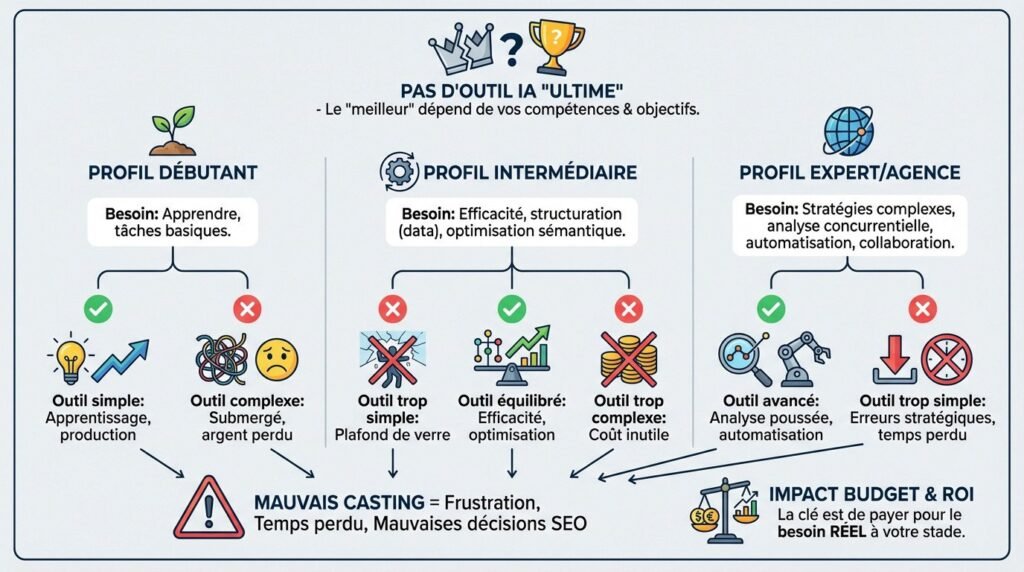
Affiliate is a tightrope walk. Content must be informative enough to inspire trust, yet decision-oriented enough to push the click. The pages that perform aren’t necessarily the longest, they’re the most « useful » at the moment of choice.
Frase is particularly suited when the priority is the SEO brief and semantic optimization. On a transactional query, the tool helps you not forget the criteria the SERP makes unavoidable: price, warranties, compatibilities, alternatives, limitations. This discipline reduces hollow content that just lines up paragraphs without addressing real objections.
Wisewand AI takes over on intent alignment for typical affiliate formats: comparisons, « top » lists, selection pages. The content must follow a decision logic: use context, criteria, recommendation, then justification. In an internal Atelier North test, two articles targeting the same query were published: the one structured around a decision grid (rather than a product description) achieved a higher click-out rate at comparable traffic.
Otomatic becomes useful as soon as you need to industrialize: page variations for related niches, regular price updates, mass publishing of supporting content (FAQ, maintenance guides, accessories). Affiliate rarely wins on a single « money keyword », it wins on a portfolio of well-orchestrated pages.
Pick the AI SEO tool that fits your goal
Fast traffic, affiliate, or production at scale: each SEO strategy demands a different tool. Jump directly to the most suitable solutions for your use case.
The key points here don’t forgive:
Transactional intent: the page must answer « what to buy » and « why », not just « what is it ». Decision-oriented structure: criteria, comparison, recommendation by profile. SEO discourse mastery: avoid vague phrases, justify choices, and stay consistent with SERP expectations.
- « Top » pages: win with a clear selection grid + use-case scenarios.
- Comparisons: win with stable criteria + verdict per profile.
- Buying guides: win with addressed objections (durability, support, budget).
Final insight: in affiliate, the best optimization is often better decision support. A useful AI is one that structures that decision without diluting credibility.
Which AI to choose to build SEO authority?
Building authority isn’t about publishing a lot, it’s about publishing « right », consistently, over time. The sites that become references look more like books than feeds.
In this context, Frase is an asset for competitive analysis and semantic depth. The tool helps map what competitors actually cover (not just keywords), and identify the editorial « gaps »: procedures, standards, precautions, common mistakes, edge cases. On a topic like « calibrating a band saw », the difference between an average article and an authority article comes down to precision, steps, and variants by equipment.
Discover Frase.io →Skoatch belongs more to a content and marketing strategy logic. When the goal is credibility, you must harmonize tone, define sections, plan series, and think about bridges between content pieces.
Plumy AI is relevant when you need structured, consistent generation, able to hold an editorial line across long, technical content. An AI that can produce stable outlines, spell out prerequisites, and keep terminology constant reduces the « patchwork » effect that undermines credibility. For a pillar page, end-to-end consistency matters as much as exhaustiveness.
Three levers dominate:
Editorial depth: go beyond « what » to address « how », « why », and « when to avoid ». Thematic consistency: series, internal linking, concept continuity. Quality as perceived by Google: clarity, precision, examples, and no visible approximations. Even without name-dropping acronyms, you quickly grasp that credibility shows in the details.
When authority becomes the north star, the tool that « writes fast » loses appeal against the one that « structures better ». The next transition follows: do you need a generalist AI to do everything, or specialized SEO tools to steer?
Generalist AI vs specialized AI SEO: the real choice
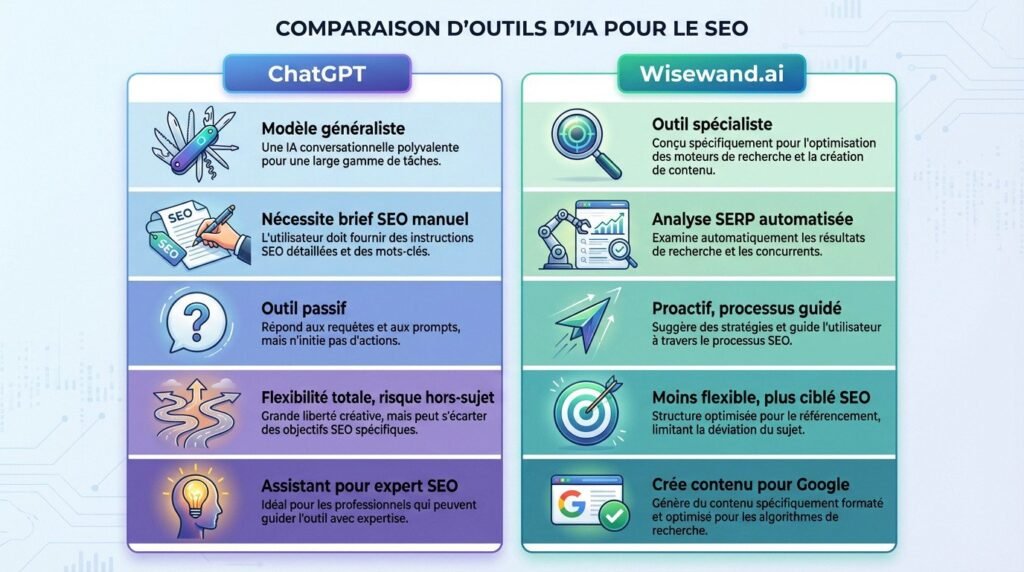
A generalist AI is excellent for speeding up daily work: rephrasing, summarizing, suggesting angles, prepping emails, helping explore an idea. In an SEO team, it’s the equivalent of a versatile assistant, useful at every stage. Merlin AI, for instance, positions itself as a cross-cutting assistant: ideation, research, rapid information extraction, and productivity support.
But as soon as it’s about producing pages that win rankings, the difference is in the steering. Specialized tools « understand » more about SERP mechanics, intent hierarchy, how to integrate coherent semantic coverage, and sometimes publishing automation. A generalist tool can help you write a good text, but it doesn’t guarantee content calibrated for a given query.
An operational rule helps decide: generalist AIs assist; AI SEO tools pilot. Atelier North kept a generalist AI for brainstorming angles and improving clarity, but moved SEO production onto tools focused on analysis and structure. This split reduced internal confusion: everyone knows which tool serves which result.
Final insight: the right choice doesn’t pit « generalist » against « specialized », it orders them in a workflow where one accelerates and the other secures performance.
Summary table: which AI based on your SEO goal?
To avoid the « catch-all » tool trap, this table proposes a simple arbitration: goal, most suitable AI, operational reason, and typical site type. The idea isn’t to crown a winner, it’s to clarify a usage choice.
| SEO goal | Recommended AI | Why (decisive criterion) | Site type |
|---|---|---|---|
| Fast traffic | Wisewand AI | SERP-driven writing with mastered intent. | Media, niche blog, content site |
| Traffic + cadence | Otomatic | WordPress automation and at-scale publishing. | Multi-category WordPress sites |
| Affiliate | Frase | SEO briefs and semantic optimization for commercial intent. | Review sites, buying guides, comparison sites |
| Affiliate (comparisons) | Wisewand AI | Intent / decision-format alignment (top, vs, selection). | « Best of » sites, money pages |
| Authority | Skoatch | Content strategy and marketing consistency across editorial series. | Brand, B2B, expert hub |
| Authority (long content) | Plumy AI | Structured, consistent generation, suited for pillar pages. | Technical guides, documentation |
| Daily support | Merlin AI | Cross-cutting assistant: research, ideation, synthesis, productivity. | All types (complementary) |
The most useful reading of this table: if the goal is fuzzy, the tool will inevitably disappoint. The next section pushes the logic further: combining several AIs to build a truly effective SEO chain.
Can you combine multiple AIs for an effective SEO strategy?

In practice, high-performing teams rarely run on a single tool. They build an AI SEO stack where each block has a clear role: research, brief, writing, optimization, publishing, updating. Complementarity avoids two extremes: the bloated stack and the single tool that does everything « average ». The goal is a realistic, sustainable, measurable workflow.
Next, a brief-and-SERP-oriented tool defines the structure and topics to cover. Finally, an automation block publishes and orchestrates cadence, with light human checks on « money » pages. The clearest gain wasn’t raw speed, it was the reduction of back-and-forth.
A concrete « 2026 » chain example for an affiliate site:
1) Frase to produce a brief (questions to address, expected terms, structure).
2) Wisewand AI to write a comparison aligned with intent and SERP format.
3) Otomatic to publish, categorize, and queue updates.
4) Merlin AI to speed up micro-tasks (title variations, summaries, support replies, table scripts).
The key is keeping a steering rule: one « conductor » for the strategy (keywords, clusters, priorities) and AIs serving execution. Without governance, combining multiple tools creates noise and inconsistencies.
Final insight: a good stack doesn’t pile up features, it chains responsibilities. This principle naturally sets up the verdict: pick the tool by YOUR goal, not by trend.
Verdict: which AI SEO to choose by YOUR goal?
The choice becomes simple as soon as you clarify the expected result. To grab volume quickly, you need an AI that understands the SERP and an organization that publishes fast. For affiliate, you need an AI that structures decision and respects commercial intent. For authority, you need an AI that supports depth, consistency, and a sustainable editorial strategy.
The key takeaway: performing SEO = tool + method + steering. AI accelerates, structures, and automates, but direction remains a business decision. And it’s that decision that must drive your choice.
FAQ
How to choose between Wisewand AI and Frase?
Choose Wisewand AI if your main need is SERP alignment and intent-driven writing (fast traffic, comparisons). Choose Frase if you want to secure SEO briefs, analyze competitor content, and guarantee solid semantic coverage, especially useful for affiliate and authority content.
What’s the minimal workflow to publish fast without losing quality?
A minimal robust workflow: (1) SERP-based brief and expected questions, (2) writing structured by intent, (3) short review for facts, titles, and internal links, (4) publishing and query tracking. The goal is reducing back-and-forth rather than aiming for perfection on the first draft.
When does Otomatic become essential?
As soon as the friction isn’t writing anymore but execution: formatting, WordPress publishing, categorization, cadence, and updates. When volume exceeds a few pieces per week, automation becomes a competitive advantage more than a comfort.
How to avoid affiliate content that all looks the same?
Work angles by profile (beginner, pro, budget), enforce a stable criteria grid, add concrete use cases, and differentiate verdicts. AI must produce a decision-oriented structure, but differentiation often comes from examples, limits, and contextualized recommendations.
What really makes « authority » in Google’s eyes?
Useful depth (procedures, nuances, mistakes to avoid), thematic consistency (clusters, internal links), and perceived quality (precision, constant terminology, no approximations). An AI like Frase, Skoatch, or Plumy AI helps structure, but authority is mostly won through editorial rigor and continuity.