

Claude and ChatGPT are the two assistants most people end up comparing, and on paper they look almost identical: a free tier, a standard plan around $20 a month, and a power tier that starts at $100. The real differences sit in how the plans are built, which extras are bundled, how each company handles usage limits, and what you actually plan to do all day. Here is the comparison, using the official US pricing pages as they stood on October 23, 2026.
In short: at the standard level the price gap is small. ChatGPT Plus is $20 a month, Claude Pro is $20 a month or $17 a month if you pay $200 up front for the year. ChatGPT adds a cheaper $8 Go tier and a wider toolbox (custom GPTs, scheduled tasks, an always-on agent on Pro). Claude puts its coding and research tools inside the Pro plan and is the one many writers and developers prefer for long, careful work. If you can only pick one: ChatGPT for the widest all-round toolkit, Claude if long writing, documents or code are most of your day. Both have a free tier worth trying first.
Prices checked on October 23, 2026. Some links on this page are affiliate links for other tools we recommend; Claude and ChatGPT links are plain official links. Nothing here is a lab benchmark: we compare official plans, published limits and the way each product is packaged.
In this article
The prices side by side
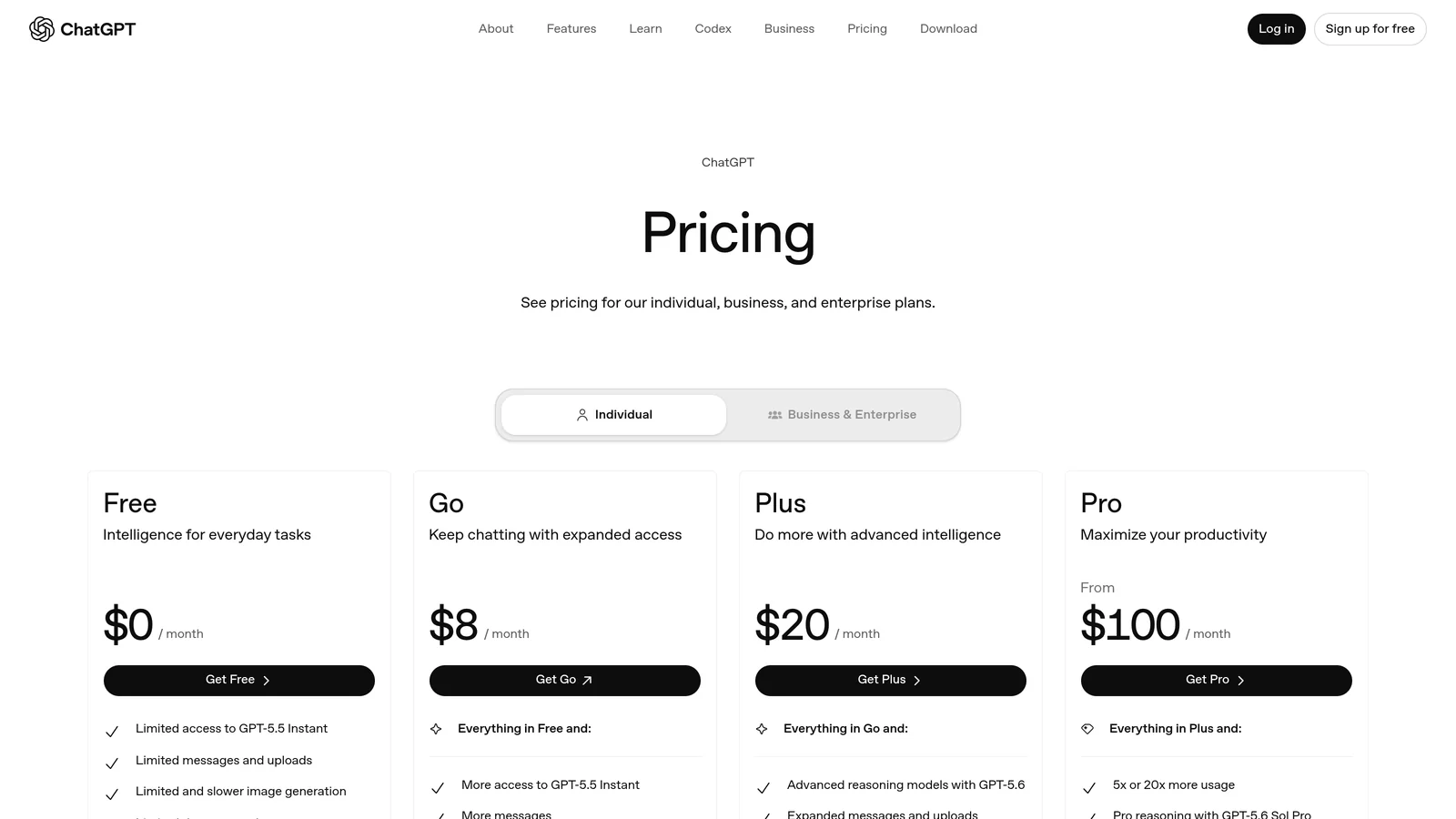
Both companies publish a clear individual ladder. The table below is what their official pages showed on October 23, 2026. OpenAI’s pricing page is rendered per country, so we cross-checked the US figures against OpenAI’s US App Store listing the same day (Go $8.00, Plus $19.99, Pro tiers at $100, $200 and $500).
| Level | ChatGPT | Claude |
|---|---|---|
| Free | Free, $0 | Free, $0 |
| Entry | Go, $8/month (may include ads) | no equivalent |
| Standard | Plus, $20/month | Pro, $17/month billed annually ($200 up front) or $20 billed monthly |
| Heavy use | Pro, from $100/month (three usage tiers, $100, $200 and $500 in the US App Store) | Max, from $100/month (5x or 20x the Pro usage) |
| Teams | Business and Enterprise, priced per user | Team, standard seat $20 billed annually or $25 monthly; premium seat $100 or $125 |
Three things stand out. First, the standard tier is a draw if you pay monthly: $20 each. Second, Claude rewards commitment: paying $200 for the year brings Pro to about $17 a month, roughly $40 cheaper over twelve months than ChatGPT Plus ($240). Third, ChatGPT is the only one with a real entry-level step. Go costs $8, which is $96 a year, and OpenAI says openly that this plan may include ads.
Over a full year, the standard plans work out like this:
- ChatGPT Go: $96 a year at $8 a month.
- Claude Pro, annual: $200 a year, paid at once.
- ChatGPT Plus: $240 a year at $20 a month.
- Claude Pro, monthly: $240 a year, the same as Plus.
- Both heavy tiers: from $1,200 a year at $100 a month.
Free versions compared
Neither company hides its free plan, but they describe it differently, and the difference tells you something. OpenAI lists a series of limits: unlimited text chats with GPT-6 (subject to abuse guardrails), plus limited messages with uploads, limited image creation, limited voice chats, limited deep research, limited memory and context, limited Codex access, and limited access to ChatGPT Work on the desktop app. Its context window on the free tier is 27K tokens, about twelve pages of text according to OpenAI.
Anthropic lists what you get: chat on web, desktop and mobile, web search, file creation and code execution, memory, connections to apps and tools, Artifacts, Claude Design, Slides and Docs, and up to five Projects. The free plan runs on Sonnet and Haiku; Opus and Fable are not included. The usage cap exists, the page calls it the lowest of any plan, but it is not quantified.
Our read: if you ask a few questions a day, both free plans are enough. If you hit a wall in the first week, that is your signal to pay, and it tells you which wall matters. A wall on uploads and images points to ChatGPT. A wall on long documents and code sessions points to Claude.
What each paid plan includes
This is where the two companies diverge. They did not package the same things at the same level.
Claude Pro: coding and research tools inside the plan
The official Pro page lists, on top of at least 5x the free usage per five-hour session: hand-off and scheduled tasks, Claude Dashboards (in beta), Claude Code, Claude Science, Projects, more models (Opus, Sonnet and Haiku, with the top Fable model available through usage credits), and Claude in Chrome and Microsoft 365. The current model line on Anthropic’s API pricing page is Fable 5.1, Opus 5.5, Sonnet 5.5 and Haiku 5.5.
The logic is a suite: one subscription, several working environments. For someone who writes, analyzes and codes in the same day, that is a strong argument.
ChatGPT Plus: the broadest toolbox
Plus adds advanced reasoning models with GPT-6, expanded messages and uploads, more accurate image creation, expanded deep research, expanded memory and context, projects, scheduled tasks and custom GPTs, expanded Codex usage, expanded ChatGPT Work on desktop, web and mobile, and early access to new features. Plus users also get the larger 54K to 256K context windows listed on the pricing table, where Pro stretches to 128K and 400K.
Custom GPTs and scheduled tasks remain the two things Claude does not copy one for one. If you want to configure an assistant once and reuse it, or have something run on a schedule, ChatGPT has the longer head start. The Pro tier goes further with Dot, an always-on agent, longer Codex and ChatGPT Work sessions, and unlimited faster image creation.
Try both free before you pay. The fastest way to decide is to run the same real task, a document you need to rewrite or a piece of code you need to fix, on both free plans and compare the answers.
Writing and long documents
This is the question most readers of this site care about, so let us answer it without pretending a ranking exists. No independent benchmark settles which assistant writes better, and preferences shift with every model release. What we can say from the official material:
- Claude’s free plan lists Artifacts, Docs and Slides creation, and long-document handling is the reason many professional writers use it for first drafts.
- ChatGPT presents itself as the generalist: text, images, voice, research and automation in one place.
- For long texts, the deciding factor is context, the amount of text the assistant can hold in view. Both companies raise context and memory as you move up the plans, so a thesis, a white paper or a book manuscript is a poor fit for the free tier of either one.
A practical test that costs nothing: paste the same 3,000-word draft into both free plans and ask each to tighten it without changing the meaning. Then ask for a different tone. Judge two things, how much of your own voice survives and how many sentences were quietly changed in meaning. That tells you more than any review, including this one.
The most common mistake: neither Claude nor ChatGPT is an SEO writing tool. They produce text, but they do not read a search results page, score semantic coverage or suggest the entities you should mention. If your goal is publishing content that ranks, use a general assistant for drafting and a dedicated tool for optimization. See our guide on whether ChatGPT is still worth using for SEO, and our comparison Wisewand vs ChatGPT for SEO.
Coding and engineering
Searchers often ask about the key differences between Claude and ChatGPT in engineering, and the honest answer starts with packaging. Both companies now sell a coding agent as part of the subscription: Claude Code ships inside Claude Pro, and Codex is part of every ChatGPT plan at a different depth (limited on Free and Go, expanded on Plus, longer sessions on Pro).
- Where you use it: Claude Code is built around working in your terminal and your repository. Codex runs across ChatGPT and its own apps. Check which workflow fits how you already code.
- How you pay for heavy use: both move you to a $100 plan with 5x or 20x usage multipliers. Neither publishes a message count, so plan for a trial month before committing.
- API access: Claude Max includes API credits ($100 a month on Max 5x, $200 on Max 20x) for use on the Claude Platform, a detail that matters if you build things.
Developers tend to split along habits rather than raw capability. Pick the one whose agent fits your editor and your review flow, and keep the other on the free tier as a second opinion. When one model gets stuck on a bug, asking the other is often the fastest fix.
Usage limits, the part nobody quantifies
Neither company sells unlimited use, whatever you pay. Both reason in multipliers instead of message counts. Claude Max lets you choose 5x or 20x the Pro usage per five-hour session. ChatGPT Pro advertises its own larger allowances. Claude also states that the top Fable model is limited to 50% of weekly limits on Max.
The consequence is practical: if you regularly hit the ceiling of your plan, the question is not who is more generous but which one costs less at the next step up. At $100 a month the two are priced identically. Before you upgrade, check whether a cheaper path exists: switching the heavy task to a smaller model, splitting long jobs, or keeping a second assistant for overflow. Our review of Merlin AI vs ChatGPT covers the multi-model route for people paying for two subscriptions.
Why people say they are switching to Claude
You will read that “everyone is switching to Claude”. We cannot verify a mass migration, and no public data we know of proves it. What we can do is list the reasons users give most often, and judge each against the official pages:
- Long, careful writing. Users describe a more natural tone and better handling of lengthy documents. This is a preference, not a measured fact.
- A bundled work suite. Claude Pro includes Claude Code, Claude Science and Claude Design, which is easy to verify on the pricing page.
- A calmer product. Fewer features to learn, which some people like and others find limiting.
- Cheaper annual billing. $17 a month against $20 is real, though you pay $200 at once.
People also move the other way, mostly for the same reason: ChatGPT does more things, and some people want those things. Treat “everyone is switching” as a prompt to test, not as evidence.
Privacy and data
Both companies let you opt out of having your content used to train models, but the controls live in settings, so check them when you create the account. OpenAI’s pricing table shows an opt-out on every plan. Both sides also sell team and business plans for work involving client material. If you paste client documents, contracts or unpublished work, read the current data policy of the plan you pay for and keep sensitive material out of any free account.
Which one to pick
Pick ChatGPT if
- You want one tool for everything: text, images, voice, research and automations.
- You like building reusable assistants (custom GPTs) or running scheduled tasks.
- Your budget is tight: the $8 Go plan has no equivalent at Anthropic.
- You work with colleagues who already use it and want to share setups.
Pick Claude if
- Your main work is long writing, editing and reading documents.
- You code and want an agent bundled with the subscription.
- You are happy to pay $200 once and bring the monthly cost down to about $17.
- You prefer a focused work environment to a large catalog of extras.
Pay for neither if
- You ask a handful of questions per week. The free plans are enough.
- You already pay for two or three assistants. An aggregator or a single plan will cut the bill.
- Your goal is search-optimized content. Then a dedicated tool such as Wisewand matters more than the choice of chatbot.
Is there an AI better than Claude?
Not in general, and the same goes for ChatGPT. The sensible question is “better at what”. Gemini wins when your day lives in Gmail and Docs. Perplexity wins when you need sourced answers. Grok has live access to posts on X. We compare those in separate pages: Gemini vs ChatGPT, Grok vs ChatGPT, and the wider map in the best AI to use in 2026.
One last tip that works with any model: results depend at least as much on how you ask as on what you pay for. A clear task, the audience, the format you want and an example beat a bigger subscription every time.
FAQ
Is Claude better than ChatGPT?
There is no objective answer, and be careful with articles that claim one. The plans are priced alike at the standard and heavy tiers. Claude emphasizes writing and a bundled set of work tools, ChatGPT emphasizes breadth, custom GPTs and automation. The better one is the one that matches your main task, which you can test on the free plans in an afternoon.
How much does Claude cost compared with ChatGPT?
On October 23, 2026: Claude Pro is $17 a month billed annually ($200 up front) or $20 monthly, versus $20 for ChatGPT Plus. ChatGPT also has Go at $8 a month, which Claude does not. The heavy tiers, Claude Max and ChatGPT Pro, both start at $100 a month.
What is Claude mainly used for?
Writing and editing, reading and summarizing long documents, research and coding. The Pro plan bundles Claude Code and Claude Science, so many people use it as a combined writing and development assistant.
Does Claude have a free version?
Yes. The free plan covers chat on web, desktop and mobile, web search, file creation, code execution, memory and up to five Projects, on the Sonnet and Haiku models. Usage is capped at the lowest level of any plan.
Which is better for coding, Claude or ChatGPT?
Both include a coding agent in the subscription, Claude Code on Pro and Codex across ChatGPT plans. The better choice depends on whether you want a terminal-and-repository workflow or the ChatGPT environment. Many developers keep both and switch when one gets stuck.
Are the usage limits the same?
Neither publishes an exact message quota. Both express higher plans as multipliers, 5x or 20x, and neither plan is unlimited at any price.
Why is everyone switching to Claude?
We cannot confirm a large migration. Users who switch usually cite writing quality, long-document handling and the tools bundled in Claude Pro. Others switch the other way for ChatGPT’s wider feature set. Test both on your own tasks.
Can I use Claude and ChatGPT at the same time?
Yes, and many people do, comparing outputs on the same prompt. Two $20 subscriptions add up quickly, so consider keeping one paid plan and the other free.
Want to publish content that ranks? A general assistant writes text but does not analyze a search results page. We compare the tools built for that job, by profile and budget.