While ChatGPT remains a flexible generalist assistant requiring manual steering, Wisewand.ai stands out with native SERP analysis. This specialist approach delivers content aligned with search intent without complex prompt engineering. It’s the ideal solution to industrialize optimized article production and maximize organic search ROI. Produce SERP-driven SEO content with Wisewand.ai
Organic traffic stagnation often stems from AI-assisted writing that’s too generic and disconnected from search engines’ technical requirements. This wisewand vs chatgpt seo comparison pits the two solutions to identify which truly delivers lasting first-page positioning. You’ll see how native SERP data usage beats simple text generation to achieve true semantic optimization.
- SEO specialist vs AI Swiss Army knife: the clash of philosophies
- SERP analysis: the secret ingredient ChatGPT doesn’t have
- From brief to final text: workflow and quality comparison
- In the field: which is more effective for affiliate and e-commerce?
- Verdict: which tool to choose by profile and goals in 2026?
SEO specialist vs AI Swiss Army knife: the clash of philosophies
This is where the fundamental distinction plays out: understanding each tool’s DNA is the key to picking the right battle.
ChatGPT: the universal assistant that needs an SEO pilot
ChatGPT is a generalist language model that can write anything. However, it has no native « awareness » of SEO. It doesn’t know what Google expects for a specific query and doesn’t know what ranks a page today.
To get a usable result, you have to supply all the intelligence: keywords, structure and angle. It’s a passive tool that demands precise instructions; without a finely tuned prompt, it remains blind to the actual SERP requirements.
In short, it’s a formidable assistant for the expert who knows how to steer it, but a risky blank page for a beginner.
Wisewand: the specialist focused on one job, content for Google
On the opposite end, Wisewand positions itself as a specialist tool. Its sole function is to produce articles optimized for organic search. It’s built specifically to satisfy search algorithms, not to chat.
Unlike its rival, it’s proactive. Before writing, it scans the SERP to understand what’s already working. It integrates that technical analysis directly into its process to match search engine expectations.
Its goal isn’t to converse but to create content with a real chance of ranking on Google.
👉 Use Wisewand.ai to industrialize optimized article production
Both approaches in brief
Here are the key differences to visualize the positioning in this wisewand vs chatgpt seo duel:
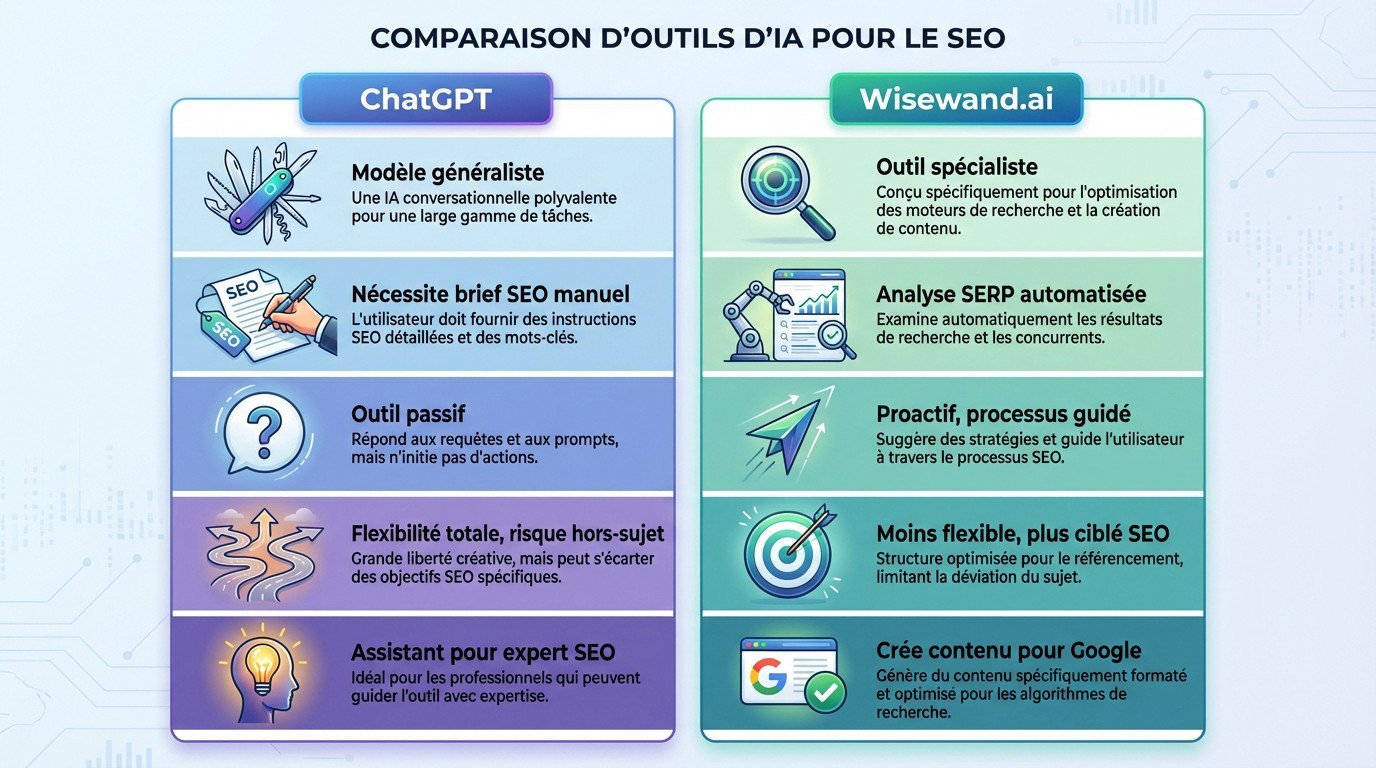
- ChatGPT: Generalist approach, requires a complete manual SEO brief, total flexibility but risk of going off-topic.
- Wisewand.ai: Specialist approach, automated SERP analysis, guided process, less flexible but performance-focused.
The choice depends on your need: are you looking for an all-purpose assistant or a traffic-dedicated production system?
SERP analysis: the secret ingredient ChatGPT doesn’t have
Now that the philosophical difference is clear, let’s look concretely at the feature that makes all the difference on the technical side.
How Wisewand decodes Google’s results page
Wisewand doesn’t guess. The tool automatically scans the top 10 to 20 Google results for your target keyword. It’s a real-time analysis, not an assumption.
It then extracts the exact Hn structure of your direct competitors. The AI also spots key semantic entities and the average length of ranking pages. Finally, it detects dominant search intent, whether informational or commercial.
This 50,000-word context becomes the AI’s « SEO brain » for writing. Nothing is left to chance.
ChatGPT’s blind spot: guessing search intent
Conversely, ChatGPT operates in total isolation, even with GPT-4. It has no real-time technical access to the SERP for your precise query. It relies solely on its training data, which is static.
For a query like « best mountain bike », it doesn’t know whether you want a comparison or a buying guide. Without current context, it generates a generic response. See the risk?
This is the main cause of « off-target » SEO content. It systematically misses the real search intent.
Content creation process comparison
To see the wisewand vs chatgpt seo match more clearly, here’s a direct comparison of the two approaches.
| Criterion | ChatGPT | Wisewand.ai |
|---|---|---|
| SERP analysis | Manual (the user must do it) | Automated and built-in |
| Hn structure definition | Manual (must be supplied in the prompt) | Auto-suggested from the SERP |
| Semantic optimization | Manual (user must list keywords) | Built-in (based on competitor analysis) |
| Intent understanding | Low (based on the prompt) | High (based on ranking pages) |
| Internal linking | None | Auto-suggested |
This table shows the shift of effort. The tool works, not you.
From brief to final text: workflow and quality comparison
SEO « prompt engineering » with ChatGPT: a long-haul effort
Believing a simple « write me an article » is enough is a beginner’s mistake. To get results, you must become a prompt expert able to steer the machine with precision.
Here’s the raw reality of an efficient manual workflow that turns the generalist AI into a competent writer.
- Manually analyze the SERP to grasp the intent.
- Define the detailed, logical Hn outline.
- List primary and secondary keywords.
- Write a complex, multi-step, very detailed prompt.
- Generate text section by section to keep control.
- Proofread and fix repetitions and empty sentences.
In short, it’s a real job that demands technical expertise and a lot of patience.
Wisewand’s guided process: speed and built-in structure
Here, you change paradigm with a smooth step-by-step process. You enter your keyword, and the tool scans the SERP, structures a coherent outline and writes the full article with the vital data baked in.
The time savings are brutal. This research and structuring work, which would take you hours by hand, is wrapped up in minutes flat.
You’re no longer a prompt engineer sweating it out, but an editorial supervisor validating strategy.
Fluency and repetition: the « natural » test
The real issue in the wisewand vs chatgpt seo match often lies in repetition and the robotic style. Without strict guidance, the generalist AI loops in circles.
Wisewand analyzes a massive 50,000-word context from search results. It draws from this semantic reservoir to offer a rich vocabulary, mechanically limiting redundancies for more digestible output.
A human proofread remains essential to refine tone, but the baseline is significantly better.
In the field: which is more effective for affiliate and e-commerce?
Theory is nice, but for specific monetization goals like affiliate or e-commerce, which tool truly delivers the most value?
Wisewand’s affiliate templates: a conversion shortcut
Wisewand offers specialized modes for affiliate content, a major advantage over ChatGPT, which stays a generalist tool. You target conversion, not just text.
You get direct access to templates designed for conversion. Here are the formats that speed up your production:
- Product Review: Structure optimized to present a product and convince.
- 1 vs 1 Comparison: Balanced head-to-head between two products.
- Best X for Y: Creates product lists (« top 5 of… ») that perform well in SEO.
These templates embed copywriting best practices for affiliate, expertise ChatGPT doesn’t natively have.
ChatGPT for transactional content: possible but tedious
You can build an affiliate article with ChatGPT, but it requires crafting an extremely detailed prompt. You have to provide structure and arguments manually.
The result is often less impactful because the AI isn’t trained for sales persuasion. The tone stays too neutral, missing the conversion angle.
E-commerce use case: product descriptions and category pages
For e-commerce, ChatGPT is useful to quickly generate product description drafts, especially at scale via the API. It’s a good starting point.
However, for high-stakes category pages, Wisewand’s SERP-based approach is more relevant. In this wisewand vs chatgpt seo duel, the specialist tool wins.
Wisewand ensures the category text covers the semantic field Google expects, a clear visibility edge.
Verdict: which tool to choose by profile and goals in 2026?
Enough theory. After breaking down the mechanics of both solutions, time to decide concretely based on your situation and growth ambitions.
The pricing-model duel: credits vs monthly subscription
With ChatGPT Plus, you pay a fixed monthly subscription. It’s the « all-you-can-eat » formula: ideal for experimenting, iterating without counting, and handling varied tasks without worrying about the final bill or volume produced.
Conversely, Wisewand runs on a credit system that never expires. Here, you buy a tangible result: an optimized article ready to rank. It’s a mathematical and predictable approach, designed for pure production rather than creative exploration.
When ChatGPT is the right choice (and enough)
If you’re a versatile user juggling emails, LinkedIn posts and brainstorming, stick with OpenAI’s tool. Its conversational flexibility makes it the perfect generalist assistant to unlock creativity or handle daily admin tasks.
It’s also the weapon of the experienced SEO freelancer who already masters SERP technical analysis cold. If you know how to steer prompt engineering to apply your own methodology, it’ll serve as a fast, obedient executor.
Why SEO professionals turn to Wisewand
On the other hand, the site publisher, affiliate or agency looking to scale must change weapons. Wisewand lets you industrialize the production of high-fidelity content without ever sacrificing the semantic relevance Google demands.
Here you aim for immediate ROI. It’s not a text generator but a system integrating SEO strategy to rank fast. To dig deeper, see our complete Wisewand.ai review, which pits it against competitors like Frase.
Ultimately, the choice between ChatGPT and Wisewand depends on your priority: versatility or SEO performance. ChatGPT remains a powerful generalist assistant for those who master prompt engineering. Conversely, Wisewand stands out as the ideal solution to industrialize optimized content production and maximize your Google visibility.
FAQ
Which is the best AI for SEO?
There’s no single answer, it depends on your need. If you’re looking for an all-in-one tool able to analyze the SERP and write ready-to-rank optimized content, Wisewand.ai is often regarded as the best specialized option. If you need an assistant to brainstorm keywords or build outlines manually, ChatGPT remains very strong.
Which AI is better than ChatGPT for web writing?
For purely SEO web writing, Wisewand.ai outperforms ChatGPT because it natively integrates competitor analysis and semantic optimization into its writing process. It avoids ChatGPT’s generic side by structuring content according to Google’s actual expectations for each keyword.
How reliable is ChatGPT for SEO?
ChatGPT’s reliability for SEO is variable. While excellent on syntax, it can « hallucinate » facts or propose structures that don’t match current search intent. Without expert human supervision and very precise prompts, its reliability for ranking an article is lower than a SERP-guided tool.
What’s the best SEO tool to generate content?
The best tool combines data analysis and writing. Wisewand stands out by fusing those two steps: it first analyzes search results (SERP) before generating text. This ensures the produced content is technically aligned with what Google wants to see, unlike a classic text generator.