Key takeaways
Key takeaways:
Choosing an AI tool should not be based on its popularity, but on its strict alignment
with your level of technical expertise. Using generalist assistants when starting out, then
moving to semantic optimization solutions to scale, keeps the budget under control while
significantly increasing SEO performance.
To go further:
write SEO content tailored to your skill level with Wisewand.ai
.
Getting lost in the jungle of software subscriptions is the classic mistake that hurts profitability, making the choice of the right AI SEO tool by level as complex as it is risky for your cash flow. This comparative analysis filters out marketing promises to isolate the solutions that truly fit your level of expertise, from brainstorming on ChatGPT for beginners to advanced semantic workflows for experts. You will gain access to a fact-based decision grid for integrating artificial intelligence that strictly matches your ranking imperatives, avoiding the costly trap of unused features.
- Why choosing an AI tool depends on your SEO level
- AI tools to get started with SEO: simplicity and ease of use
- Stepping up: tools for intermediate SEOs
- The expert SEO and agency arsenal: performance and workflow
- Comparison table: which AI tool for which SEO profile
- ChatGPT, Claude, Gemini: how generalist LLMs actually serve SEO
- Risks and pitfalls to avoid with AI in SEO
- How to effectively integrate AI into your SEO process
Why choosing an AI tool depends on your SEO level
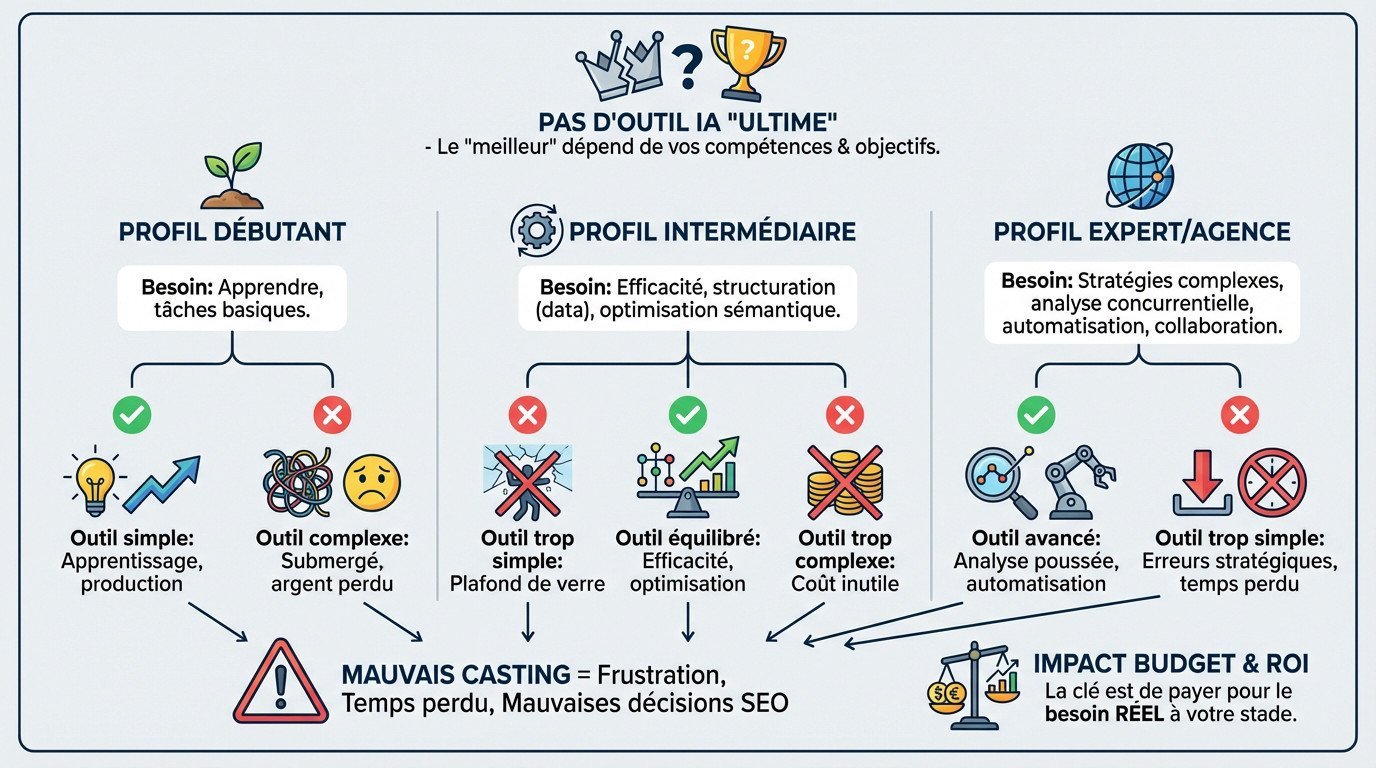
The myth of the « ultimate » AI tool that doesn’t exist
Let’s stop believing in the miracle software. A generalist assistant like ChatGPT does not provide the same services as a specialized suite like Scribe or Semrush. The « best » software is just a marketing illusion; reality strictly depends on your current skills and your growth objectives.
Articles that sell you a universal solution as a « game-changer » often lie by omission. The real challenge is not to pick the most expensive option, but to find the solution that matches your specific context to avoid waste.
In short, this guide will not give you an arbitrary ranking. It offers a pragmatic framework to choose wisely.
The risks of bad casting: too simple or too complex
Imagine a beginner facing a technical behemoth. They end up drowning in incomprehensible metrics, victims of analysis paralysis, while their expensive subscription runs idle. That’s literally money thrown out the window every month.
Conversely, give an overly simplistic tool to an expert, and they will hit an immediate glass ceiling. Without analytical depth or real-time SERP data, it becomes impossible to build complex strategies or compete on competitive queries.
In both cases, the verdict is final: frustration, loss of precious time and poor SEO decisions. Bad software casting is the surest way to kill your profitability.
Defining your profile: beginner, intermediate, expert
The beginner profile is just discovering the mechanics of search engine optimization. They need help with brainstorming or simple rewriting via generalist AIs. Their goal is to learn the basics and produce their first content pieces without drowning in technicalities.
The intermediate profile has mastered the fundamentals. They are looking for efficiency and want to structure their texts with data to climb in the results. This is where the question arises: which AI tool for SEO to choose by level to optimize semantically?
Finally, the expert/agency profile drives large-scale strategies. They demand tools for advanced competitive analysis, team collaboration and complex workflow automation to maintain a high-quality industrial production.
The impact on budget and return on investment
Paying a high price does not guarantee performance at all. If you only use 10% of the features of a premium suite because it is too advanced for you, your ROI is negative.
However, penny-pinching with a free tool can cost you even more in missed opportunities. You risk making invisible strategic mistakes or spending hours fixing what a proper tool would have handled in a minute.
Real profitability comes down to paying only for what you actually need at your current stage of development.
AI tools to get started with SEO: simplicity and ease of use
Now that the scene is set, let’s see concretely where to start. Selecting an AI SEO tool by technical level is the only way to avoid drowning in useless or overly complex options.
ChatGPT: the Swiss Army knife for basic tasks

Think of ChatGPT as the ideal entry point for any newcomer. It is perfect for brainstorming, unlocking inspiration, generating lists of relevant questions (PAA), finding original article angles or building basic outlines.
Its strength also lies in its ability to rewrite heavy paragraphs, simplify technical language for a general audience or quickly generate metadata (titles, descriptions).
However, see it as a tireless versatile assistant, rather than a true specialized SEO tool capable of complex strategy.
Perplexity AI: the AI-powered search engine
If you want reliability, Perplexity AI positions itself as an excellent research tool for beginners. Its major strength is undeniable: it cites its sources for every piece of information provided.
It is the dream tool to fact-check, dig up recent statistics or quickly understand a topic based on up-to-date web data, where a standard ChatGPT often stays stuck in the past.
In short, it is a massive time saver to secure your initial research phase.
The limits to know so you don’t shoot yourself in the foot
Beware, these generalist tools have no real-time SEO data. They know nothing about current search volumes, real keyword difficulty or the specific search intent hidden behind a query.
Moreover, they are unable to perform fine semantic analysis or compare your draft to those of competitors already ranking on the SERP. It is literally a blind approach.
Using them to write an article from A to Z without any human supervision is the best way to produce content that will never rank.
Concrete use cases for a beginner
To benefit from these technologies without risking penalties, here are example prompts to use these tools properly at the start of your journey.
- « Generate 10 article title ideas on [topic] for a beginner audience. »
- « Act as an SEO expert and suggest 5 questions people ask before buying [product]. »
- « Find 3 recent, sourced statistics about [theme] with Perplexity. »
- « Rewrite this paragraph to make it simpler to understand: [paste paragraph]. »
- « Create a meta description under 155 characters for an article titled [title]. »
Stepping up: tools for intermediate SEOs
You have mastered the basics and generalist assistants are showing their limits. It is time to move to tools that truly speak the language of SEO and structure your production.

NeuronWriter: the right compromise to start semantic optimization
NeuronWriter stands out as the ideal gateway to serious semantic optimization. The tool scans the SERP to dictate the exact terms and entities to include. It turns your intuitions into a content strategy validated by current data.
It is the ultimate weapon for tight budgets that refuse to sacrifice performance. It generates content briefs modeled on your competitors and assigns a critical optimization score to benchmark yourself against rivals.
Its interface can sometimes feel less intuitive for collaborative work in large teams. Still, for a freelancer or solo publisher, efficiency is formidable.
SurferSEO: the benchmark for competitive analysis (especially in English)
SurferSEO remains the heavyweight of the sector, a robust solution praised by experts. Its firepower lies in the depth of its competitive analysis and its famous « Content Score ». It has become an industry standard for measuring the technical quality of a page.
It does not stop at keywords: it dictates the full structure of the article. Word count, heading density, image volume: everything is calibrated against the standards of the pages already ranking in the top spots.
Be careful though, its effectiveness is known to be limited in non-English markets. Semantic recommendations there are sometimes less relevant than its surgical performance on English content, which can frustrate non-English users.
From « gut-feeling » writing to « data-driven » writing
Forget the inspiration of the moment. The paradigm shift is brutal: you no longer write about what you think is relevant, but about what Google and users actually expect.
These tools force you to cover a topic in its entirety, with no blind spots. You must answer implicit questions and use the exact vocabulary. It is the end of improvisation and the beginning of surgical precision to satisfy the algorithm.
At this precise stage, SEO leaves the realm of craftsmanship to become a more scientific, measurable and decidedly less artistic discipline.
When should you invest in these tools?
The warning signal is simple. You publish regularly, your texts are « well written », but traffic is desperately stagnant. This is proof that you are missing that layer of technical optimization that makes the difference between page 2 and the top 3.
The investment is also justified by the phenomenal time savings on brief creation. Whether for yourself or to guide external writers, the structure is served on a silver platter.
To go further in automation, it can be wise to compare solutions like Wisewand vs Frase in order to structure your content with even more finesse and profitability.
The expert SEO and agency arsenal: performance and workflow
For those who aim for nothing less than first place and who manage large volumes, intermediate tools are no longer enough. Welcome to the big leagues.
Scribe: the integrated platform for the non-English market
Choosing an AI SEO tool by level of expertise is a game changer. Scribe stands out as the integrated reference platform. It is not just software, it is a complete ecosystem built for pure performance.
Its power lies in its advanced features: deep semantic optimization through the Vista Score, preventive cannibalization detection and smooth tools for team collaboration.
By connecting with a performance tracking ecosystem, Scribe becomes much more than a writing aid: it is a true global SEO command solution.
Clearscope and Semrush: the international heavyweights
Clearscope remains a premium reference internationally, highly respected by the elite of the trade. However, its language support outside English is often judged inferior to others, which can hold back some projects.
Semrush’s « Content Toolkit » takes a different approach. Its main strength is using Semrush’s massive proprietary data to generate content based on exclusive and concrete SEO insights.
It is the ideal option for teams already embedded in the Semrush ecosystem who require total data consistency, from keyword research to final writing.
Beyond writing: workflow, collaboration and automation
At this level of demand, the challenge goes beyond writing a good article; it is about managing an industrial production process.
- Centralized brief management and writer coordination within the platform.
- Instant document sharing and collaborative validation.
- Surgical detection of duplicate or cannibalized content at site level.
- Technical API integration with other tools in your stack.
- Smart automation of certain recurring audit and reporting tasks.
Advanced automation for technical profiles
For experts, AI makes it possible to go far beyond simple assisted writing. We are talking here about automating heavy technical tasks via custom scripts or tools dedicated to massive optimization.
This is the realm reserved for technical profiles unafraid to get their hands dirty in code to gain efficiency.
By the way, solutions like the Otomatic AI WordPress plugin allow you to automate entire parts of your strategy, freeing up time for high-value analysis.
Comparison table: which AI tool for which SEO profile
The visual summary to choose without mistake
This table is not meant to hand out medals, but acts as a pragmatic orientation guide. The goal is not to define the absolute « best », but to match a precise technical need with the most relevant solution for your workflow.
Don’t look only at the strengths; the « Limits » are often more revealing to avoid a costly mistake. A good choice is made by knowing both sides of the coin. It is the only way to pick an AI SEO tool by level without regretting your investment later.
The AI tools for SEO comparison table
Here is a summary of each solution’s real capabilities, structured to compare what is comparable at a glance.
| Tool | Ideal Profile | Main use case | Main strength | Main limitation | Indicative price |
|---|---|---|---|---|---|
| ChatGPT (free/Plus version) | Beginner | Brainstorming, ideation, rewriting, basic tasks | Versatility, free access, ease of access | No SEO data, risk of generic content, no SERP analysis | Free / Affordable |
| Perplexity AI | Beginner / Intermediate | Information research, fact-checking, source discovery | Cites sources, up-to-date web data | Not a writing or optimization tool | Free / Affordable |
| NeuronWriter | Intermediate | Semantic optimization, brief creation | Excellent value for money, effective in multiple languages | Interface less geared toward collaboration | Affordable |
| SurferSEO | Intermediate / Expert | In-depth competitive analysis, content audit | Analytical power, well-known content score | Weaker on non-English markets, more expensive | Premium |
| Scribe | Expert / Agency | Content strategy steering, team workflow | All-in-one platform, strong for non-English, cannibalization detection | Learning curve, significant budget | Premium |
ChatGPT, Claude, Gemini: how generalist LLMs actually serve SEO
We talked about specialized tools, but let’s come back to generalist AIs like ChatGPT or Claude. Used well, these language models (LLMs) are powerful allies for your SEO, provided you know exactly what to ask of them.
Beyond text generation: analytical assistants
Too many users still think AI is only for raw writing. This is a beginner’s mistake that drastically limits your results and growth. Asking ChatGPT « write me an article about gardening » only produces generic, flat, soulless content.
Your AI SEO tool, by level, should act as a rigorous analyst, not as a simple parrot. Its real strength lies in its ability to sort, classify and synthesize technical or semantic data that you specifically provide.
Think of these models as a direct extension of your own analytical brain. They process raw data, but you keep final strategic control.
Concrete SEO tasks by skill level
For beginners: don’t go after immediate complexity with Python scripts. Use AI to overcome the blank page syndrome, find relevant synonyms or structure your first detailed content outlines.
For intermediates: it’s time to step up on the technical side. Generate error-free JSON-LD structured data for a FAQPage or adapt your existing content to other markets with fine contextual translation.
For experts: automation becomes the watchword here to save time. Import an Ahrefs export to semantically cluster your keywords, analyze the sentiment of thousands of customer reviews or generate complex htaccess rewrite rules in seconds.
ChatGPT vs Claude vs Gemini: which one for which task?
ChatGPT (GPT-4): it remains the undisputed leader for creativity and conversational fluency. It’s the ideal tool for your brainstorming sessions, finding original angles and handling tasks that require some imagination.
Claude (Anthropic): its raw strength lies in its large context window. It’s the perfect choice for analyzing long PDF documents, digesting massive CSV exports or summarizing entire web pages without losing track of the information.
Gemini (Google): its native integration with the Google ecosystem is a major strategic asset. It is potentially very powerful for analyzing data directly from Search Console or cross-referencing complex metrics from Google Analytics.
The critical importance of the prompt and context
Let’s be clear: the quality of the answer depends 90% on the quality of the question (the prompt). A vague prompt will always produce a mediocre result, no matter how theoretically powerful the model is.
A good prompt structures the machine’s thinking to obtain a usable result. Assign it a specific role (« Act as an SEO expert »), provide detailed context, list your instructions and enforce a strict output format.
Without this rigor, you will only get generic content with no added value. It is precisely this mastery of the prompt that separates the amateur from the professional who converts.
Risks and pitfalls to avoid with AI in SEO
AI is a powerful tool, but like any technological lever, used poorly, it can cause considerable damage. Ignoring technical and editorial risks is a sure way to crash.
« Empty » content: when AI speaks to say nothing
You quickly spot these mass-generated texts: flawless syntax, smooth vocabulary, but a desperately flat substance. The tool lines up words without ever bringing real experience or a sharp opinion. It’s clean, but completely devoid of substance.
On the surface, the article seems to address the topic. Yet the user leaves frustrated because their real problem is never solved. AI skims over concepts where an expert would dig deep to provide a real solution.
The verdict is immediate: the reader bounces within seconds. Your bounce rate explodes, and Google ruthlessly penalizes this massive exit.
Over-optimization and loss of authenticity: the « good student syndrome »
Trying to reach a perfect semantic score is a classic trap. Many beginners force the integration of terms suggested by the tools until they get a bright green 100/100. This is often a major strategic mistake.
The text then becomes heavy, robotic and packed with indigestible repetitions. You fall into gross over-optimization, a negative signal that search algorithms now spot very easily.
Worse, your content loses all its flavor. It looks just like that of your ten competitors. Without a unique « voice », it creates no connection with the reader and converts nobody.
Google penalties: myth or reality in 2026?
Let’s be clear on the official position: Google does not hunt AI, it hunts mediocrity. What gets punished is the industrial production of low-quality content at scale, whether written by a robot or a human.
The real danger lies in violating anti-spam rules. Publishing thousands of pages with no added value just to occupy the ground leads directly to deindexing or demotion.
It is therefore possible to do AI SEO writing without Google penalties, provided you do it intelligently and prioritize real usefulness for the reader.
The human in the loop: the only real safeguard
AI must remain a high-performing assistant, never become the pilot. Your human expertise, your field knowledge and your critical thinking are the only elements the machine cannot simulate.
Your role evolves: you are no longer just a writer, but an editor-in-chief. You must validate, correct, enrich and personalize every sentence proposed. This is a real artistic direction job.
Letting AI run on autopilot guarantees failure. Even the best AI SEO tool by level will never replace your final judgment.
How to effectively integrate AI into your SEO process
Knowing which tools to use and being aware of the risks is good. But concretely, how do you organize your work so that AI becomes a real productivity lever without sacrificing quality?
Step 1: strategy and keyword research remain human
Defining content strategy, carefully selecting topical pillars and fine-tuning search intent analysis remain purely human tasks. No algorithm can fully grasp your market’s context or your brand’s DNA. This is architect’s work, not mere execution. You must keep firm control of this foundation.
AI can certainly help clear the ground and find ideas, but the final decision on which keywords to target rests on strategic analysis of your business objectives. Don’t confuse search volume with commercial relevance. It is your judgment that turns raw data into real opportunity.
Never make the mistake of delegating your strategic vision to a machine. That would be long-term commercial suicide.
Step 2: AI to speed up brief and outline creation
This is where automation changes the game. Use specialized tools or LLMs to scan the SERP, extract competitor Hn structures and list the must-have semantic entities. The goal is to shortcut tedious research work. You save precious time gathering factual information.
The aim is to generate a very complete brief draft in a few minutes, work that previously took hours. You get a solid, data-rich base, ready to be exploited immediately. Productivity explodes without loss of substance.
The human then steps in to refine this raw plan, add their unique angle and their own logical structure. AI provides the bricks, but you draw the house’s blueprints to captivate the reader.
Step 3: assisted writing, not delegated writing
You need to fully understand the concept of assisted writing. You can ask the AI to draft a first version of a technical section, find a punchy phrasing, or develop a specific point. The tool acts as a tireless junior assistant who unlocks the blank page syndrome. It proposes, you decide.
But the writer keeps a firm hand on the keyboard, rewrites flat passages, adds personal examples, real anecdotes and sharp opinions. They inject the human element where the machine remains cold and factual. This is the extra soul that builds reader loyalty.
That is the whole point of the Wisewand vs ChatGPT for SEO debate: one structures, the other generates, but the human always pilots the overall vision. Without this active supervision, content remains generic and flavorless.
Step 4: optimization and proofreading, a double validation
Once the text is written, run it through a semantic optimization tool such as NeuronWriter, Surfer or Scribe to check topic coverage. These tools compare your text to Google’s best results to ensure its relevance. This is an indispensable technical step to secure visibility.
This is the « machine » validation, but it must be followed by a « human » validation: is the text pleasant to read? Choosing the right AI SEO tool by level does not exempt you from checking the credibility of the statements. Your expertise remains the final filter.
One does not go without the other. Semantic score does not do it all, readability is queen when it comes to converting visitors.
Selecting the right AI tool requires aligning its features with your SEO maturity. While generalist models are enough for ideation, specialized solutions like Scribe become essential to steer semantic performance. AI remains a powerful lever, but it is your human supervision that guarantees strategic relevance and the final content quality.