
A professor, a client or an editor wants to know whether your text came from ChatGPT, Claude or Gemini. AI detectors exist to estimate that probability. They are not equal: some are free and open to anyone, some are sold only to schools, some bundle plagiarism checks, and none of them is infallible. This page compares ten AI detectors by use case and budget, with plan prices read on the vendors’ own pages on October 23, 2026.
In short: for a free, no-account check, Scribbr (up to 1,200 words per check) and ZeroGPT are the quickest. For a serious free-to-start tool with plagiarism and reports, Winston AI and GPTZero are the usual picks. For publishers and SEO teams who need scale, Originality.ai and Pangram. For schools, Turnitin (sold to institutions, not individuals). No detector is accurate enough to prove anything on its own: always cross-check with a second tool before drawing a conclusion.
Our default starting point: a free trial, then plans from about $10 a month billed annually (prices read October 23, 2026).
Some links on this page are affiliate links (Winston AI, GPTZero, Originality.ai, Quetext, DetectGPT): we earn a commission if you subscribe, at no extra cost to you, and it does not change any figure quoted. The accuracy numbers that vendors advertise are their own; we say so each time. We did not run a lab benchmark for this page.
In this article
- The comparison at a glance
- How an AI detector works
- The 10 best AI detectors in detail
- The best free AI detector
- AI detectors for students and teachers
- Detectors for publishers and SEO teams
- Checking a PDF or a long document
- Are AI detectors accurate?
- Humanizers and bypass tools
- Good habits for a reliable result
- Privacy of the text you paste
- My text is flagged as AI: what now?
- FAQ
The comparison at a glance
| Detector | Free option | Paid plans (read Oct 23, 2026) | Best for |
|---|---|---|---|
| Winston AI | Free trial: 2,000 credits over 14 days | Essential $10/mo annual ($18 monthly), Advanced $16 ($29), Elite $26 ($49) | Detection plus plagiarism and shareable reports |
| GPTZero | Free plan, 10,000 words a month | Premium and Professional, from about 10 to 20 per month billed annually | Teachers, students, a trusted second opinion |
| Originality.ai | 10,000 words one time (100 credits) | Pro $12.95/mo annual ($14.95 monthly), Enterprise $136.58/mo annual | Publishers, agencies, SEO teams |
| Pangram | Free plan with limits | Individual $20/mo (7-day trial), Professional $65, Team $40 for 2 seats | Editors, researchers, high-stakes reviews |
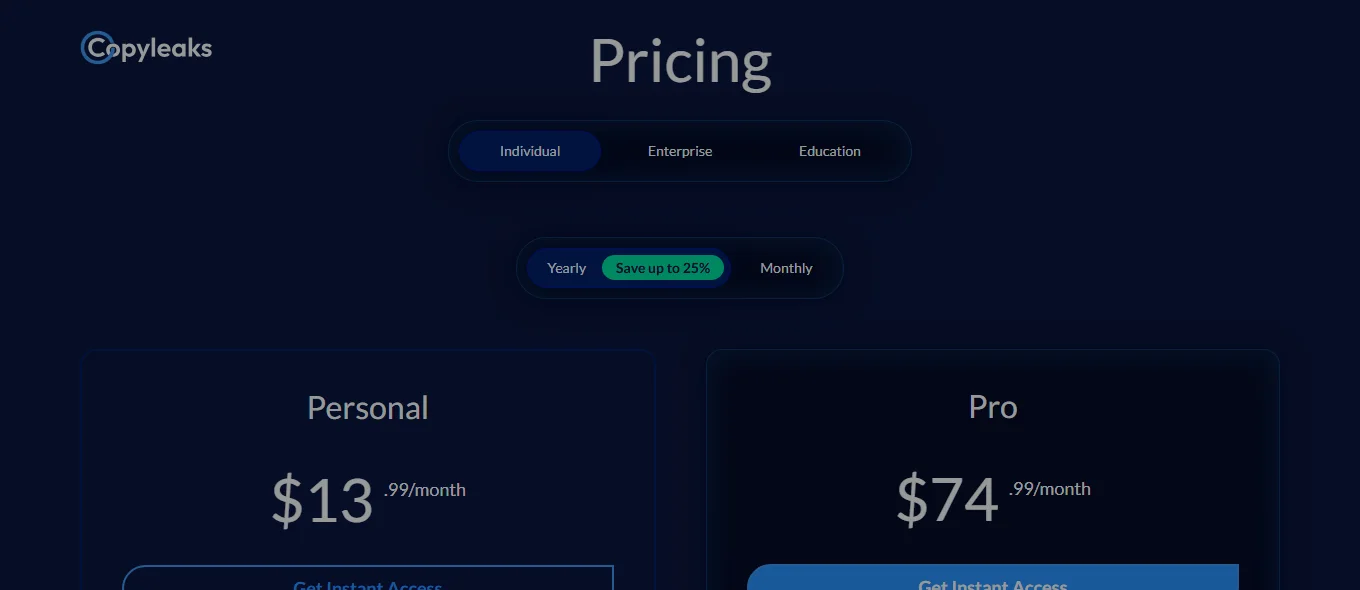
| Copyleaks | Limited free scans | Personal $13.99/mo annual ($16.99 monthly), Pro $74.99/mo annual | AI plus plagiarism for businesses and schools |
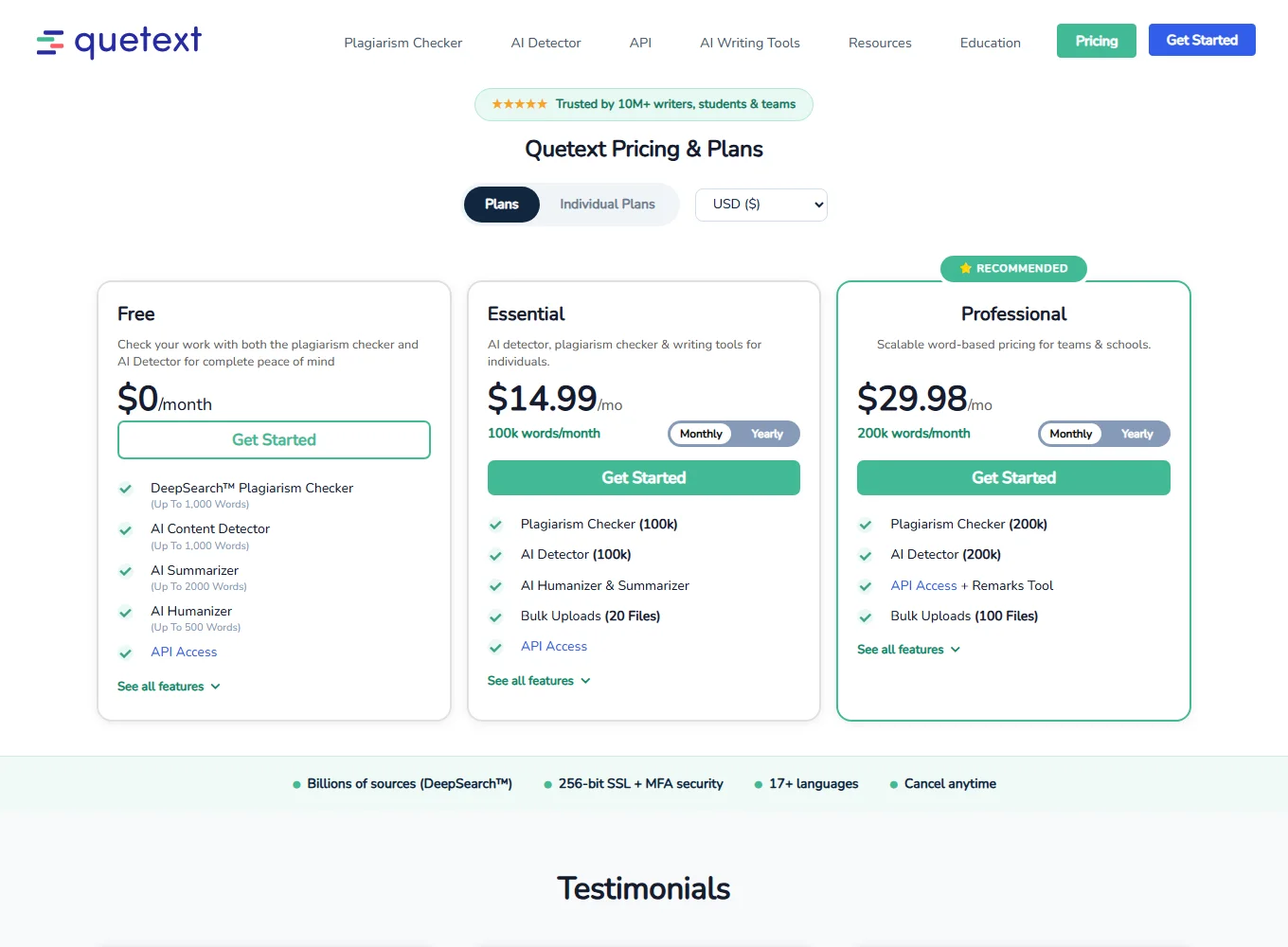
| Quetext | Free: 1,000 words for the AI detector | Essential from $14.99/mo, Professional from $29.98/mo | Plagiarism first, AI detection as a bonus |
| ZeroGPT | Free, no credit card | Paid personal and business plans (not itemized here) | Instant checks without an account |
| Scribbr | Free, unlimited checks up to 1,200 words each | None for the detector | Students, no sign-up |
| QuillBot AI Detector | Limited free use | Part of Premium (about 10 per month billed annually) | Writers already using QuillBot |
| Turnitin | Not sold to individuals | Institutional contracts only | Universities and schools |
Where a vendor shows its prices in another currency to visitors from your country, we say so below. The paid prices are list prices read on October 23, 2026 and they change often, so confirm on the vendor’s page before you pay.
How an AI detector works
Understanding the mechanism lets you read a score instead of being intimidated by it. A detector does not “recognize ChatGPT”. Most of them estimate how predictable a text is for a language model, and many also use a classifier trained on large sets of human and machine writing. Two signals come up again and again.
Perplexity: how surprising is the text?
Perplexity measures how hard it would be for a model to guess the next word. Human writing wanders: a rare word, an odd turn of phrase, a tangent. Generated text tends to pick the statistically likely word, which makes it less surprising. Low perplexity raises suspicion.
Burstiness: how uneven is the rhythm?
Burstiness looks at the variation in sentence length and complexity. A person writes a three-word sentence, then a forty-word one. A model produces an even rhythm, paragraphs of similar size, calibrated sentences. A rhythm that is too regular raises suspicion.
The direct consequence: a detector does not detect AI, it detects regularity. That is why very formal human writing, a literal translation or a standardized technical text can be flagged wrongly, and why an AI text that someone has reworked by hand can slip through.
The 10 best AI detectors in detail
1. Winston AI: the most complete free-to-start suite
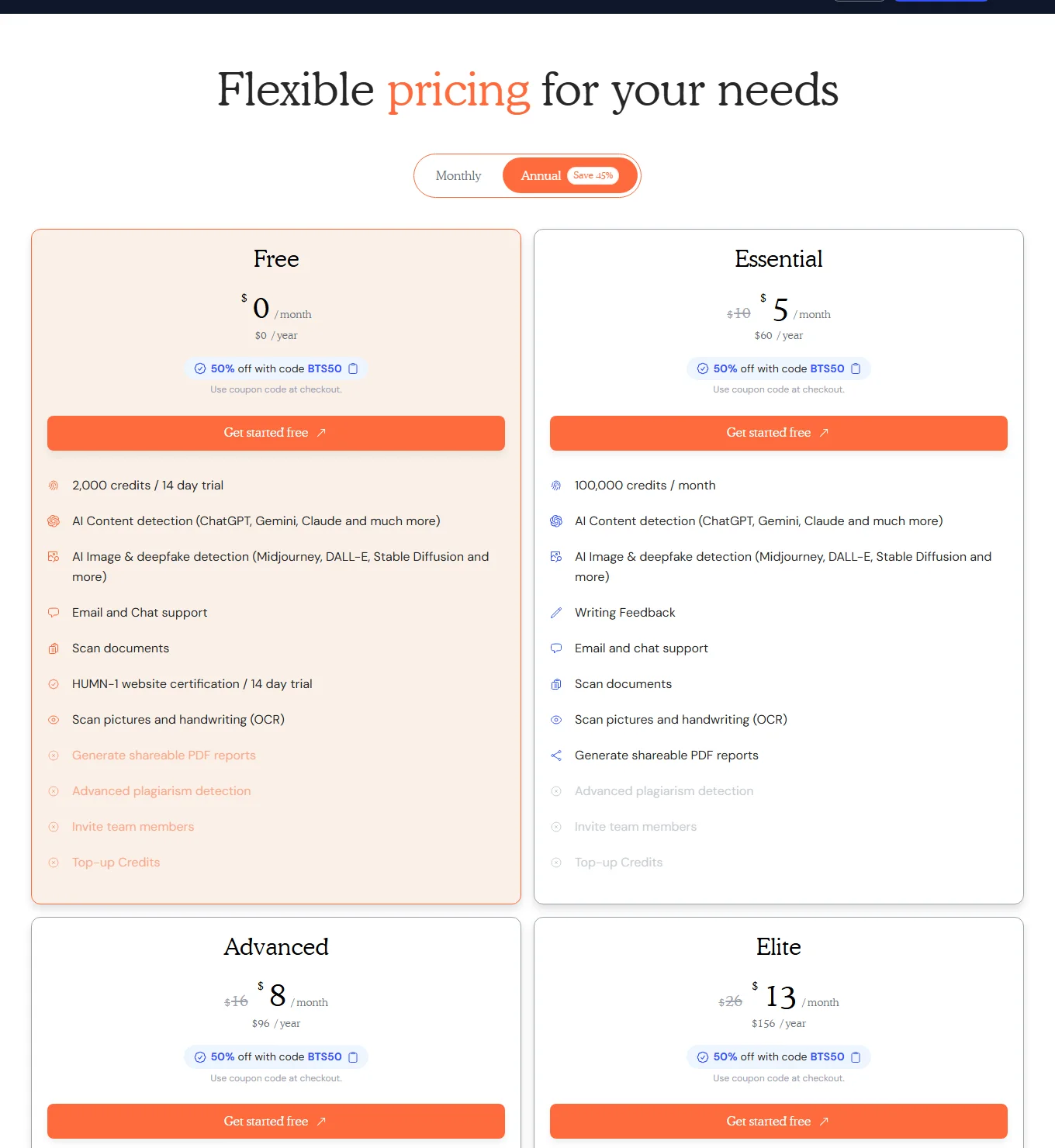
Winston AI covers AI text detection (ChatGPT, Gemini, Claude and more), AI image and deepfake detection, an advanced plagiarism checker, writing feedback, shareable PDF reports and the ability to scan documents and handwriting through OCR. The free plan is really a trial: 2,000 credits over 14 days. Paid plans on October 23, 2026: Essential at $10 a month billed annually ($18 month to month) with 100,000 credits a month, Advanced at $16 ($29) with 200,000 credits and plagiarism, and Elite at $26 ($49) with 500,000 credits. The page was also advertising a 50% promo code at the time we read it, so check the checkout price.
Winston advertises very high accuracy, but that figure comes from the vendor and cannot be reproduced from outside. Its sweet spot is the user who wants one tool for text, plagiarism and reports without paying on day one.
2. GPTZero: the best-known name and a good second opinion
GPTZero is one of the most widely used detectors, aimed at teachers and students first. Its pricing page presents itself as used in over 100 countries and as an official AI detector partner of the American Federation of Teachers, both vendor statements. The free plan allows 10,000 words a month with a basic scan and one advanced scan. The Premium plan (300,000 words a month) and Professional plan (500,000 words a month) were shown to us at 9.99 and 19.99 euros per month billed annually; the page converts to your local currency, so a US visitor sees dollars.
It also offers a plagiarism check, a hallucination detector, writing replay to document how a text was written, and a Chrome extension. If another tool flags your text, GPTZero is the usual second check.
3. Originality.ai: built for publishers and agencies
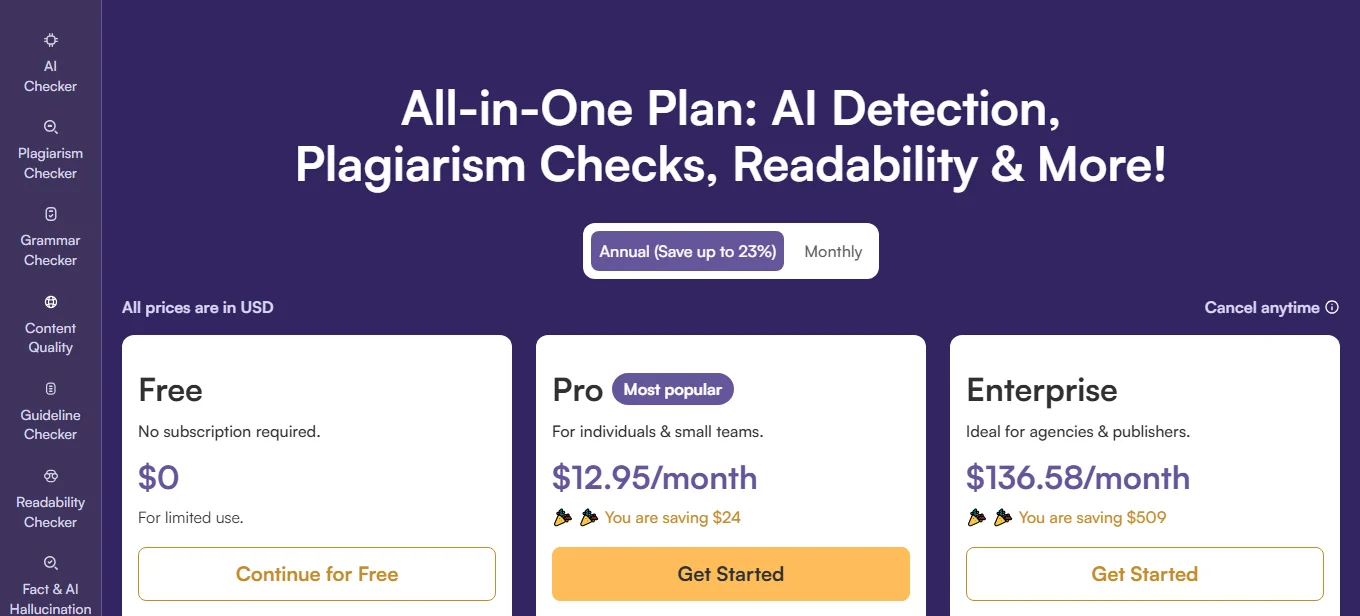
Originality.ai is the detector many SEO agencies and editors reach for: AI detection, plagiarism, a content quality score, fact and hallucination checking, readability and a Chrome extension that records how a document was written. It is credit based, where one credit covers 100 words. On October 23, 2026 the page showed a free allowance of 10,000 words (one time), Pro at $12.95 a month billed annually ($14.95 monthly, 200,000 words a month, team seats and file uploads) and Enterprise at $136.58 a month billed annually ($179 monthly, 1.5 million words a month, API access).
It is mostly tuned for English and for production audits: checking what a team of freelancers sends you. It is overkill for a one-off check.
4. Pangram: a newer name that editors talk about
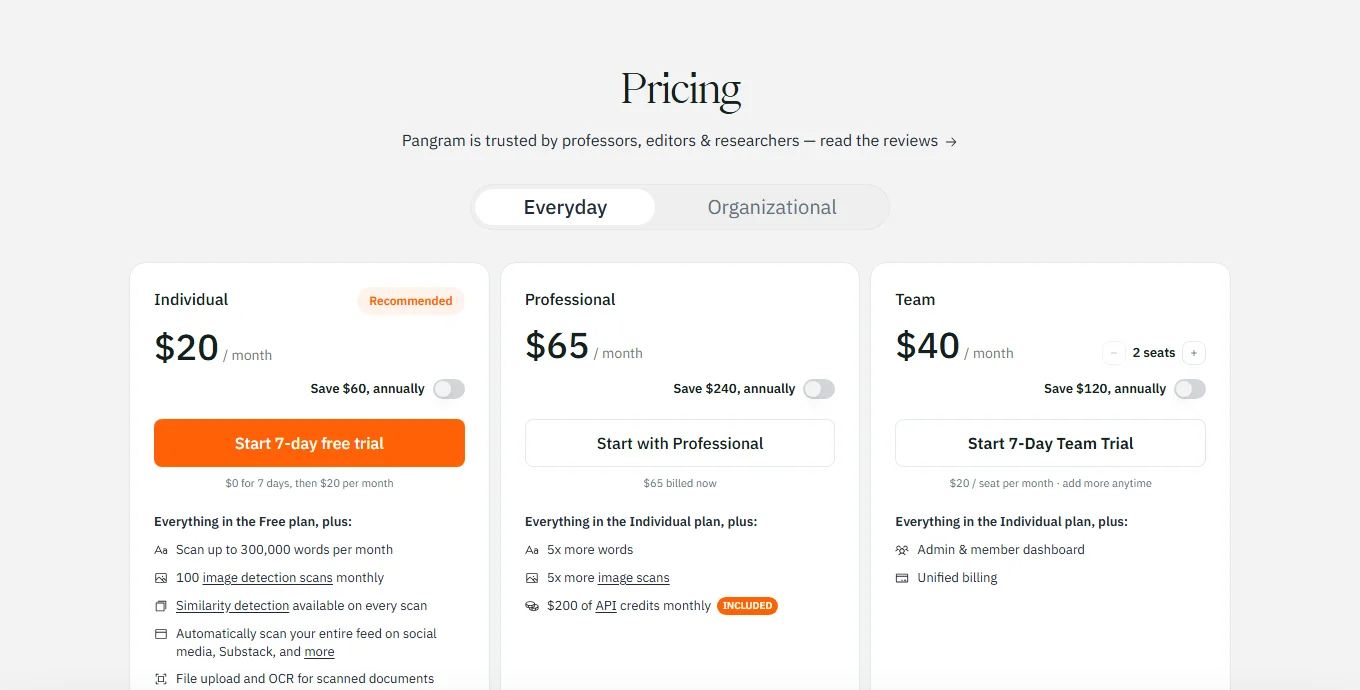
Pangram has become a regular in discussions among editors and researchers. Its pricing page lists an Individual plan at $20 a month with a 7-day free trial (up to 300,000 words a month, image detection scans, file upload with OCR, Google Docs and Gmail integrations), a Professional plan at $65 a month with five times the words and $200 of monthly API credits, and a Team plan at $40 a month for two seats. A free plan also exists. We have no independent figures to quote on its accuracy, so treat it as one more strong option to cross-check against, not as a verdict machine.
5. Copyleaks: AI and plagiarism for organizations
Copyleaks scans for AI-written text and plagiarism in one report, supports AI detection in over 30 languages, and has browser and Google Docs add-ons. The Personal plan is $13.99 a month billed annually ($167.88 a year) or $16.99 month to month, with 1,200 credits that cover up to 300,000 words. The Pro plan is $74.99 a month billed annually and adds team seats and site scanning.
Copyleaks says on its own materials that texts passed through some writing assistants can be flagged as AI, which is the type of false positive that traps honest writers. Turnitin’s page also cites an independent evaluation in which Turnitin and Copyleaks classified all 126 test documents correctly. That is Turnitin’s account of the study, so read it as a reasonable signal and not as a guarantee.
6. Quetext: plagiarism first, AI detection as a complement
Quetext is a plagiarism checker that added AI detection. The free plan covers the plagiarism checker and the AI detector for up to 1,000 words each, plus a short AI summarizer and humanizer. Essential starts at $14.99 a month (100,000 words a month) and Professional at $29.98 a month (200,000 words, bulk uploads of 100 files). If your main worry is copied text in a thesis or an article, with AI as a secondary check, this is a sensible fit.
7. ZeroGPT: instant checks without an account
ZeroGPT is one of the most visible free detectors in search results. It is free forever without a credit card and highlights the sentences it finds suspicious. It sells paid personal and business plans, and an API, but we did not itemize the prices for this page. Worth noting: the same company sells an AI paraphraser and an “AI humanizer”, the tool meant to make text harder to detect. It sells both the shield and the sword. That is not disqualifying, but it shows how much of the detection market is commercial rather than settled science.
8. Scribbr: free, unlimited and no sign-up
Scribbr’s AI detector is free with unlimited checks of up to 1,200 words each, requires no account, and says it does not store or share what you paste. It supports several languages (including German, French and Spanish) and distinguishes between text that is fully AI-generated, AI-refined and human-written, with feedback at paragraph level. Scribbr is upfront that no detector can provide complete accuracy. The free tool is ad-supported. For a student who wants a quick self-check, it is hard to beat on convenience.
9. QuillBot AI Detector: handy if you already use QuillBot
QuillBot bundles an AI detector with its paraphraser, grammar checker, summarizer and humanizer. Free use of the detector is limited, and full access is part of Premium, which was shown to us at 9.95 euros a month billed annually (it converts to your local currency). If you already pay for QuillBot, the detector is a convenience. It is not a reason to subscribe on its own.
10. Turnitin: the institutional standard
Turnitin is the global standard for academic integrity checks and is sold to schools and universities, not to individuals. It says its AI content checker helps educators identify when a tool such as ChatGPT, a text spinner or an AI bypasser (often called a humanizer) may have been used in a submission. It publishes pages about its false positive rate and cites independent research. As a student you cannot run your essay through Turnitin before submitting unless your institution gives you access.
Important for students: a “human” result on a free tool does not guarantee a “human” result on Turnitin. They use different models and different reference data. Treat free tools as a rough self-check, not as a rehearsal for your school’s system.
A note on DetectGPT. DetectGPT is another quick, paste-and-check detector. We could not read its pricing page reliably when we checked on October 23, so we are not quoting prices for it. If you want a simple tool for express checks, you can look at it directly: DetectGPT.
The best free AI detector
If cost is your first criterion, four options stand out:
- Scribbr: unlimited checks up to 1,200 words, no account.
- ZeroGPT: free forever, instant, highlights suspicious sentences.
- GPTZero: a free plan with 10,000 words a month and a basic plus one advanced scan.
- Winston AI: a free 14-day trial with 2,000 credits that also shows its plagiarism and report features.
The common limits of free versions are a cap on words or scans, no plagiarism checks and few exportable reports. For regular or professional use, the reason to pay is plagiarism and shareable reports, not a dramatic gain in reliability.
The best free habit: run the text through two detectors with different engines, for example Scribbr and GPTZero. If they agree, the signal is stronger. If they disagree, your text is in the gray zone and no score will settle it for you.
AI detectors for students and teachers
This is the most tense use case, because the stakes are a grade, a degree, sometimes a disciplinary process, not search rankings. The landscape splits into two worlds that rarely meet.
On the institution side: Turnitin and similar systems
Schools run institutional tools that sit inside the learning platform. They check a paper when it is submitted, produce a report for the marker, and combine AI detection with classic plagiarism detection. Individuals cannot buy these directly. GPTZero and Copyleaks also sell to educators.
On the student side: self-checking before you submit
To check your own work before submitting, use consumer tools: Scribbr and GPTZero are the easy options, Winston AI if you want plagiarism and a report as well. Keep your drafts and your document history. A version history in Google Docs or Word is the best evidence of real human work, and GPTZero’s and Originality.ai’s writing replay tools exist precisely to document it.
Know your rights: a serious institution does not sanction a student on a percentage alone. A high score should open a conversation, not close a case. If you are flagged wrongly, ask for the detailed report, explain your process and show your drafts.
Detectors for publishers and SEO teams
Publishers and agencies are not worried about a grade. They worry about brand, contract terms with freelancers and, increasingly, whether Google will treat a site’s content as thin. Three tools fit that job best:
- Originality.ai for team audits: credit-based, plagiarism included, API on the Enterprise plan.
- Winston AI for a shareable report and a clean workflow, with SEO and writer solutions on its site.
- Pangram as an extra check on high-value pieces.
The honest caveat for SEO is that Google does not rank pages by detector score. What hurts a page is thin, generic, unhelpful content, whoever or whatever wrote it. If your real question is how to publish AI-assisted content safely, our guide AI SEO writing without a Google penalty covers the line, and can you rank with 100% AI-written articles looks at the evidence.
Checking a PDF or a long document
Most free detectors work by copy and paste, which becomes impractical for a 60-page thesis. For file uploads, the options narrow:
- Originality.ai accepts docx, pdf and doc files on the Pro plan and above, with downloadable PDF reports.
- Winston AI scans documents and uses OCR for pictures and handwriting on its paid plans, and generates shareable PDF reports.
- Pangram offers file upload and OCR for scanned documents on the Individual plan.
- Copyleaks lets you scan multiple files in one upload.
- Free tools (Scribbr, ZeroGPT) stay on copy and paste with a word cap per check.
A trap worth knowing: on a scanned PDF or one exported from a complex layout, text extraction can introduce line breaks, hyphenation and artifacts. Those defects change the rhythm of the sentences, so they change the burstiness, so they change the score. Always check that the extracted text is clean before you draw a conclusion from a PDF.
Are AI detectors accurate?
The honest answer is partly. Detectors estimate a probability, they prove nothing. Two structural limits follow from how they work.
- False positives: human text flagged as AI. The most exposed are very formal essays, literal translations, English written by non-native speakers, standardized technical content, and text polished by an AI-assisted grammar tool. A widely cited 2023 Stanford study found that several detectors misclassified writing by non-native English speakers far more often. Turnitin’s own page addresses this with a report on bias against non-native English speakers.
- False negatives: AI text that has been edited, paraphrased or run through a humanizer very often slips under the radar.
Why the advertised accuracy numbers mean little
Vendors advertise accuracy rates that sit very close to 100%. Those numbers come from their own test sets, with their own definition of success. No shared independent protocol allows a clean comparison between them. A detector that labelled everything “human” would also post an excellent score on a corpus that is mostly human. The only reliably checkable statement is the modest one: reliability depends on the text being analyzed, its length, its language and how it was edited.
For that reason, we do not rank detectors by “accuracy” on this page. We rank them by what they let you do: free access, plagiarism, reports, files, price and who they are built for.
Humanizers and bypass tools: why they work, and the risk
A parallel industry sells “humanizers” and “AI bypassers”. The principle is mechanical: since detectors look for regularity, add irregularity. These tools break up sentence rhythm, swap in less probable synonyms and introduce unexpected phrasing. It often works on the score, which is exactly what shows the limits of detection. Several vendors, including ZeroGPT and QuillBot, sell both a detector and a humanizer.
The real risk: an automatic humanizer frequently degrades the text. Approximate synonyms, artificial phrasing, drifting meaning. You trade a score problem for a readability problem, and a human reader notices the mush faster than a detector does. In school settings, bypass tools are explicitly named in integrity policies, and Turnitin mentions them by name.
The healthier approach is not to bypass but to rewrite: add real experience, concrete examples and a point of view. Our guide to paraphrasing text with AI explains how to rework a draft properly and where paraphrasing tools stop being useful.
Good habits for a reliable result
- Cross-check two tools with different engines, and only conclude when they agree.
- Analyze long texts. On a single paragraph the score is unstable.
- Never sanction on a score alone. Smooth human text is flagged often.
- Look at the highlighting, not only the percentage. It shows which passages caused the flag.
- Re-test after a rewrite. A reworked text can change score completely.
- Check the extracted text when it comes from a PDF or a scan.
- Keep your drafts. A version history is your best defense.
Privacy of the text you paste
Pasting a sensitive text into an online tool is not neutral: an unpublished thesis, a client article under NDA, internal data. Before you submit a confidential document, read the tool’s privacy policy. Are your texts stored? Reused to train the model? Scribbr states that it does not store or share what you submit, and the vendors that sell to schools and companies are generally the most explicit. For a really sensitive document, test an extract that is representative rather than the full file.
My text is flagged as AI: what now?
Being flagged is not a verdict, especially when the substance is good. Three levers, in this order:
- Check that it is not a false positive. Run a second detector and look at the highlighted passages. If they are definitions or standardized technical passages, the signal is probably wrong.
- Rewrite in depth, not on the surface. Add lived experience, concrete examples, a personal angle, and break the too-even rhythm. That is what really changes perplexity and burstiness.
- For SEO, strengthen E-E-A-T to avoid any penalty: an identified author, demonstrated experience and cited sources.
If you want to write more naturally from the first draft, a writing tool built around SEO structure and multiple languages helps: see our reviews of Wisewand and Rytr. And for the broader picture of which assistant to use, read the best AI in 2026.
FAQ
What is the best AI detector?
None is the best at everything, and the accuracy rates that vendors advertise are not comparable. In practice: Scribbr and ZeroGPT for free quick checks, Winston AI and GPTZero for a fuller free-to-start tool, Originality.ai and Pangram for professional use, Turnitin for institutions. Cross-checking two tools is the most reliable method.
What is the most accurate AI detector?
There is no independent public ranking that settles it. Vendors advertise figures close to 100% measured on their own data. Turnitin cites an independent evaluation in which it and Copyleaks classified all 126 test documents correctly, but that is a small set and a vendor summary. Use accuracy claims as marketing, not as proof.
What is the best free AI detector?
Scribbr offers unlimited free checks of up to 1,200 words with no sign-up. ZeroGPT is free forever and instant. GPTZero has a free plan with 10,000 words a month, and Winston AI gives a free 14-day trial. Free versions cap words and usually do not include plagiarism checks.
What is the best AI detector for ChatGPT?
GPTZero, Winston AI, Originality.ai and Pangram all target text from the main models, including ChatGPT, Gemini and Claude. None is fully reliable: ChatGPT text that has been edited can pass, and human text can be flagged.
Can AI detectors be wrong?
Yes, in both directions. False positives flag human writing as AI, especially formal, translated or technical text and English written by non-native speakers. False negatives miss AI text that has been reworked or run through a humanizer. A detector gives a probability, not proof.
Can an AI detector check a PDF?
Some can. Originality.ai (Pro and above), Winston AI (paid plans) and Pangram (Individual plan) accept file uploads, and Copyleaks scans several files at once. Free detectors usually need copy and paste. A poorly extracted scanned PDF can distort the score.
Can students use Turnitin to check their own work?
Not directly. Turnitin is sold to institutions. Students normally rely on free tools such as Scribbr or GPTZero for a self-check, knowing that a result there does not guarantee the same result on Turnitin.
Do AI detectors work on Claude and Gemini text?
The major tools say they cover the main models, including ChatGPT, Gemini and Claude, and they update as new models appear. Coverage claims come from the vendors, and a heavily edited text from any model can escape detection.
Does Google penalize AI content because of detectors?
Google does not rank pages by detector score. Thin, unhelpful or spammy pages are the problem, whoever wrote them. A detector is a quality-control aid for your own team, not a ranking factor.
Start free, then decide. Winston AI and GPTZero cover most checking needs on a free plan, and cross-checking the two before you conclude anything is the best habit you can adopt.