
ChatGPT, Claude, Gemini, Grok, Perplexity, Copilot, Mistral: the question never goes away. Which is the best AI in 2026? The honest answer is that it depends on what you want to do with it. This guide puts the main assistants side by side, by task, so you can choose the one that fits your day and not the one that makes the most noise. We compared official plans and published features, and read the US pricing pages on October 23, 2026. The best answer is not the same for a student, a writer or a Google Workspace user.
In short: there is no single best AI. ChatGPT is the most all-round choice, Claude is the one many people pick for long writing and code, Gemini shines if you live in Google apps, Perplexity is built for sourced research, Grok reads X live, and Mistral’s Vibe is the European option. All of them have a free tier, so the smartest first step is to test two on your own tasks and pay only for the one you open every day.
Prices read on October 23, 2026 on each vendor’s US page. Our own SEO writing recommendation uses an affiliate link (Wisewand); links to assistants are plain official links. No lab benchmark was run for this page.
In this article
The best AI assistants at a glance
| AI | Strength | Paid plans (US, Oct 23, 2026) | Best for |
|---|---|---|---|
| ChatGPT | Breadth: text, images, voice, research, custom GPTs, automation | Go $8, Plus $20, Pro from $100 | One tool for everything |
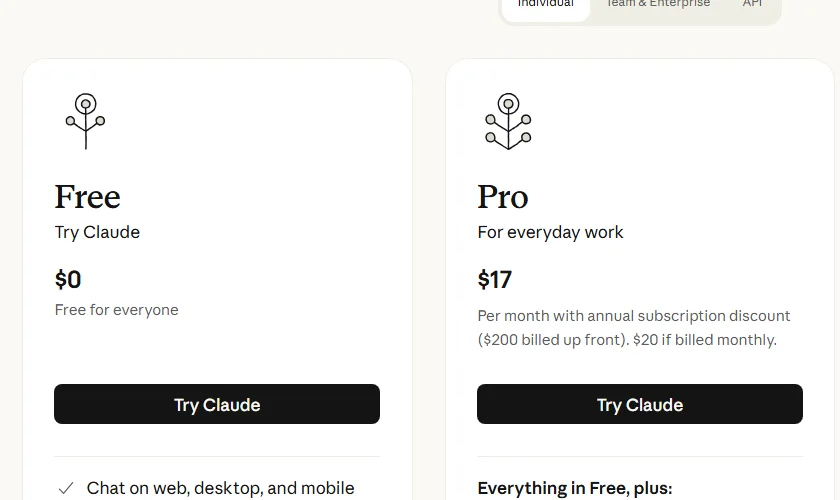
| Claude | Long writing, document handling, bundled coding tools | Pro $17 annual ($20 monthly), Max from $100 | Writers, analysts, developers |
| Google Gemini | Integration with Gmail, Docs and Chrome, bundled storage | AI Plus $4.99, AI Pro $19.99, Ultra from $99.99 | Google users |
| Grok | Live search of the web and X, image and video generation | Plus $8, Premium $30, Super $100, Ultra $200 | People who follow X |
| Perplexity | Answers with cited sources, choice of models | Pro $17 a month (annual equivalent), Max $167 | Research and fact-finding |
| Mistral Vibe | European provider, work and coding agent | Pro $14.99, Team $24.99 per user | Privacy-minded, European users |
| Microsoft Copilot | Built into Windows, Edge and Microsoft 365 | Price depends on your Microsoft plan | Windows and Office users |
Each AI in detail
ChatGPT: the most versatile
OpenAI’s assistant remains the reference for versatility. It writes, codes, reasons, generates images, handles voice and analyzes files, with projects, scheduled tasks and custom GPTs on top. Its free plan gives unlimited text chats with GPT-6 (under abuse guardrails) with limits on uploads, images and research, and the paid ladder goes from $8 to $100 and beyond. The other asset is the sheer community around it: for almost any need, someone has already shared the right prompt. The trade-off is that it is not always the best at each individual task. See Claude vs ChatGPT for the detailed head-to-head.
Claude: the writer’s and coder’s choice
Anthropic’s Claude is often preferred for long, careful writing and for reading and analyzing big documents. The free plan covers chat, web search, file creation, memory, Artifacts and up to five Projects on the Sonnet and Haiku models. Pro, at $17 a month billed annually or $20 monthly, adds more usage, Claude Code, Claude Science and access to the Opus models. It is a strong companion to ChatGPT whenever the job is writing, and many professionals use it for the first draft.
Gemini: the strength of Google
Gemini is built into Gmail, Docs, Vids and Chrome, and the paid Google AI plans bundle storage: AI Pro at $19.99 includes 5 TB, YouTube Premium Lite and the newest Gemini model. If you already work in Google’s tools, it is the smoothest assistant to adopt, and its cost can be absorbed by a storage subscription you already pay. Our Gemini vs ChatGPT page does the sum.
Grok: live access to X
xAI’s Grok is distinguished by real-time search of the open web and of X, plus image and video generation. Its Premium tier is $30 a month, 50% above ChatGPT Plus, which only makes sense if watching X is part of your work. We analyze the value in Grok vs ChatGPT.
Perplexity: the research specialist
Perplexity is a search-first assistant that cites its sources. Its Pro plan is shown at $17 a month on an annual billing equivalent and lets you pick between several underlying models; on the day we read the page it listed models from OpenAI, Google, Anthropic and xAI, among others. If your main need is finding current, sourced information and verifying it, it is more reliable than a chatbot that can answer confidently without citing anything.
Mistral Vibe and Microsoft Copilot: the specialists
Mistral’s assistant (formerly Le Chat, now Vibe) has a free plan with limited messages and web searches, and a Pro plan at $14.99 a month with more usage, spreadsheet and slide generation and all-day coding. It appeals to people who prefer a European provider. Microsoft Copilot is the natural pick if your day is Windows, Edge and Office, since it is built into them; its extra features depend on the Microsoft plan you already hold, so check Microsoft’s page for the current terms.
Free or paid: do you need to pay?
Every assistant above has a free plan that is plenty for everyday use: chatting, drafting, summarizing, searching. Paid plans mostly unlock higher limits, the strongest models, bigger context windows and work tools such as coding agents, research modes, memory and scheduled tasks. So the real question is not “which is best in absolute terms” but “do I need the paid version of one of them”.
- Occasional use: stay free. Two or three free accounts cover almost everything.
- Daily use that hits limits: pay for the one you reach for first. $8 to $20 a month is the usual range.
- AI at the center of your job: a $100 plan can pay for itself, but only after a month at the standard tier tells you that you actually need it.
Our advice: start free on two assistants, and pay only for the one you use every day. A third route exists if you keep hesitating between subscriptions: aggregators give access to several models under a single payment, at the cost of losing some native features. We cover that trade-off in our Merlin AI vs ChatGPT comparison.
The best AI by task
Best AI for writing
Claude is the usual pick for long, nuanced writing, and ChatGPT follows closely with more versatility. For SEO content, though, a general chatbot hits its limits fast: no analysis of competing pages, no calibration on keywords. A dedicated writer such as Wisewand, built around SEO structure and multiple languages, goes further. See our Wisewand vs ChatGPT for SEO comparison.
Best AI for coding
Claude and ChatGPT both ship a coding agent with their paid plans, Claude Code and Codex, and Google offers Jules and Antigravity. Developers tend to choose by workflow: terminal and repository, or inside the chat product, or in an IDE. Keep one paid and one free for a second opinion when a bug resists.
Best AI for images
ChatGPT, Gemini and Grok all generate images inside the assistant. Grok also generates short video. For a quick illustration, any of them works. For serious creative control, specialized image and video tools go further.
Best AI for research and fact-finding
Perplexity leads when you need current, sourced information, and Gemini and ChatGPT both have deep research modes. For anything that matters, open the cited sources instead of trusting the summary.
Best AI for live news and social trends
Grok is the only assistant with live access to X, which matters for fast-moving stories. Treat the output as a lead to verify, because social posts are uneven in reliability.
Best AI for students
Start free. Most assistants have study-oriented modes, and the free tiers cover essays, summaries and revision questions. If you are worried about how your work will be checked, read our comparison of AI detectors and how to paraphrase text with AI.
Which AI is better than ChatGPT?
None is “globally” better. Each one beats it on a specific ground. Claude often writes better over long texts, Gemini is more integrated with Google, Perplexity is stronger for sourced research, Grok sees X live. ChatGPT stays ahead on overall versatility and on the richness of its ecosystem. The sound reflex is to keep two assistants within reach and switch by task.
Is ChatGPT still the number one AI?
By reach and breadth, ChatGPT is still the default most people think of, and it has the largest range of plans and features. “Number one” is a different claim from “best for you”, though, and public leaderboards change with every model release. We deliberately do not declare a champion: a ranking that is true on Tuesday is outdated by the next update. What stays valid is the method in the next section.
And since people ask: Elon Musk founded xAI, the company behind Grok, so Grok is the assistant he publicly promotes. That tells you about the company, not about which assistant suits your work.
How to choose in an afternoon
Do not look for the perfect ranking. Test. Take one real task of yours, a document to rewrite, a spreadsheet question, a piece of code or a research question, and run it on two or three free assistants. Compare three things: how much of the result you can use as is, how much you must correct, and how long it took.
- Write the task once and paste the same text everywhere, so the comparison is fair.
- Note whether the assistant asked for missing information or guessed.
- Check any fact, figure or quotation it gives you against a primary source.
- Repeat with a second, different task the next day.
In practice, the “best AI” is the one whose answer saves you the most time on your case. And to get the most from any of them, everything depends on how you phrase the request: say what you want, for whom, in what format, and give an example.
Our verdict by profile
- Beginner or general use: start with ChatGPT. It is the simplest and most complete, and the help community is huge.
- Writer, student or heavy reader: add Claude for long writing and document analysis.
- Google or Microsoft user: Gemini or Copilot plug directly into the tools you already use.
- Researcher or fact-checker: Perplexity, for the cited sources.
- Follower of X and breaking news: Grok.
- Prefers a European provider: Mistral Vibe offers a good balance of quality, price and data location.
- SEO content creator: go beyond the chatbot with a dedicated writing tool built for search.
In every case, do not lock yourself into one tool. The best users juggle two or three free assistants depending on the task and pay only for the one that really saves them time. The best AI is not a title awarded once and for all, but a choice that evolves with your needs and with the steady release of new models.
The best AI for SEO content that ranks? A general chatbot does not analyze competitors or calibrate on keywords. A dedicated writer does.
FAQ
Which AI is currently the best?
There is no absolute winner. ChatGPT is the most versatile, Claude is often preferred for long writing and code, Gemini is the best fit for Google users, Perplexity for sourced research and Grok for live X search. The best one is the one that matches your main task, and you can test several for free.
Which AI is better than ChatGPT?
Each rival beats it on a specific job: Claude on long writing, Gemini on Google integration, Perplexity on cited research, Grok on live X data. ChatGPT remains ahead for overall versatility and ecosystem. Keeping two assistants and switching by task works best.
Is ChatGPT the best AI right now?
It is the most widely used and the broadest, which makes it a safe default. Whether it is the best for you depends on your task. Leaderboards change with every release, so test it against one or two rivals on your own work.
Which AI is one of the best for free?
ChatGPT, Claude, Gemini, Grok, Perplexity and Mistral all offer free plans that cover everyday use. Free plans cap usage and exclude the strongest tools, so use them to compare, then pay only for the one you rely on daily.
Which AI does Elon Musk use?
Elon Musk founded xAI, which makes Grok, so Grok is the assistant he promotes publicly. That reflects his company, not a verdict on which assistant is best for your work.
What is the number one AI now?
It depends on how you measure: audience, features, price or a given task. ChatGPT leads on reach and breadth. We do not name a single champion because rankings move with every model release.
Should I pay for an AI?
Only if you hit the limits of the free plan regularly. The usual range is $8 to $20 a month. Heavy users may move to a $100 tier, but test the standard plan for a month before you do.
Compare the head-to-heads: Claude vs ChatGPT, Gemini vs ChatGPT and Grok vs ChatGPT each break down prices and plans in detail.