⚡ Direct answer
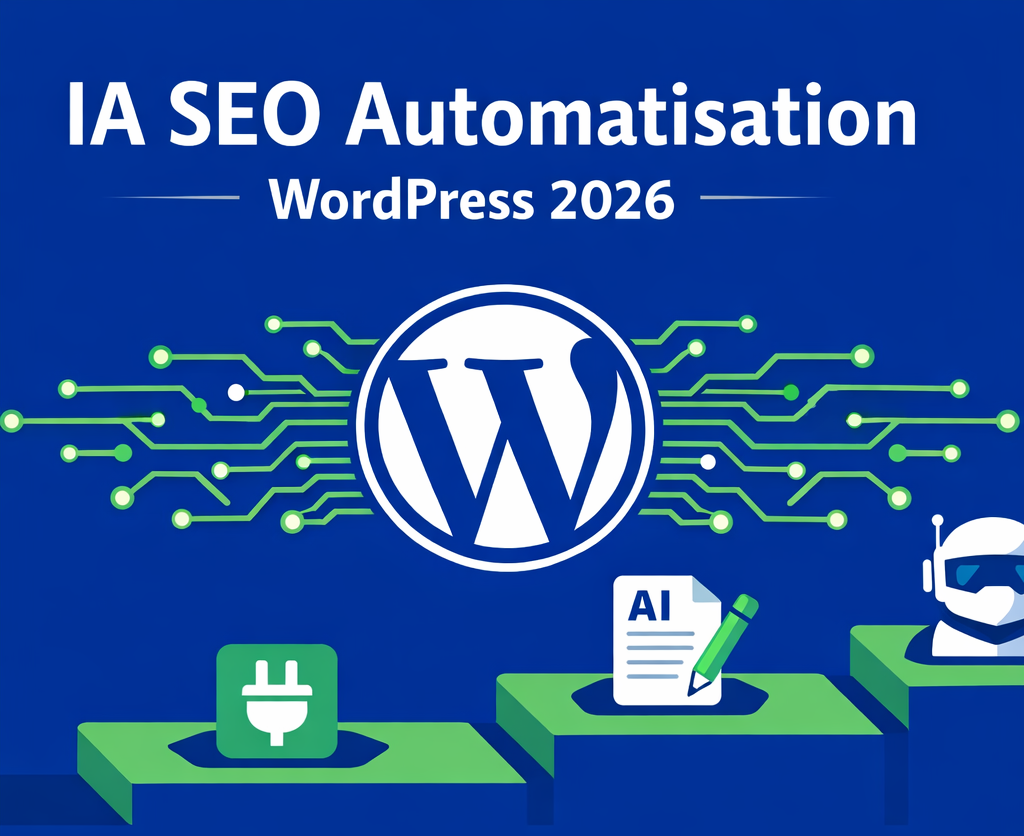
AI SEO automation on WordPress in 2026 means: AI-generated articles published, internally linked, and scheduled without manual copy-paste. The tools that actually deliver: Otomatic.ai (full WordPress plugin for mass publishing), Koala AI (direct WordPress integration + SERP scan), NeuronWriter (writing + automated internal linking). The combo of these tools can take you from 5 articles per month to 50+ per week, but only if you keep quality oversight on commercial pages.
WordPress powers ~43% of the web in 2026, and AI SEO automation is the way most niche publishers now scale content production. The promise: instead of writing one article, you set up a pipeline where AI generates, optimizes, internally links, and publishes content at a rate humans can’t match. The reality is more nuanced, automation works on some content types and fails on others. This guide explains what actually works in 2026.
What « AI SEO WordPress automation » actually means
Full automation has four stages, each of which can be automated separately:
- 1. Keyword research: identify topics to target. Still mostly manual or via Ahrefs / Semrush, AI tools don’t do this well yet.
- 2. Content generation: AI writes the article from a brief. Mature, multiple tools handle this.
- 3. Optimization: SEO scoring, semantic coverage, internal linking. Partially mature, NeuronWriter and Surfer lead.
- 4. Publishing: push to WordPress, schedule, internally link, set featured image. Mature, Otomatic.ai handles this natively.
True end-to-end automation combines stages 2-4. Stage 1 stays human, AI can’t yet figure out what’s worth ranking on better than a human strategist.
The 3 tools that actually automate AI SEO on WordPress
Otomatic.ai, the WordPress-native automation engine
Otomatic.ai is the closest thing to « set and forget » AI SEO on WordPress in 2026. It’s a plugin that lives inside your CMS, you give it a list of keywords or topics, and it handles generation, scheduling, publishing, and internal linking automatically.
What it automates: AI article generation in WordPress, scheduling queue, category assignment, featured image generation, internal linking between articles.
What it doesn’t: deep SERP analysis, semantic brief, GEO optimization.
Best fit: multi-site networks, niche publishers, content-heavy categories.
Koala AI, the affordable WordPress integration
Koala AI at $9/month integrates directly with WordPress (via plugin or API) and includes real-time SERP scanning on the target keyword. You can batch-generate articles and push them to WordPress as drafts or scheduled posts.
What it automates: AI generation with SERP awareness, WordPress publishing, image generation.
What it doesn’t: internal linking automation, advanced semantic scoring.
Best fit: affiliate sites, solo publishers, anyone testing automation before scaling.
NeuronWriter, the semantic automation layer
NeuronWriter doesn’t fully automate WordPress publishing, but it brings the strategic layer Otomatic lacks: deep SERP analysis on top 30 results, semantic NLP scoring, and automated internal linking suggestions. WordPress integration via Gold plan ($297 Lifetime).
What it automates: semantic coverage analysis, internal linking suggestions, brief generation.
What it doesn’t: scheduling queue, mass publishing.
Best fit: stack alongside Otomatic for end-to-end automation.
The recommended automation stack for 2026
No single tool covers all 4 stages well. The optimal stack splits responsibilities:
- Strategy (manual): keyword research with Ahrefs/Semrush/Ubersuggest. Human picks the topics.
- Brief (Frase.io or NeuronWriter): SERP-driven content brief with semantic coverage map.
- Generation + publishing (Otomatic.ai or Koala AI): AI writes from the brief and pushes to WordPress.
- Internal linking (NeuronWriter or Otomatic): auto-suggest links between articles.
- Human review on money pages only: commercial pages, high-stakes articles. Skip review on supporting content.
This setup typically takes you from 5 articles per month (manual) to 30-50 articles per week (automated). Cost: ~$50-$150/month all-in, vs hiring a content writer at $1,500+/month.
The limits you need to know before scaling
- Quality decay at scale: AI output stays similar in tone/structure. Publishing 50 articles a week creates « patterned » content Google can detect.
- Helpful Content Update risk: pure-AI content without human input gets demoted. Mix in expert reviews, original data, or first-hand experience on pages that matter.
- E-E-A-T weakness: AI doesn’t have lived experience or expertise. Author bios with real credentials matter more than ever.
- Internal linking quality: auto-suggested links can be irrelevant. Always review the link list before bulk-publishing.
- Topic cannibalization: at scale, you’ll generate near-duplicates. NeuronWriter’s topical maps help spot this.
The publishers winning with automation in 2026 are the ones who treat AI as a productivity multiplier, not a replacement for editorial judgment. Volume without quality oversight remains the fastest way to get penalized.
Quick setup checklist
- 1. Install Otomatic.ai or Koala AI WordPress plugin/integration
- 2. Configure category mapping (which keywords go to which category)
- 3. Set publishing schedule (1-3 articles per day max, avoid suspicious spikes)
- 4. Connect NeuronWriter for internal linking layer (optional but recommended)
- 5. Set up author bios with real names and credentials
- 6. Manually review first 10 articles before fully automating
- 7. Monitor GSC Coverage weekly for indexing issues
Conclusion
AI SEO automation on WordPress is mature enough in 2026 to genuinely 10x your content output, but it isn’t magic. Pick the right stack (Otomatic for publishing, NeuronWriter for semantic, Koala for budget), keep human oversight on what matters, and watch for the limits (quality decay, E-E-A-T weakness, cannibalization).
👉 See also: Otomatic.ai Review · Koala AI Review · Best AI SEO Tool 2026 · Can 100% AI Content Rank?
FAQ
Can I fully automate SEO content on WordPress?
Yes for generation and publishing (Otomatic.ai, Koala AI), partially for optimization (NeuronWriter). Keyword research and strategy still need human input.
Will Google penalize automated AI content?
Not by default. Google penalizes low-value content regardless of how it’s produced. Automated content + human oversight on key pages stays safe.
What’s the cheapest automation setup?
Koala AI alone at $9/month covers basic WordPress publishing with SERP scanning. Add NeuronWriter ($297 Lifetime) for internal linking and you’re at ~$120/year over 2 years.
How many articles can I publish per week?
Technically unlimited. Practically, 5-15 per week per site avoids suspicious spikes and keeps editorial quality manageable.
Does automation work for affiliate sites?
Yes, affiliate is the most common automation use case. But money pages (best-of lists, product reviews) still need human polish to convert.